
Lessons
Every lesson from every course, in course order. Each one states its outcome, teaches it, then checks it.
STAGE 1 · FOUNDATIONSMoney 101
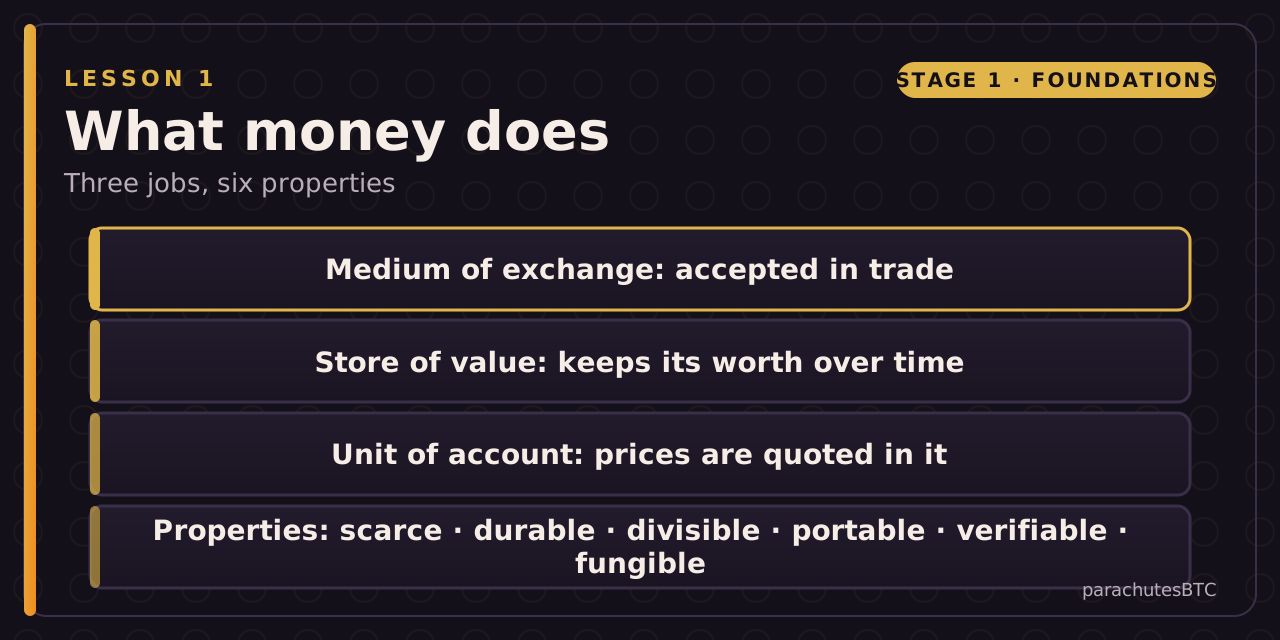
What money does
Money does three jobs and is good at them when it is scarce, durable, divisible, portable, verifiable and fungible.
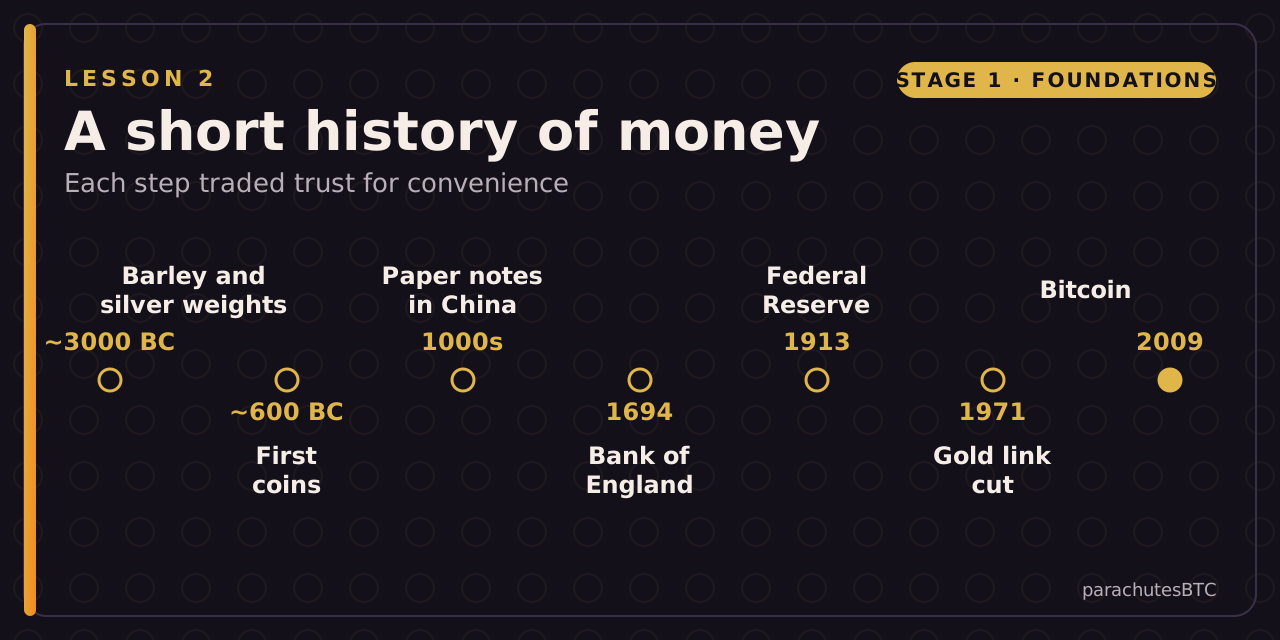
A short history of money
Money emerged from trade, not decree. Metal won for centuries; paper and bank money added convenience and a new issuer to trust.
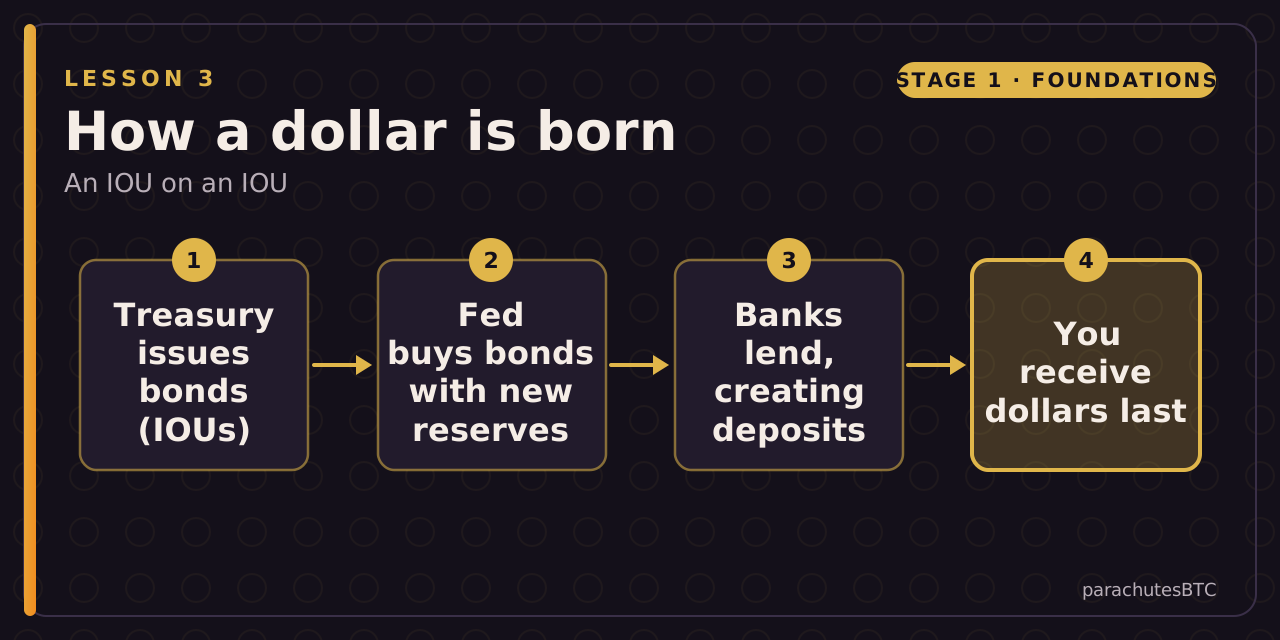
Fiat and central banks
Fiat money is backed by law, not by an asset. Central banks and commercial banks create it, and its supply has no ceiling.
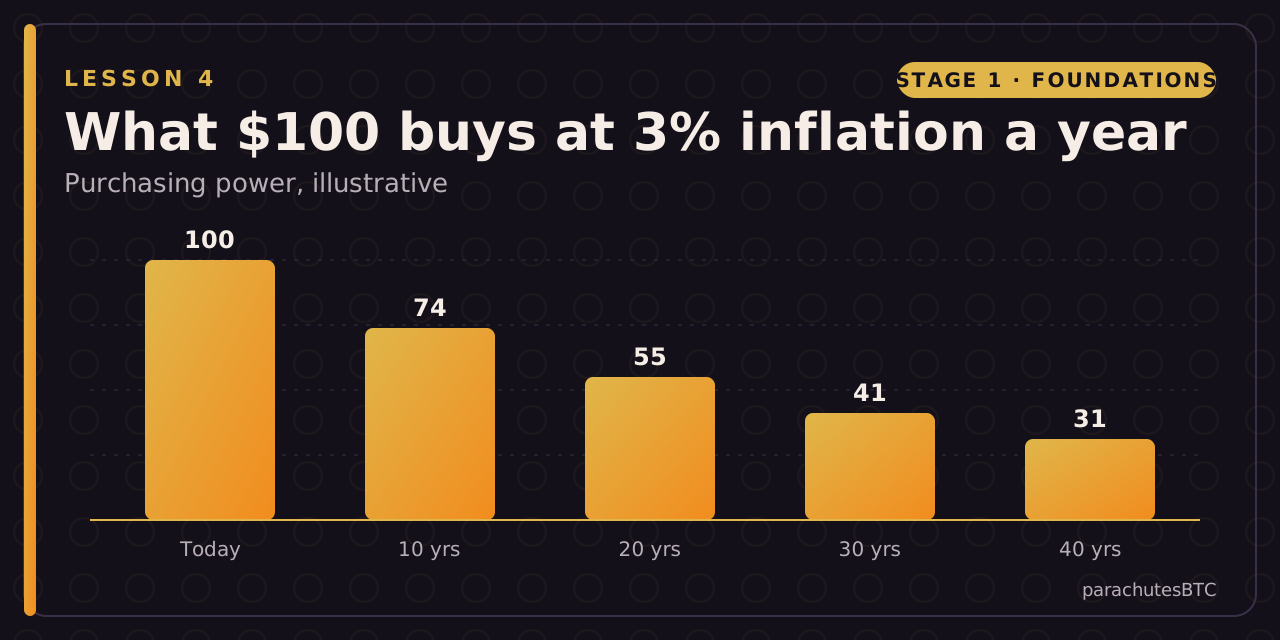
Inflation, explained
Inflation is money losing purchasing power. Even the official target compounds into most of your savings over a working life.
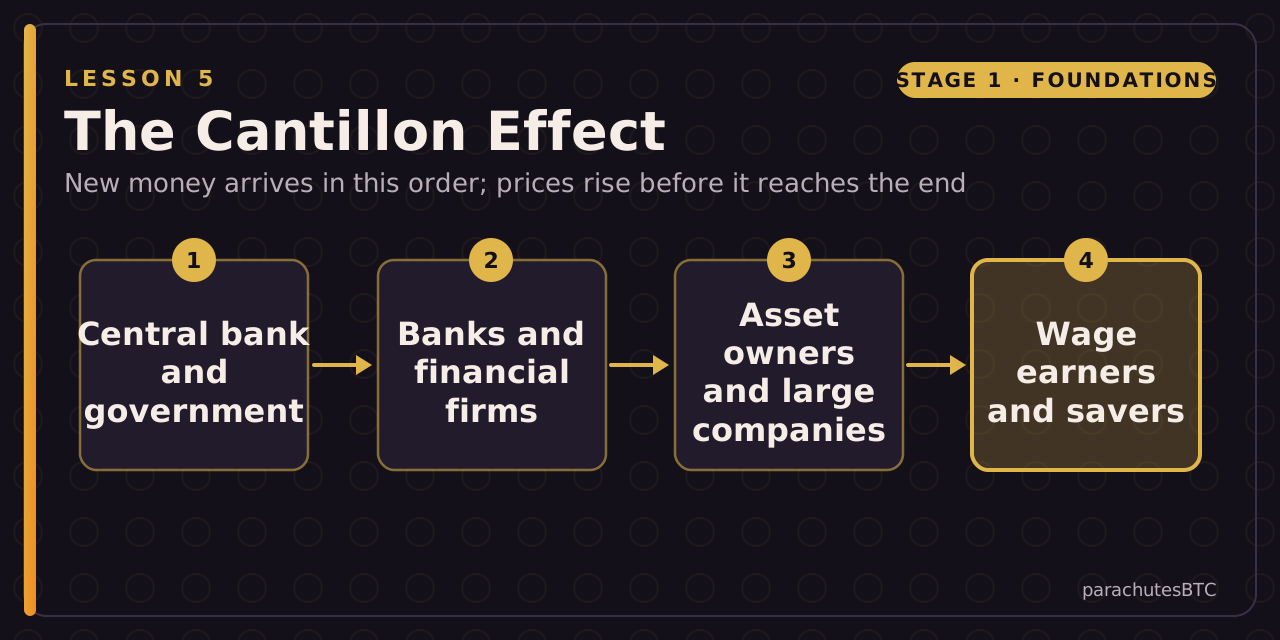
The Cantillon Effect
New money reaches some people first. They spend it at old prices; everyone downstream pays new prices. That is why money printing widens inequality.
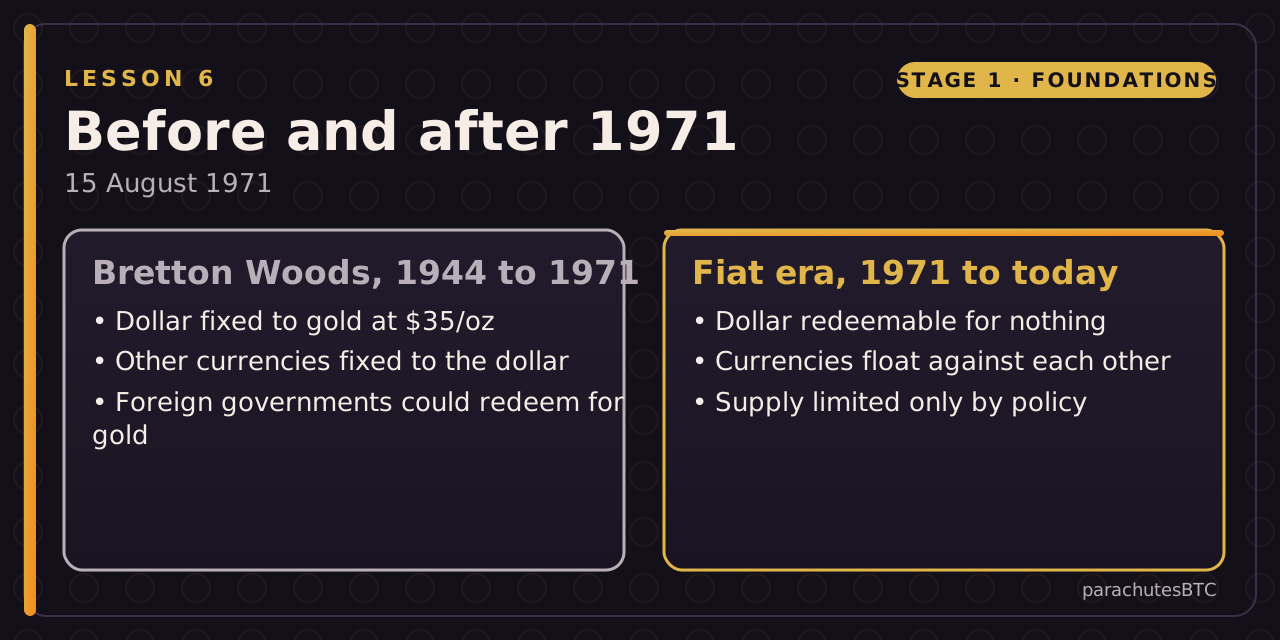
What happened in 1971
On 15 August 1971 the US ended the dollar's convertibility to gold. Since then every major currency floats, backed by nothing but policy.
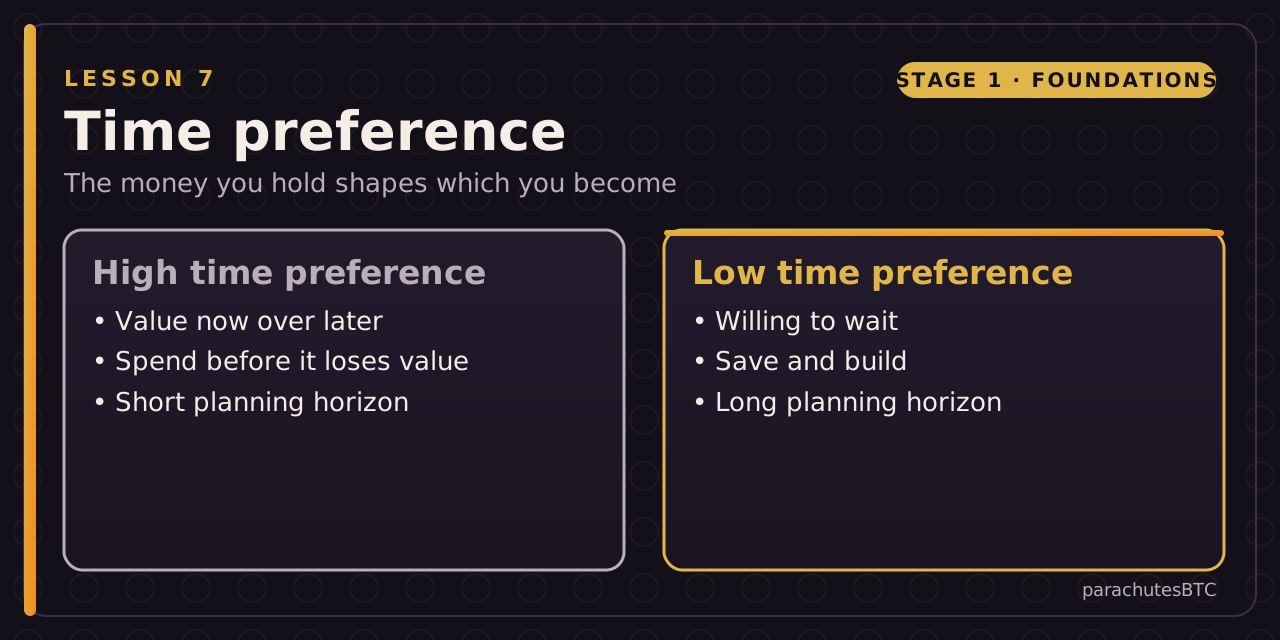
Time preference
Time preference is how much you value the present over the future. Money that leaks pushes people to spend; money that holds lets them plan.
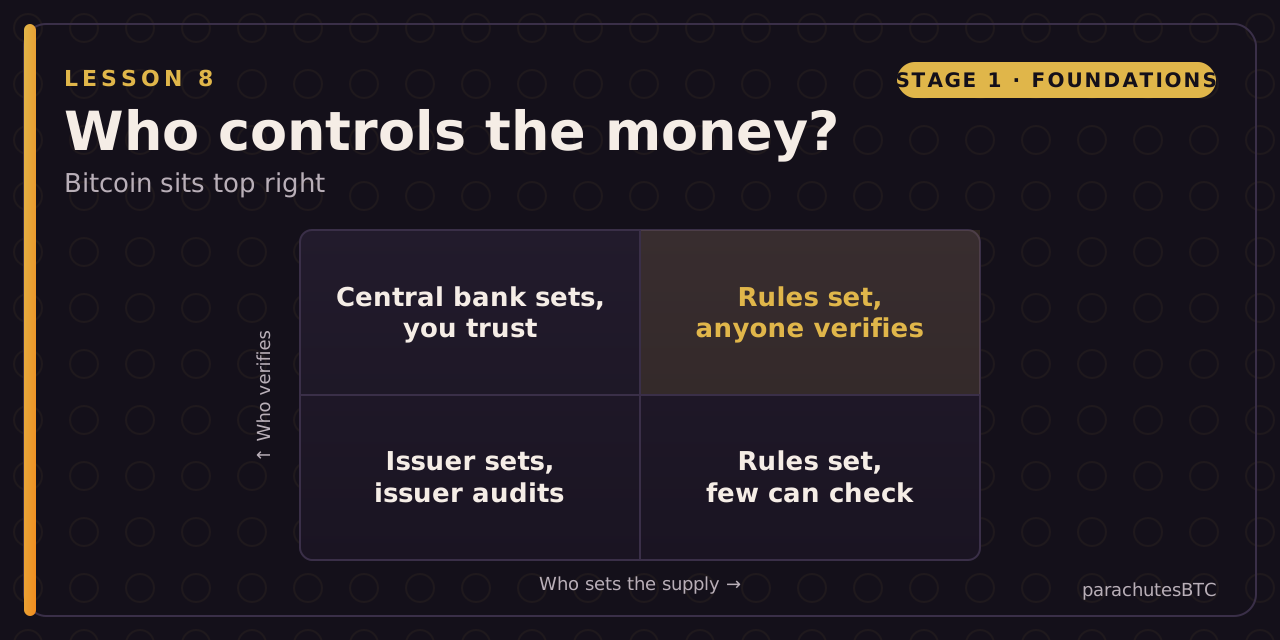
Separating money and state
Hayek argued good money needs to be taken out of the hands of government by a route they cannot stop. That is the idea Bitcoin tests.
STAGE 2 · UNDERSTAND BITCOINBitcoin in 21 minutes
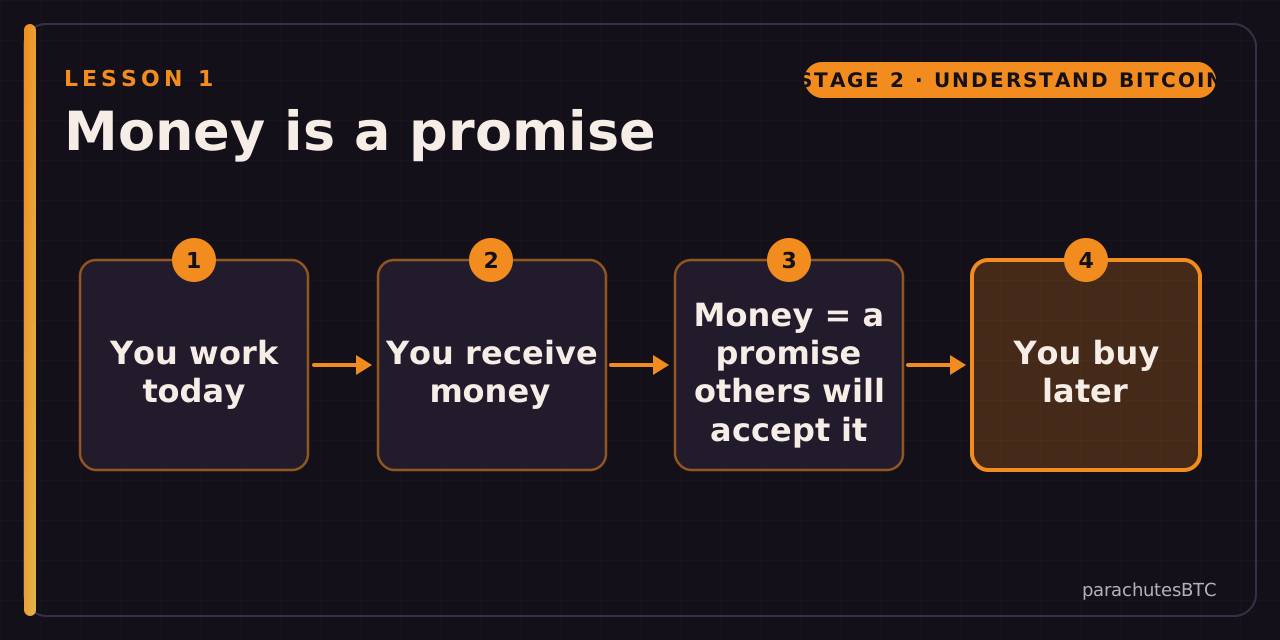
Money is a promise
Money works because people agree it will be accepted later. That shared trust is the whole trick.
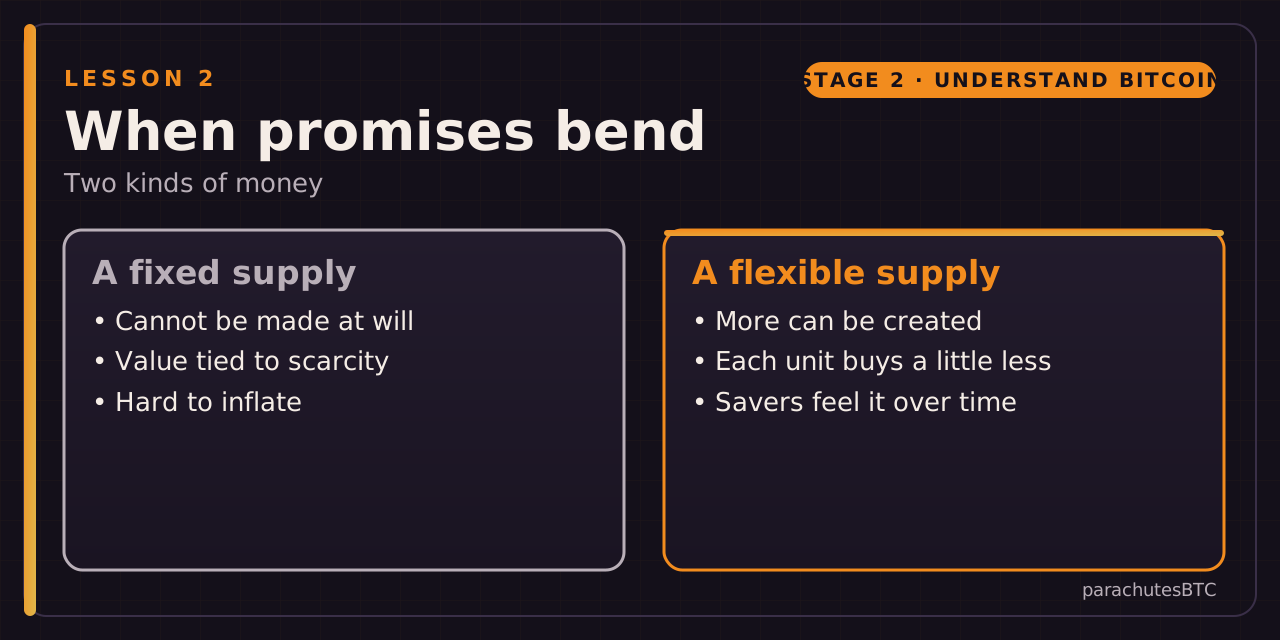
When promises bend
When more money can be created, each unit tends to buy a little less. This is what people mean by inflation.
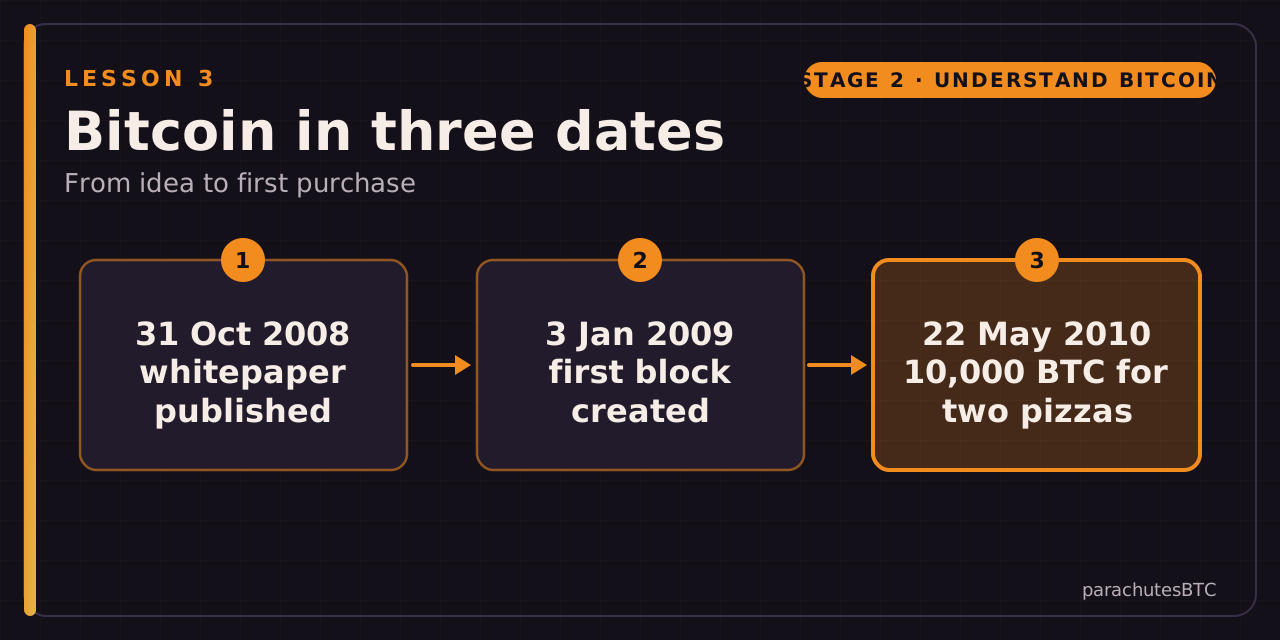
Enter Bitcoin
Bitcoin is a digital money with a fixed supply that no company or government runs. It started with a nine-page paper.
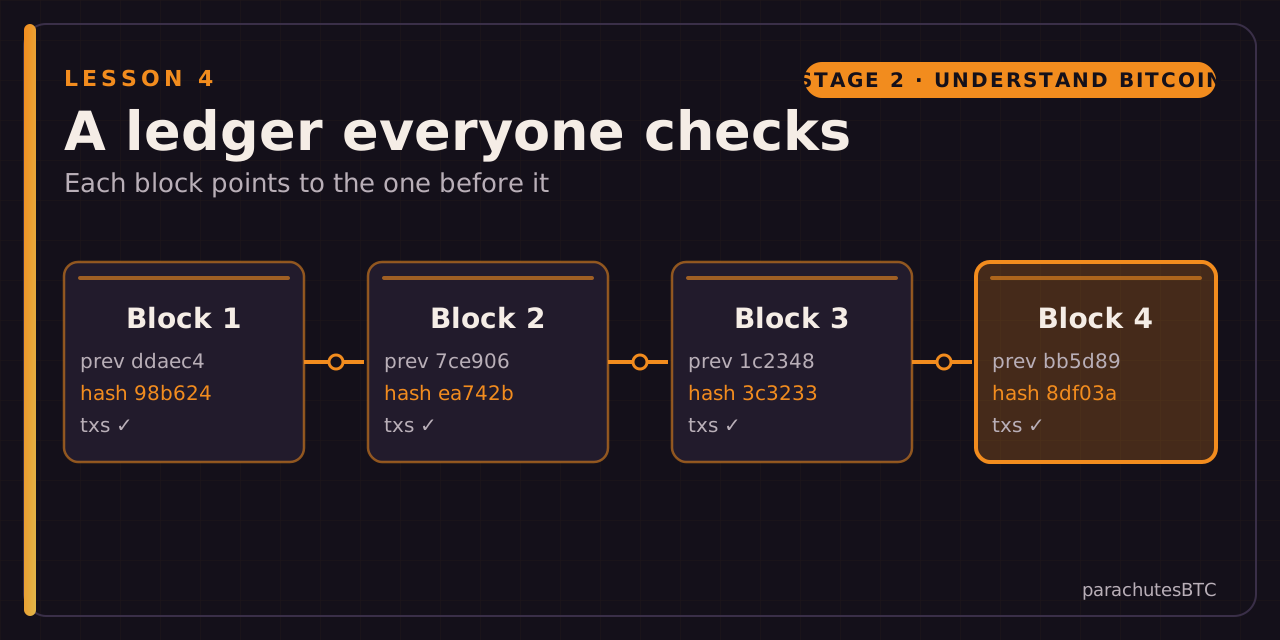
A ledger everyone checks
Transactions are grouped into blocks and linked in a chain. Miners add blocks by doing real work, and nodes check every rule.
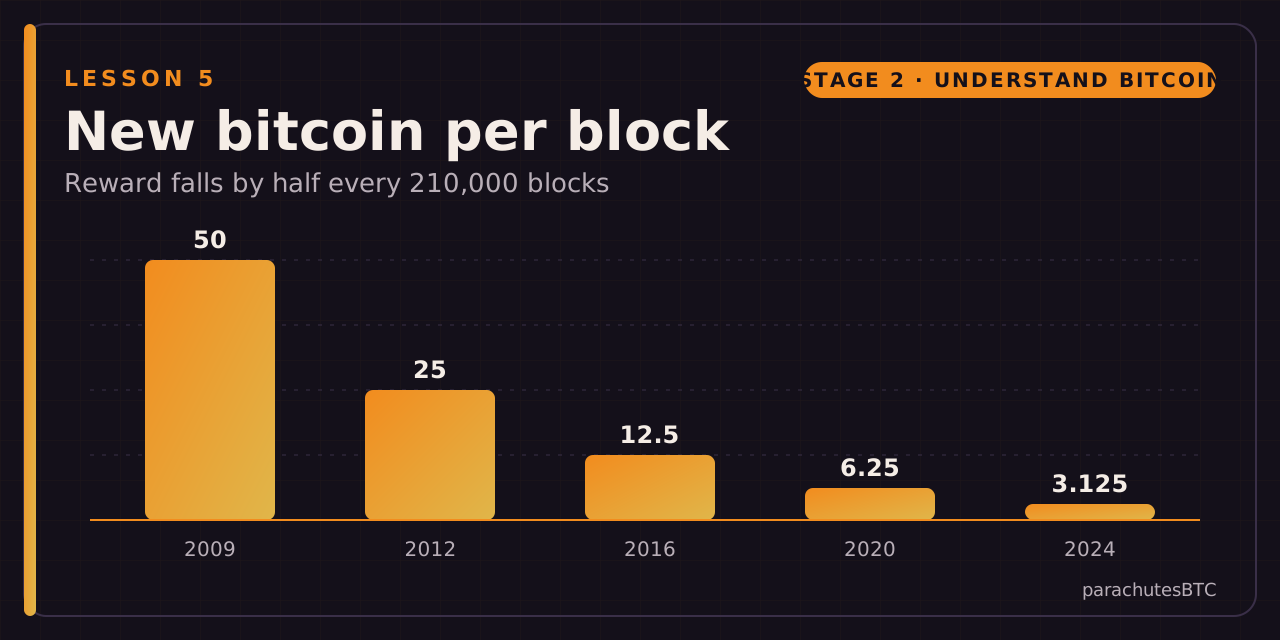
21 million and no more
New bitcoin is issued on a schedule that halves about every four years, and stops near 21 million.
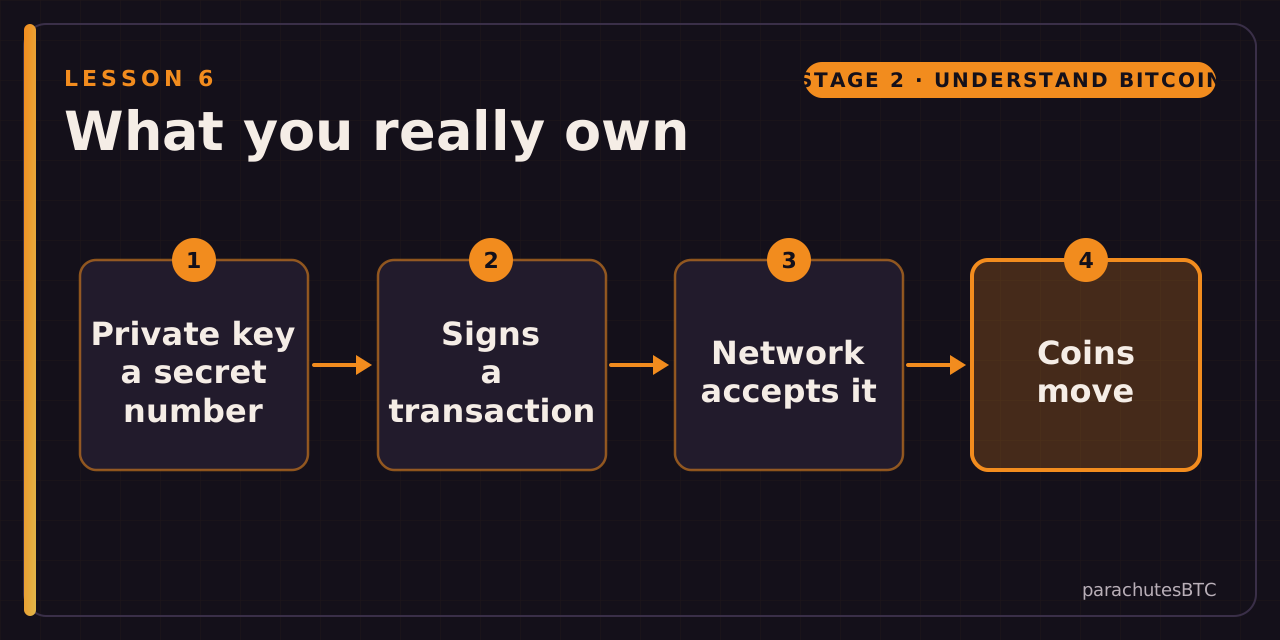
Owning it
You control bitcoin with a private key. Whoever holds the key controls the coins, which is powerful and unforgiving.
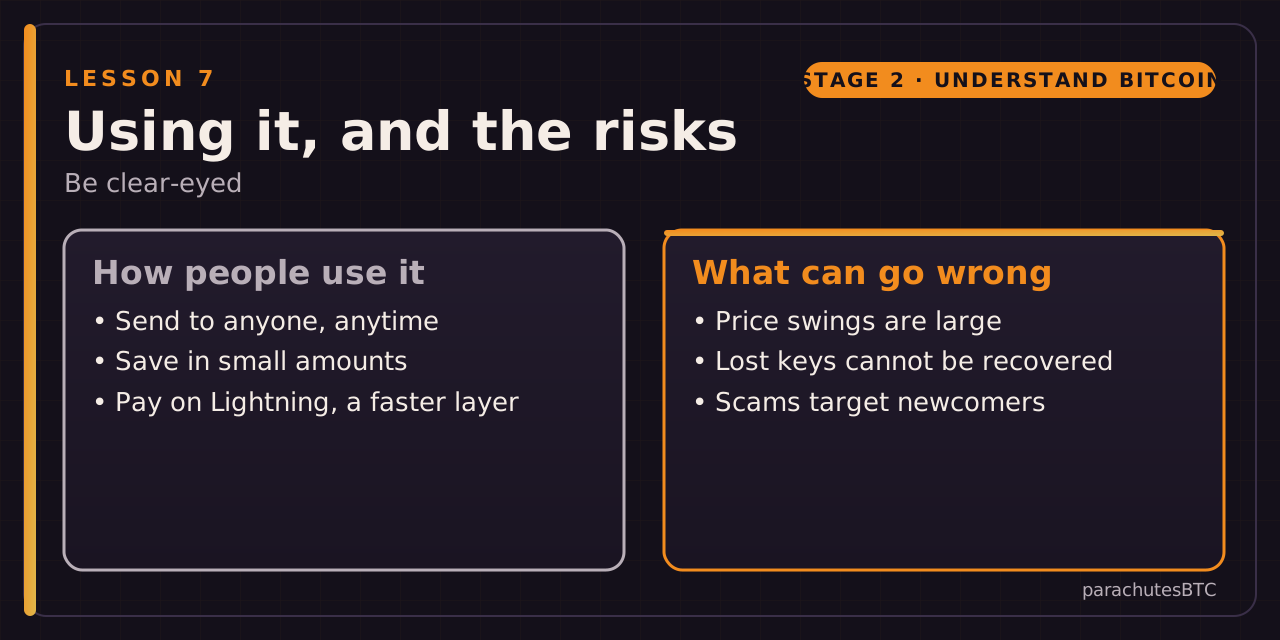
Using it, and the risks
Bitcoin can be sent to anyone and saved in small pieces, but the price is volatile and mistakes are usually permanent.
STAGE 2 · UNDERSTAND BITCOINBitcoin explained: what it is and why it matters
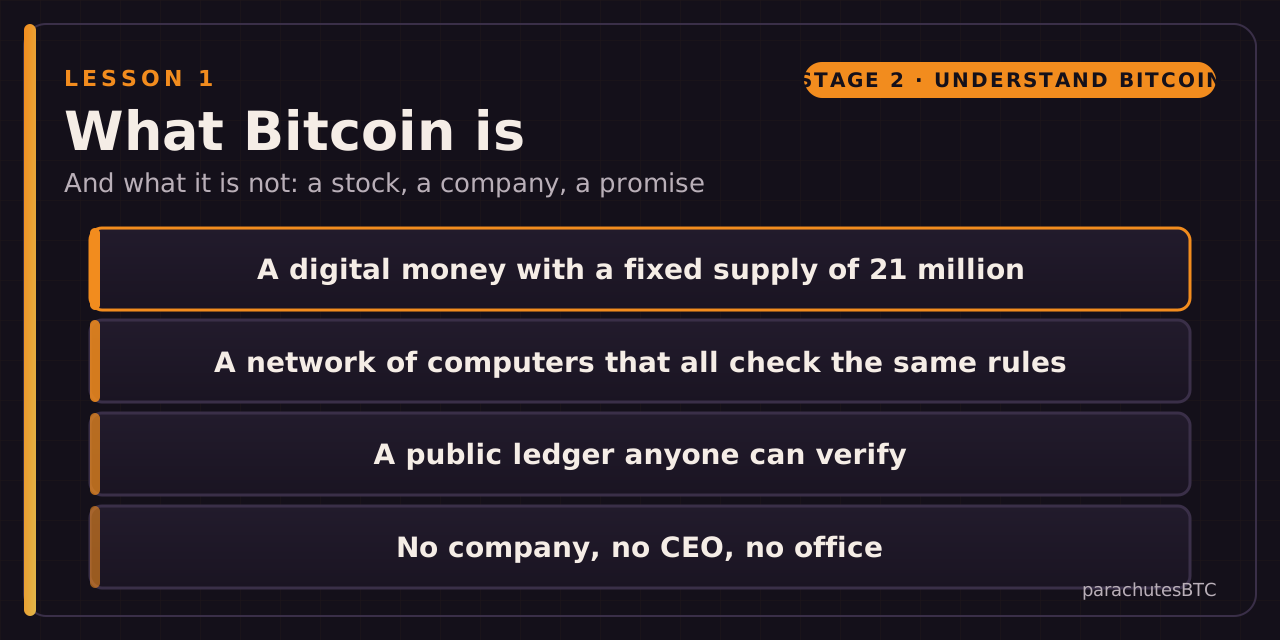
What is Bitcoin?
Bitcoin is digital money with a fixed supply, run by a network that anyone can join and verify. There is no company behind it.
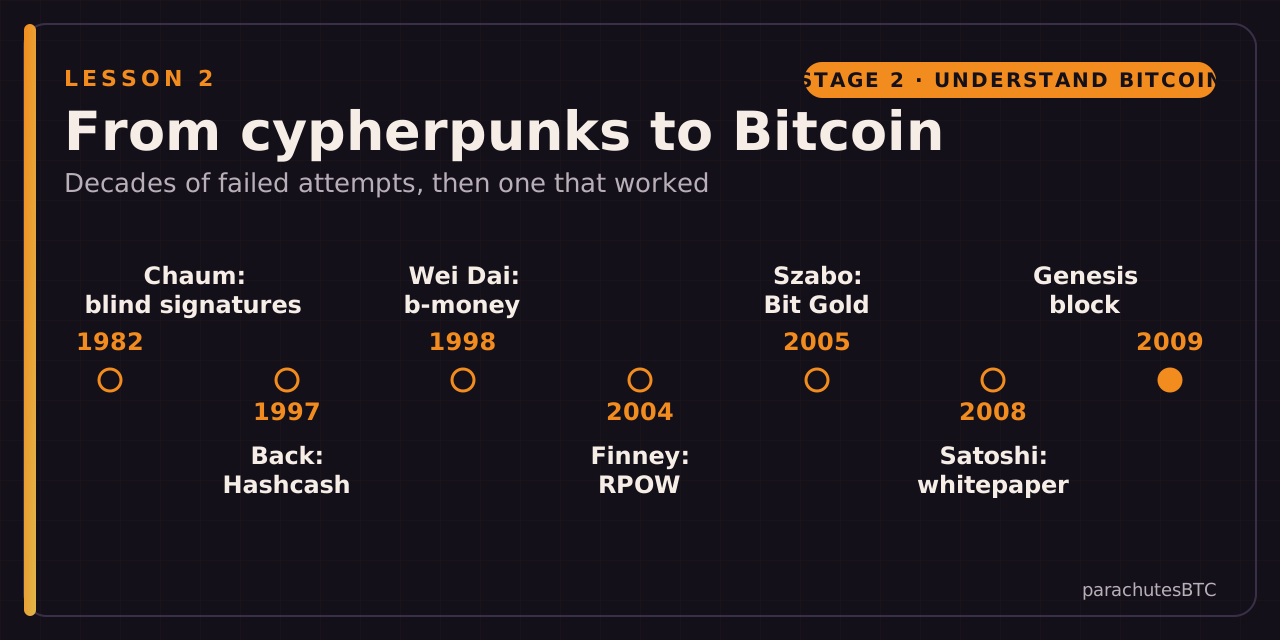
Satoshi and the origin story
Bitcoin came out of the cypherpunk movement after decades of attempts at digital cash. Its creator published it, ran it for two years and left.
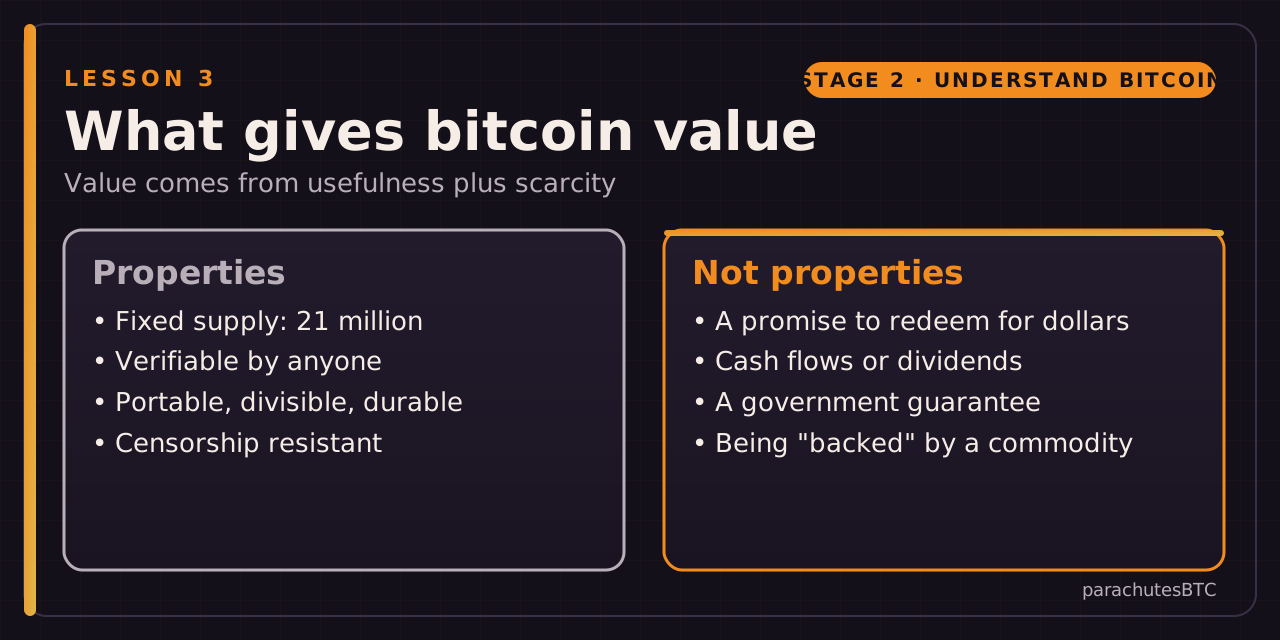
Why does bitcoin have value?
Bitcoin has value for the same reason gold does: it is useful as money and it is scarce. Nothing "backs" it, and nothing backs the dollar either.
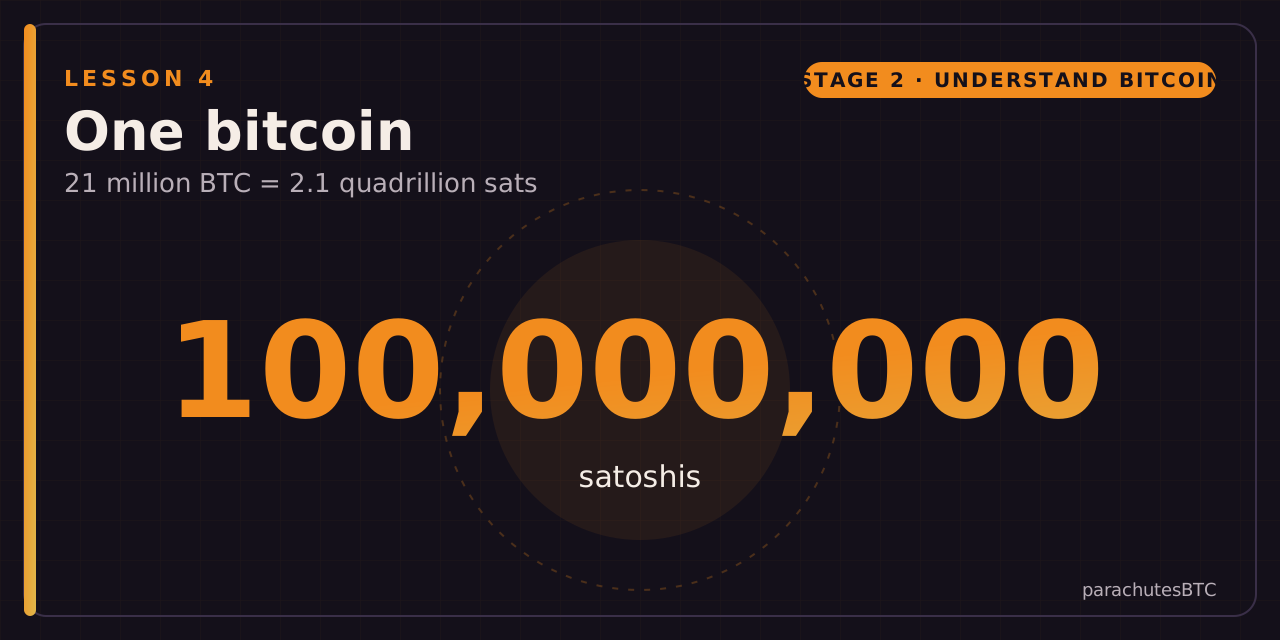
Sats, units and the price
A bitcoin divides into 100 million satoshis. You never need a whole coin, and thinking in sats makes the price easier to read.
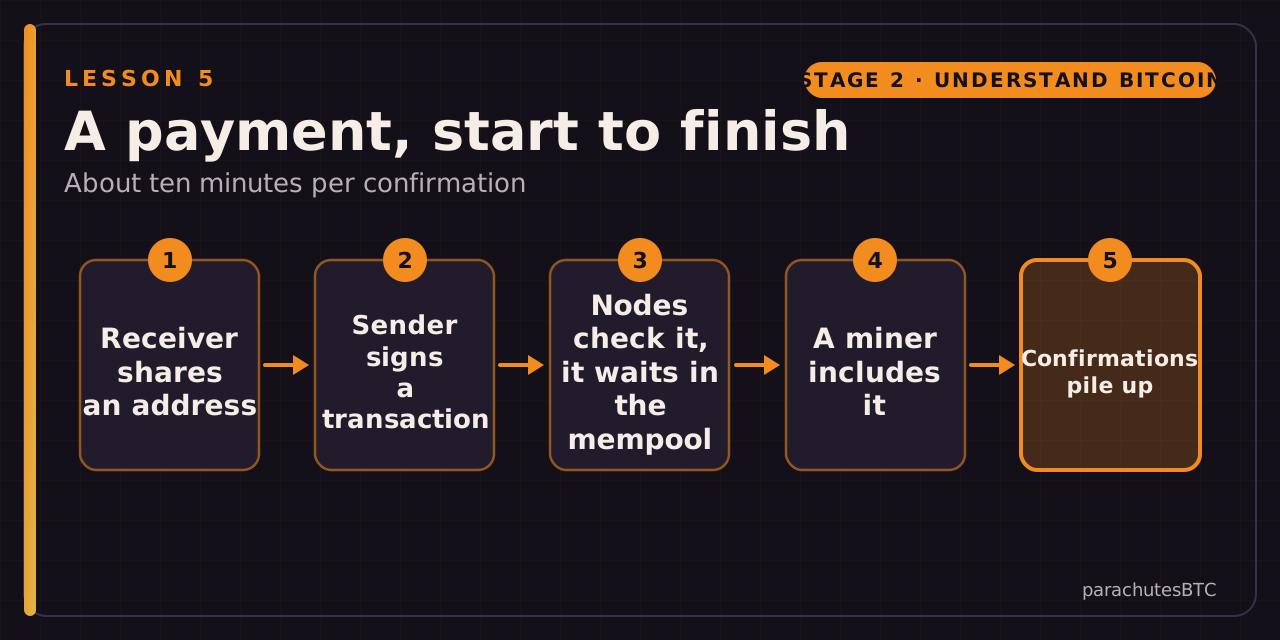
Transactions, addresses and confirmations
To get paid you share an address; to pay you sign a transaction. It waits in the mempool, a miner includes it, and each block after that is a confirmation.
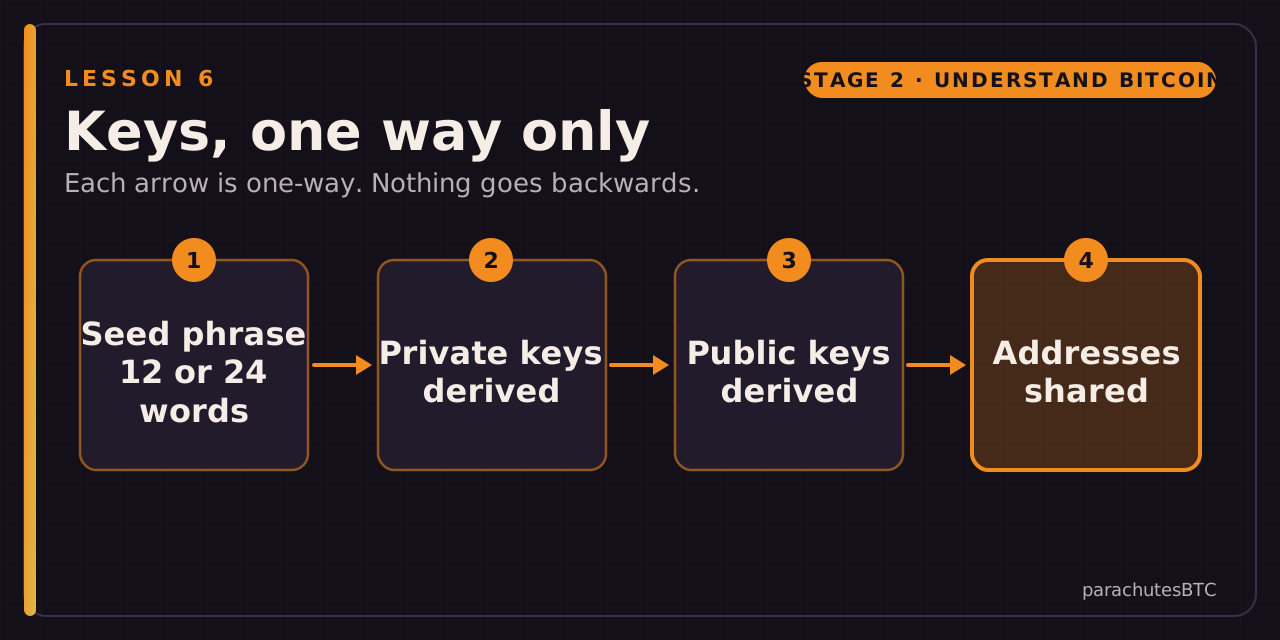
Keys: what you actually own
You do not store bitcoin; you store the keys that control it. A seed phrase recreates every key. Whoever has it has the coins.
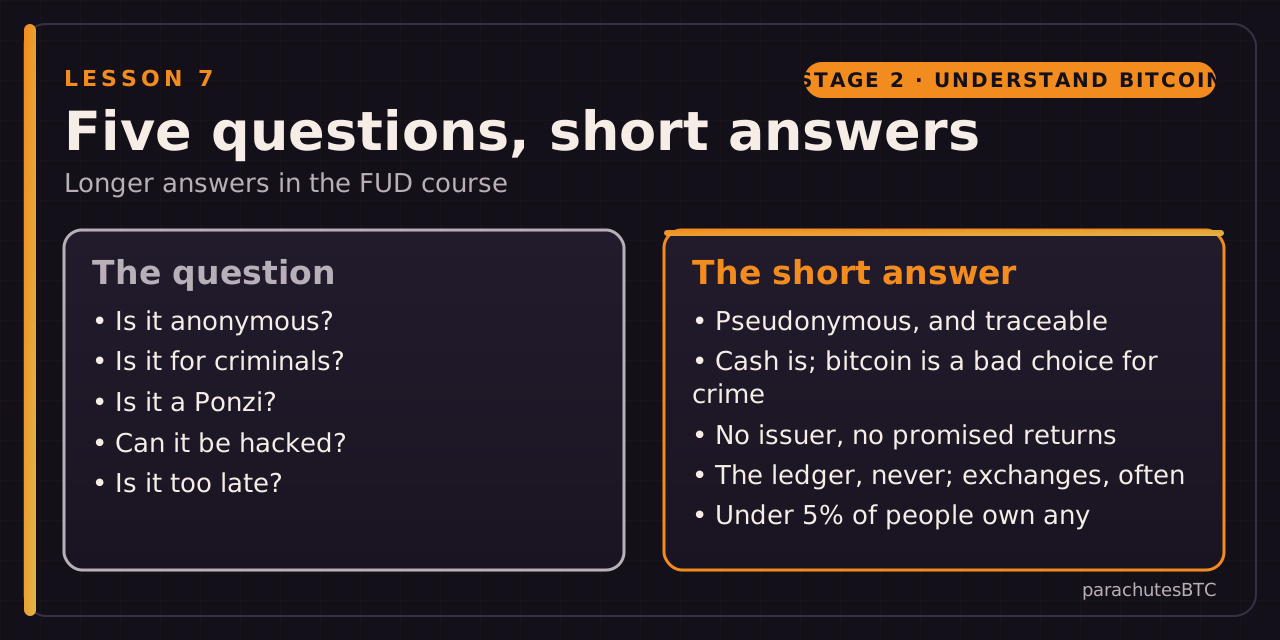
The first five questions
Anonymous? Criminal? Ponzi? Hackable? Too late? Short, honest answers to the questions every newcomer gets asked.
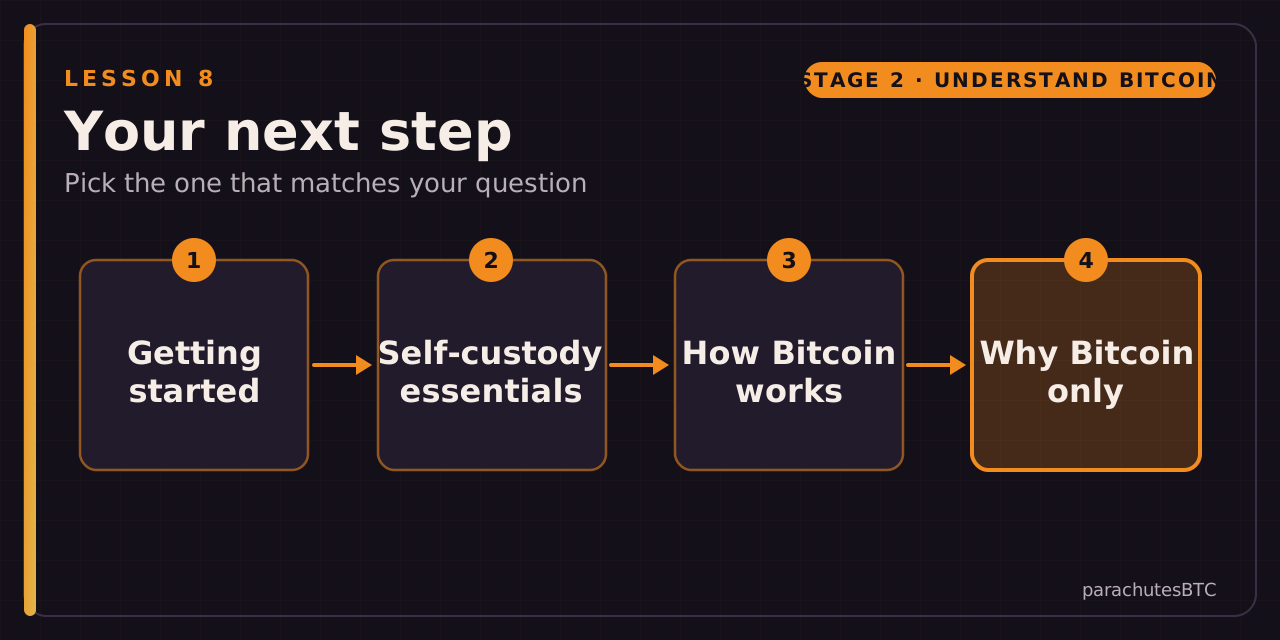
Where to go next
You know what Bitcoin is. Here is how to choose the next course based on what you want to do.
STAGE 2 · UNDERSTAND BITCOINBitcoin FUD, answered
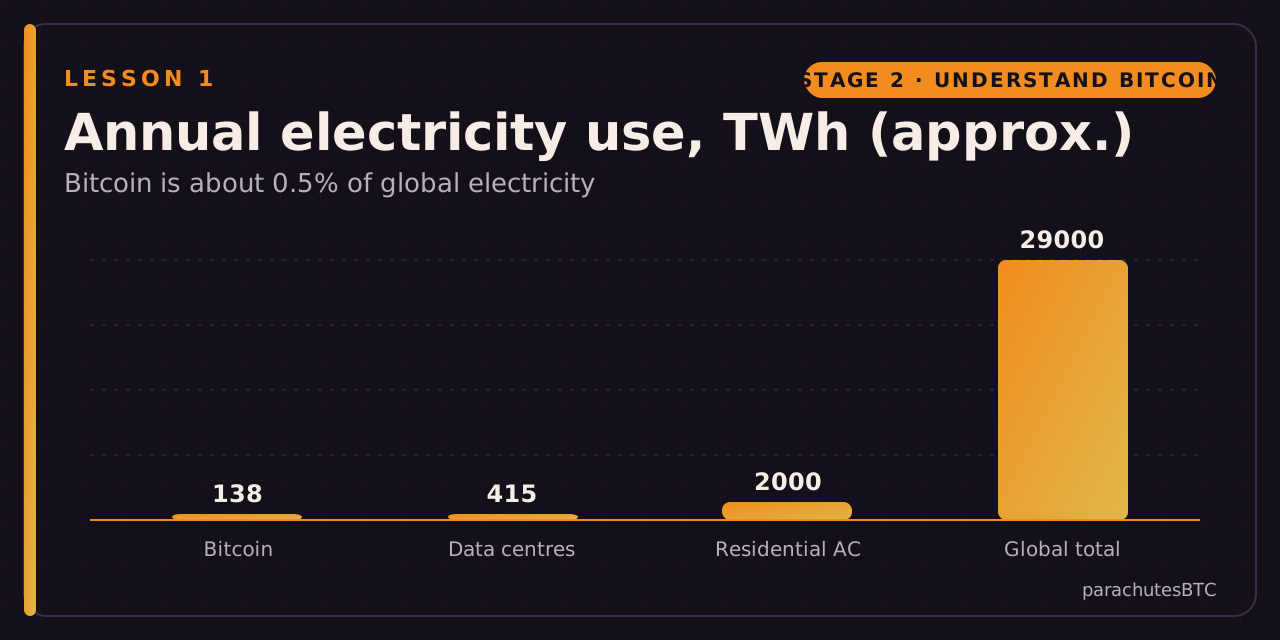
"Bitcoin wastes energy"
Bitcoin uses about half a percent of global electricity, much of it stranded or renewable. The energy is what makes the ledger expensive to rewrite.
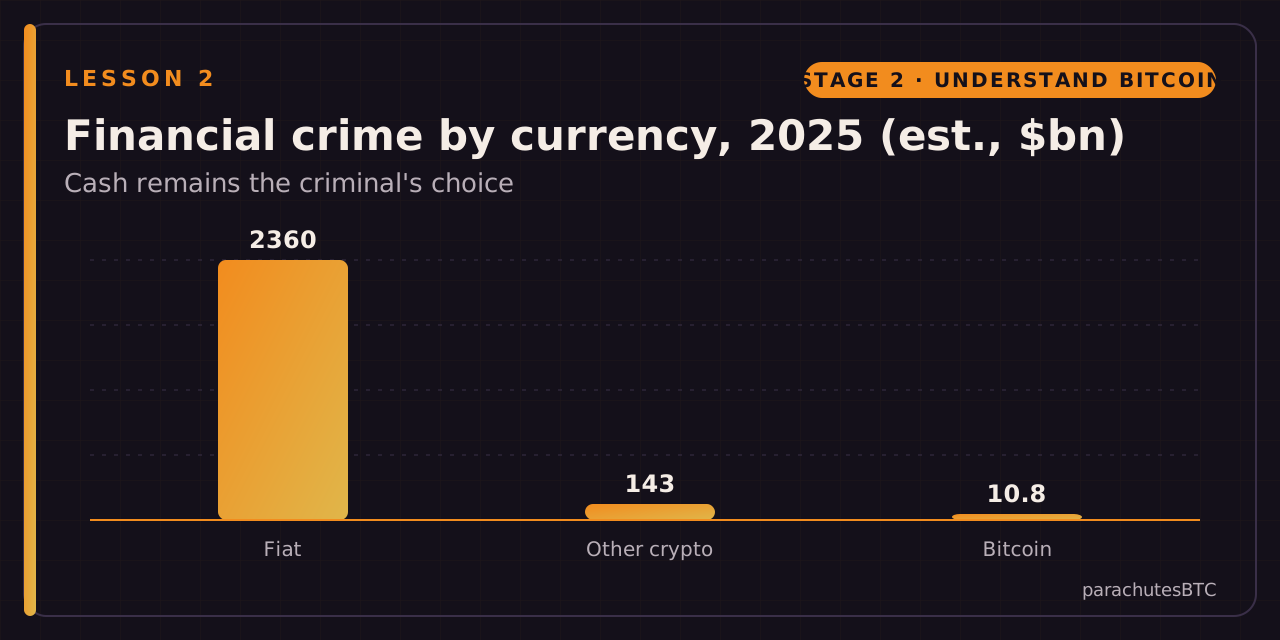
"Bitcoin is for criminals"
Illicit use is a tiny fraction of bitcoin activity, and the public ledger makes it a poor tool for crime. Cash dominates.
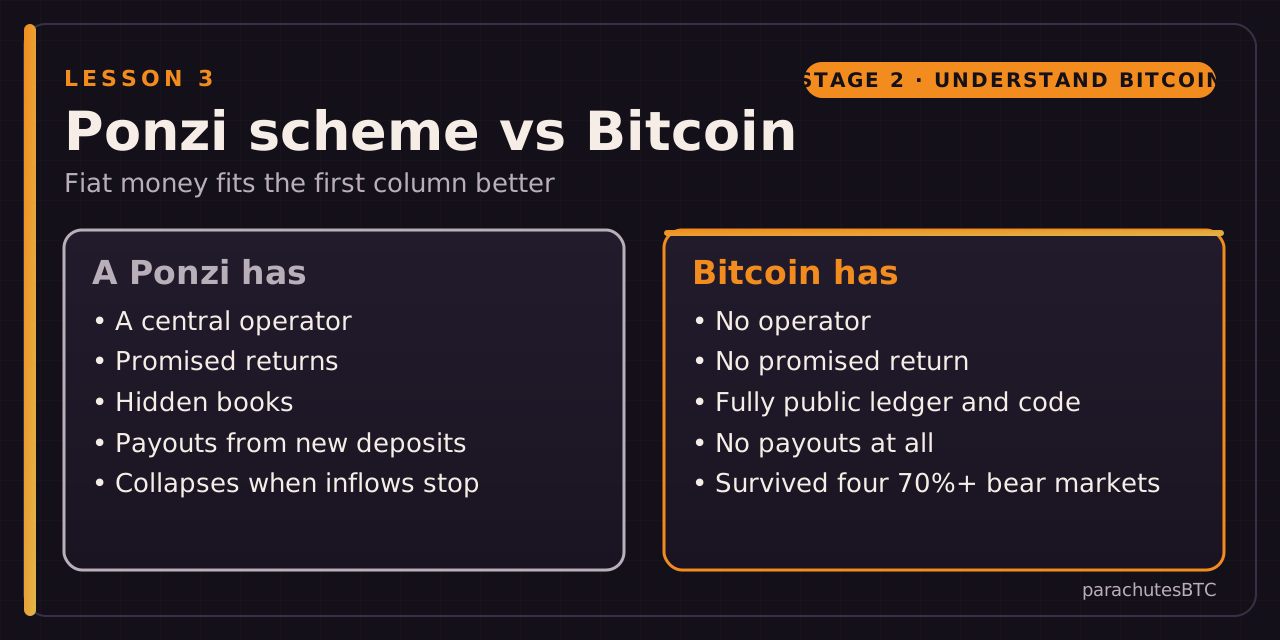
"It's a Ponzi scheme / greater fool"
A Ponzi needs an operator, promised returns and hidden books. Bitcoin has none, pays no one, and has survived every collapse in inflows.
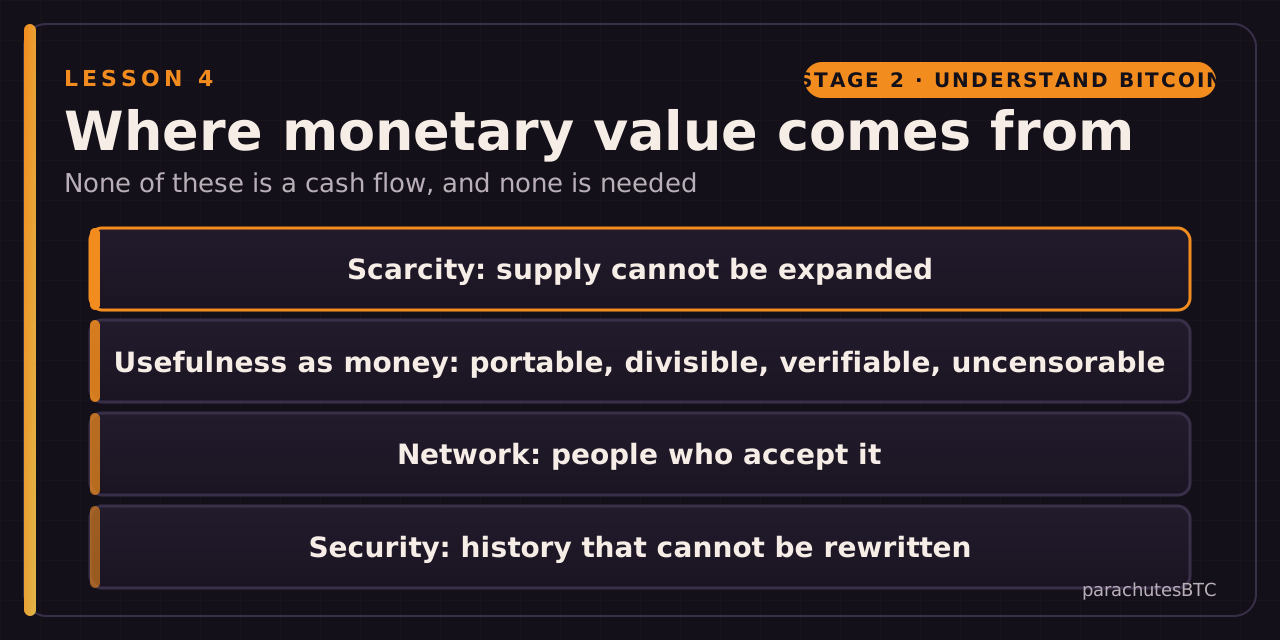
"It has no intrinsic value"
Nothing has intrinsic value; value is what people assign. Bitcoin's value rests on scarcity, usefulness as money and security, like gold's but more so.
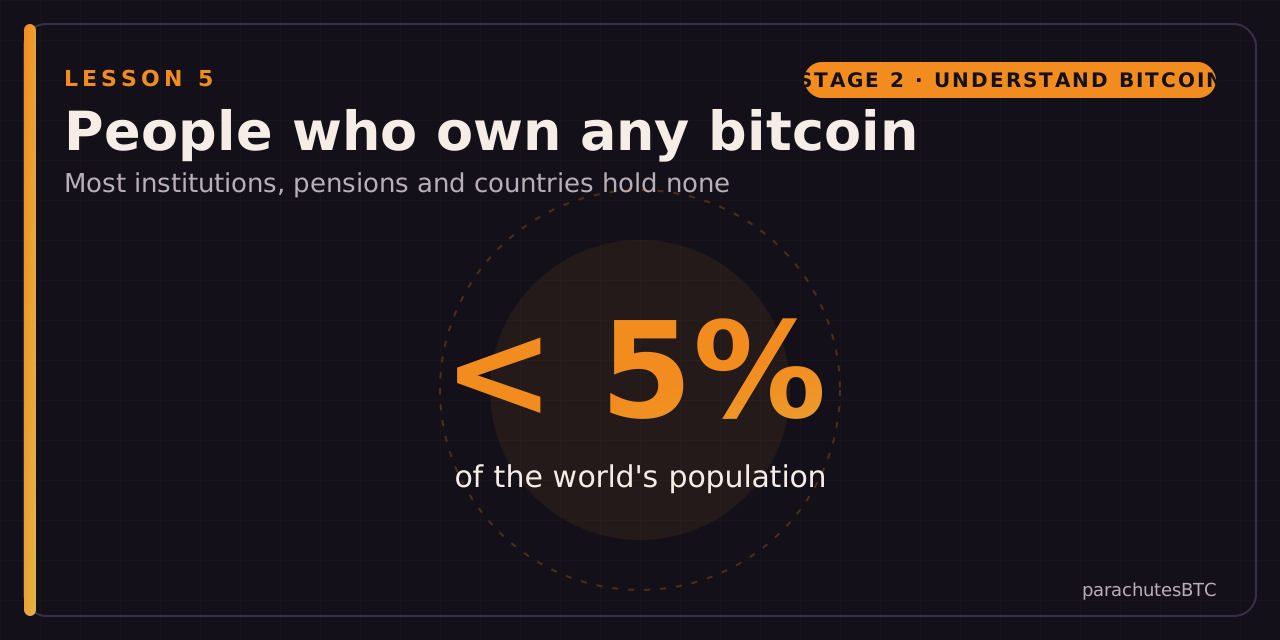
"It's too expensive / I'm too late"
Under 5% of people own bitcoin, and it is divisible into sats. "Too late" has been said at every price so far.
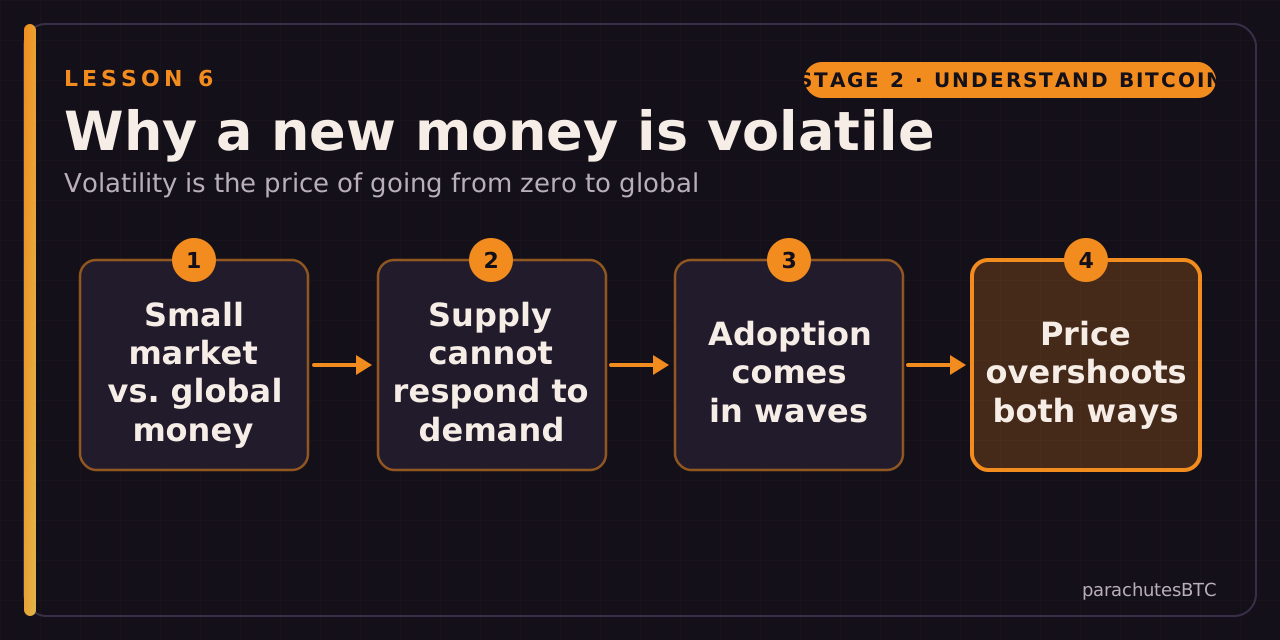
"It's too volatile to be money"
Volatility is what adoption from zero looks like when supply cannot respond. It has fallen over time, and it is a feature of the journey, not the destination.
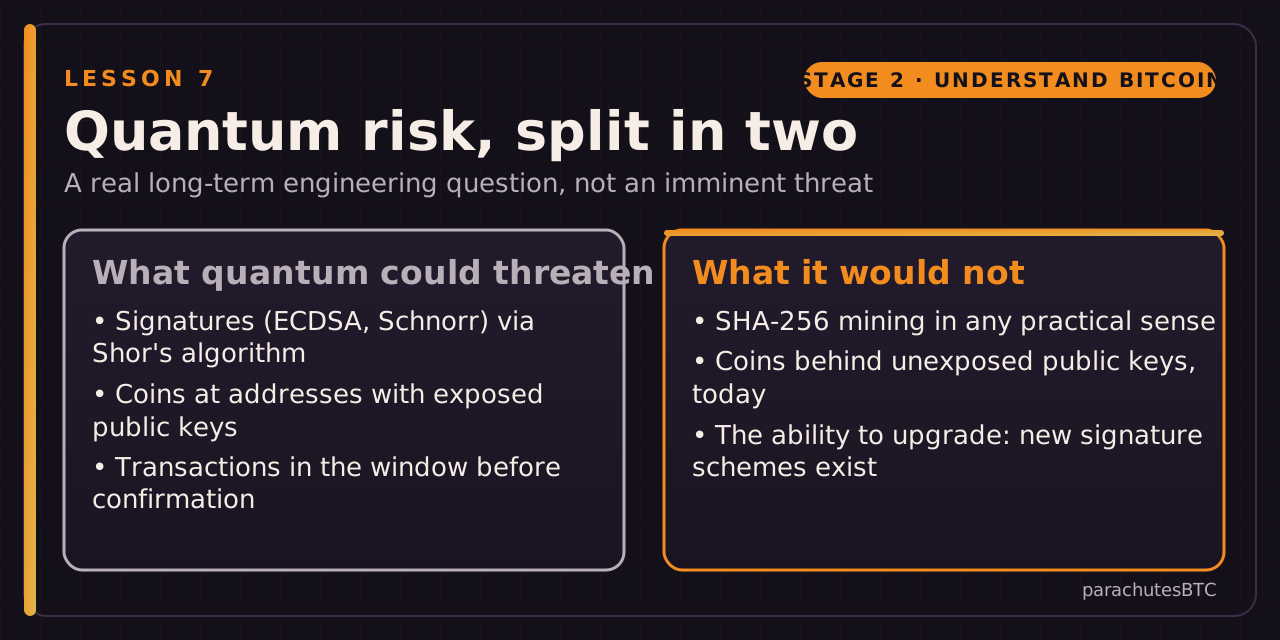
"Quantum computers will break it"
A large quantum computer could threaten signatures, not hashing. Upgrades exist, and the risk applies to all of modern cryptography, banks included.
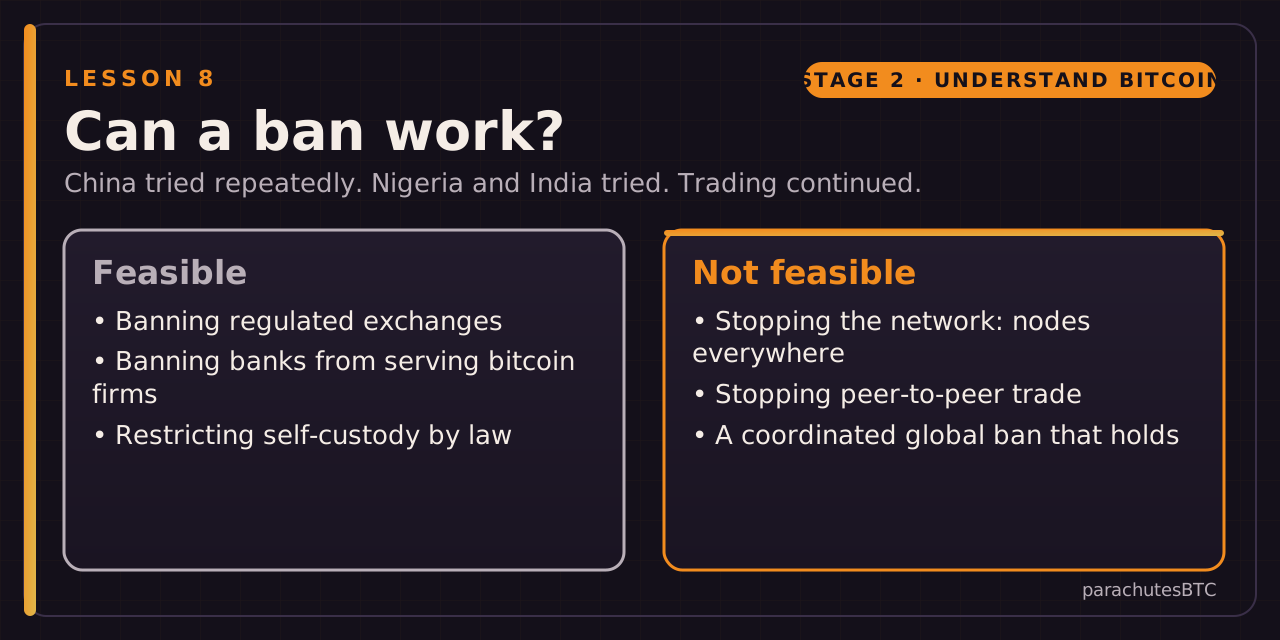
"Governments will ban it"
Governments can ban exchanges and banks, not the network. Every national ban so far has pushed activity peer-to-peer. The trend is toward regulation, reserves and ETFs.
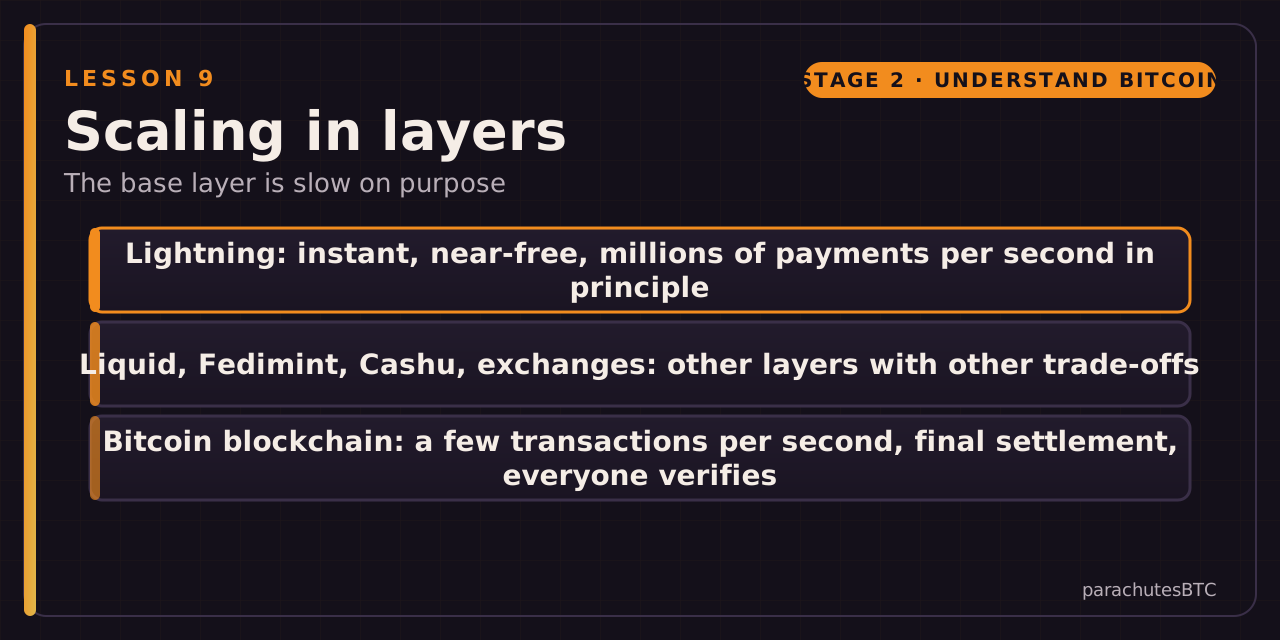
"It's too slow and can't scale"
The base layer is slow by design so anyone can verify it. Payments scale on layers above it, as every money system has.
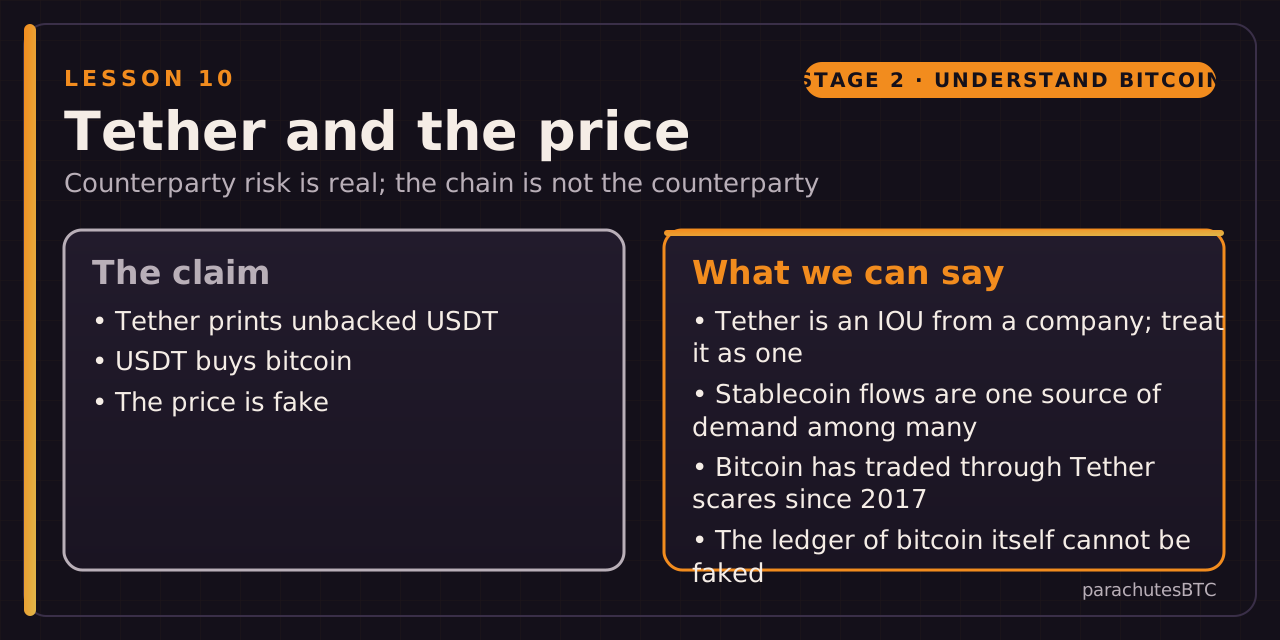
"It's propped up by Tether and whales"
Tether is a company IOU and a real counterparty risk. It is one source of demand among many, and bitcoin's own ledger cannot be printed.
STAGE 3 · OWN ITYour first bitcoin: buying, wallets, staying safe
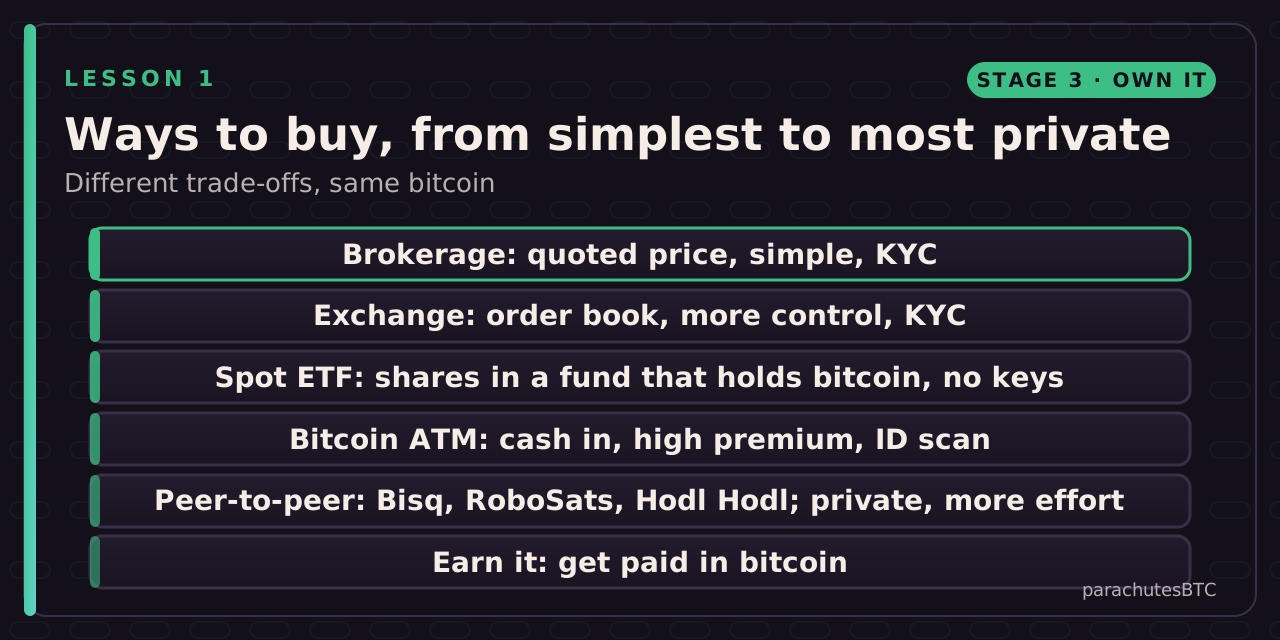
The ways people buy bitcoin
Brokerages, exchanges, ETFs, ATMs, peer-to-peer markets and earning. Each trades convenience, cost and privacy differently.

Brokerages versus exchanges
A brokerage sells to you at a quoted price; an exchange matches you with other traders. Both hold your coins until you withdraw.
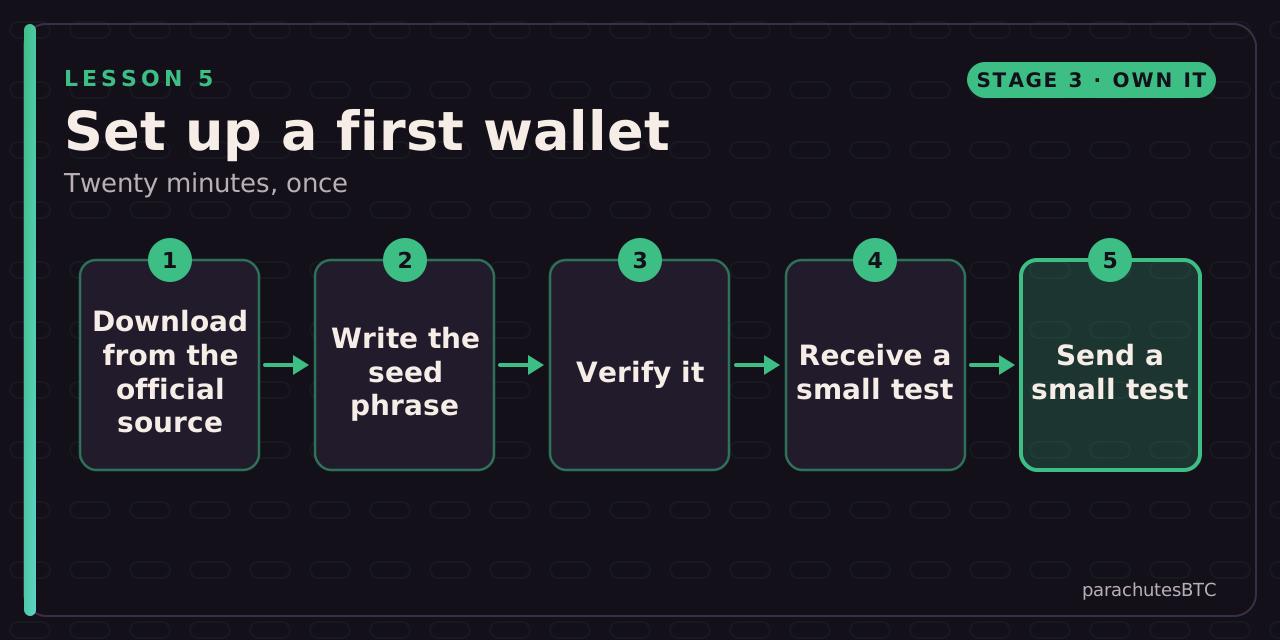
Your first wallet
Set up a self-custody mobile wallet, write and check the seed phrase, and make a small test in and out.
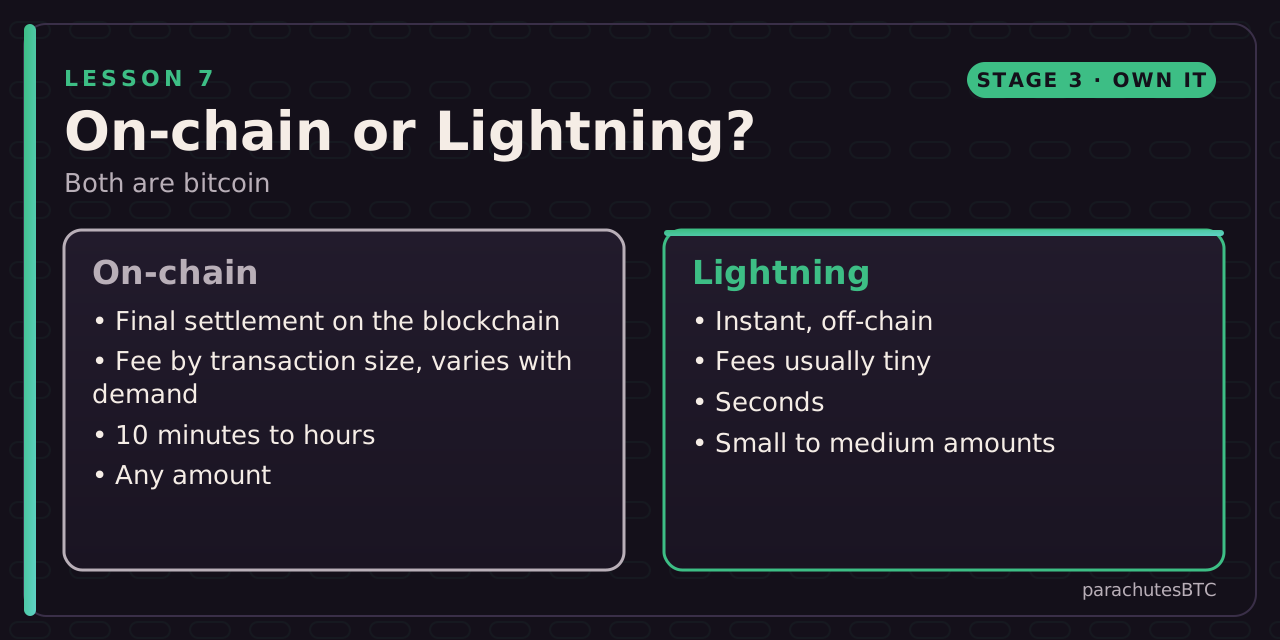
Sending and receiving, without mistakes
Check the address, pick a sensible fee, and know when to use Lightning instead of the chain.
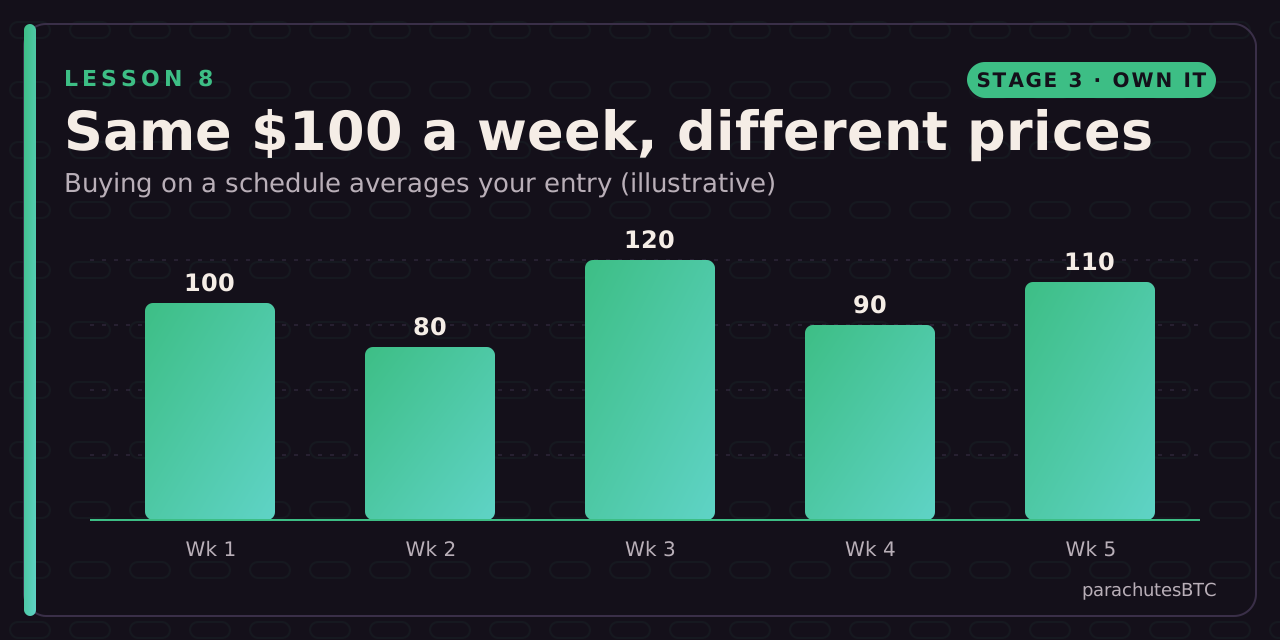
Dollar-cost averaging
Buying a fixed amount on a schedule removes timing decisions and emotion. It is a method, not a guarantee.
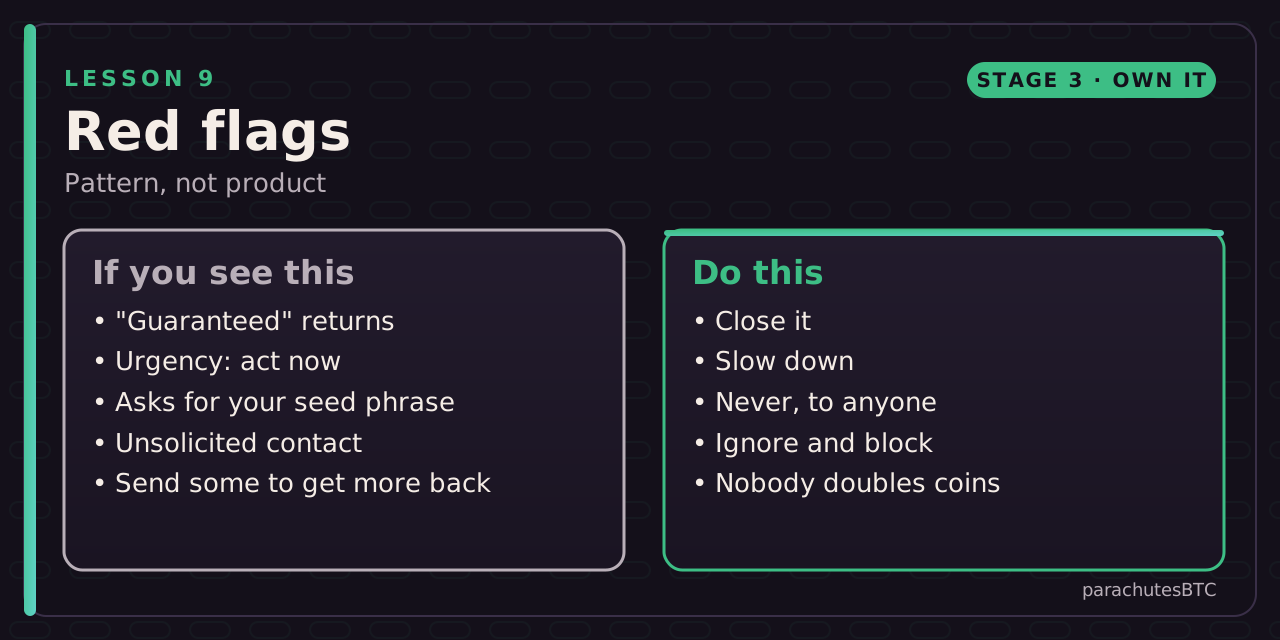
Scams, and how to see them coming
Most bitcoin losses are social, not technical. Learn the six patterns and the one rule that beats all of them.
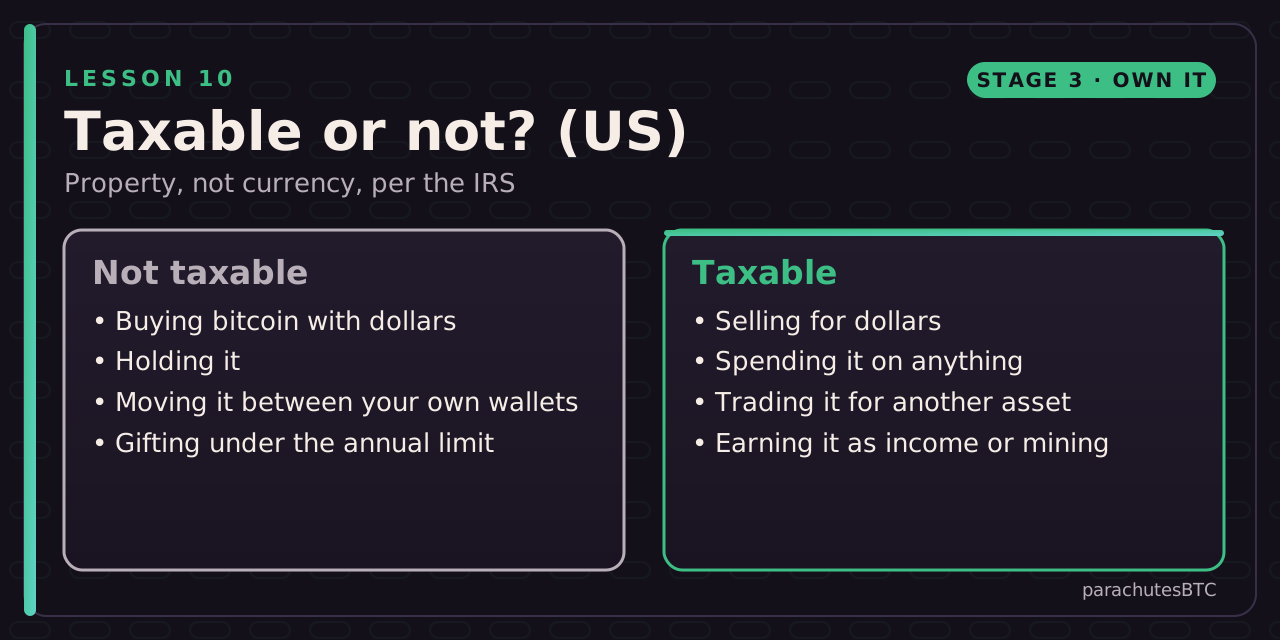
Tax basics (US)
In the US, bitcoin is property. Buying and holding is not taxed; selling, spending and earning are. Keep records from day one.
STAGE 3 · OWN ITSelf-custody essentials
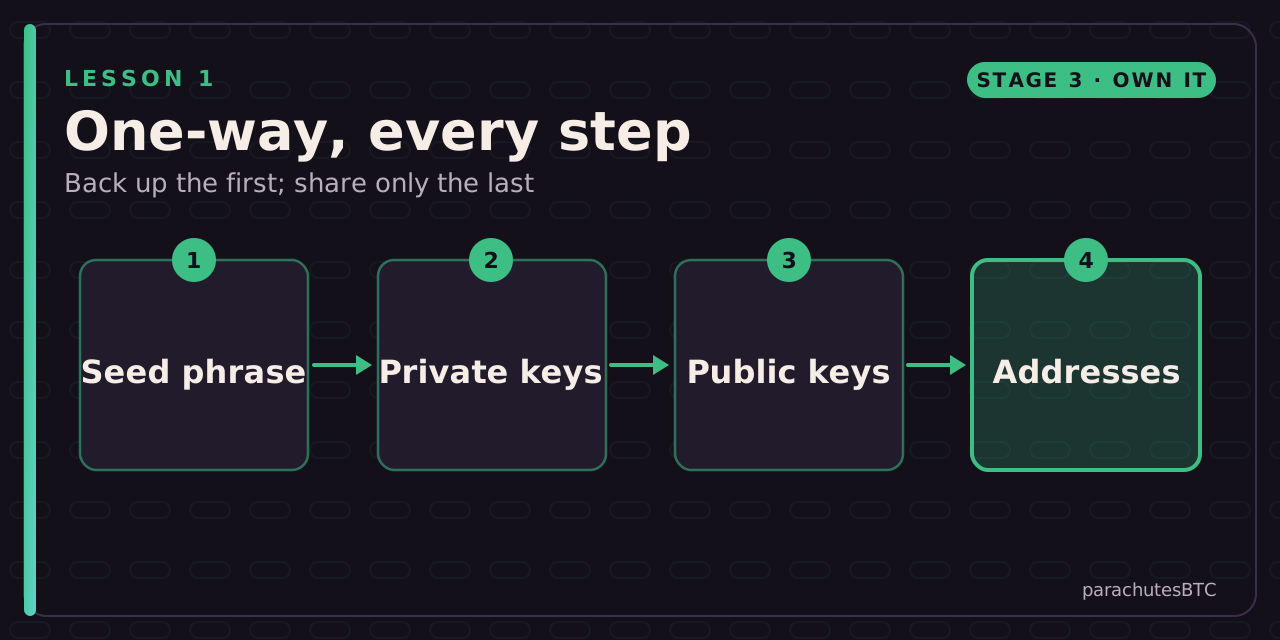
Keys and addresses
A seed derives private keys, which derive public keys and addresses. Only the seed needs backing up; only addresses should be shared.
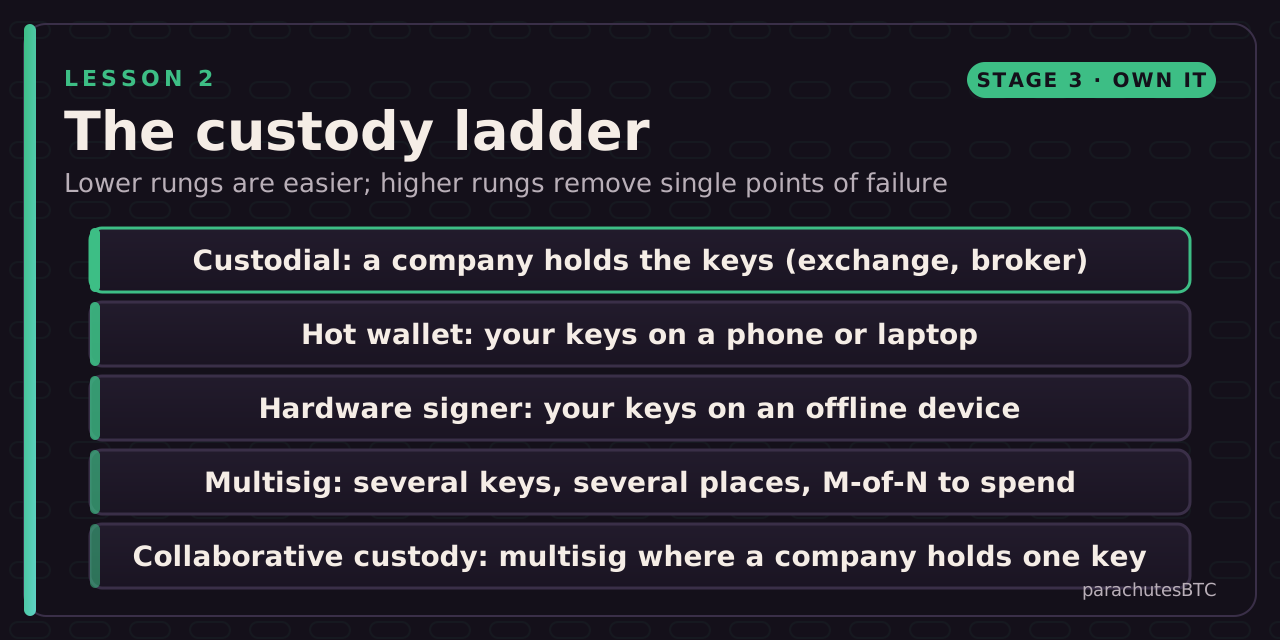
Custody options, from easy to sovereign
From custodial accounts to hot wallets, hardware wallets and multisig: what each protects against and what it costs you in effort.
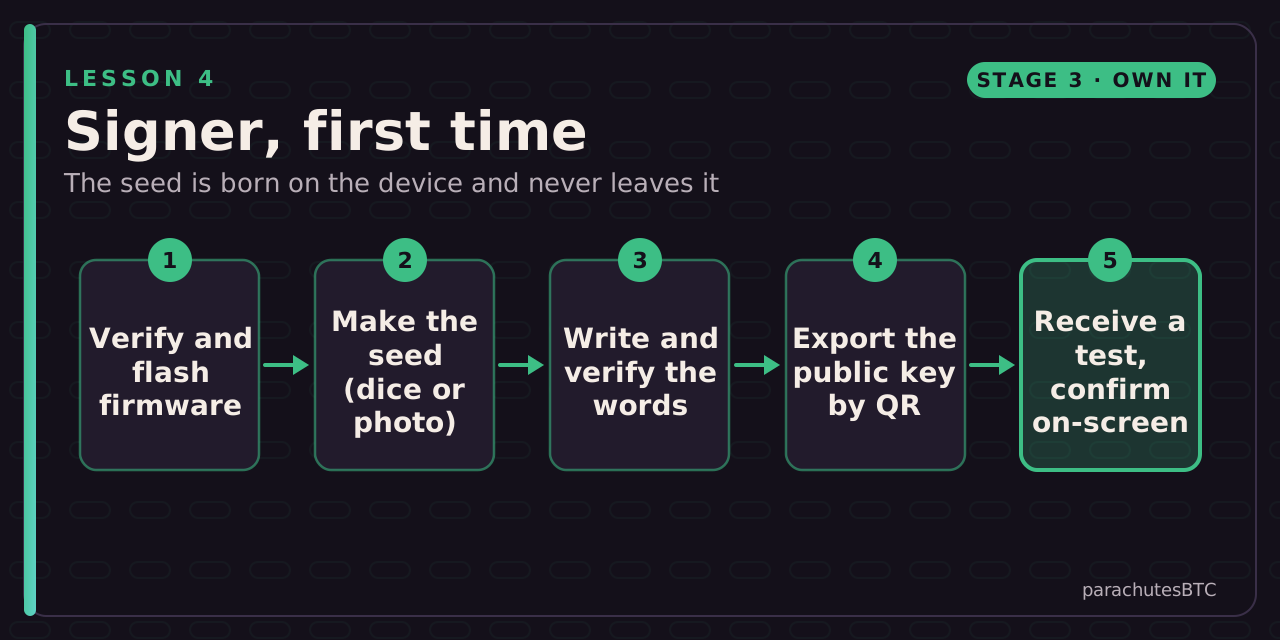
How to set up a hardware wallet
Verify the device, generate the seed on it, write and verify the words, set a PIN, then test a small amount in and out.

Backing up a seed phrase properly
Write the words, verify by restoring, move to metal for durability, keep two copies in two places, and never store them digitally.
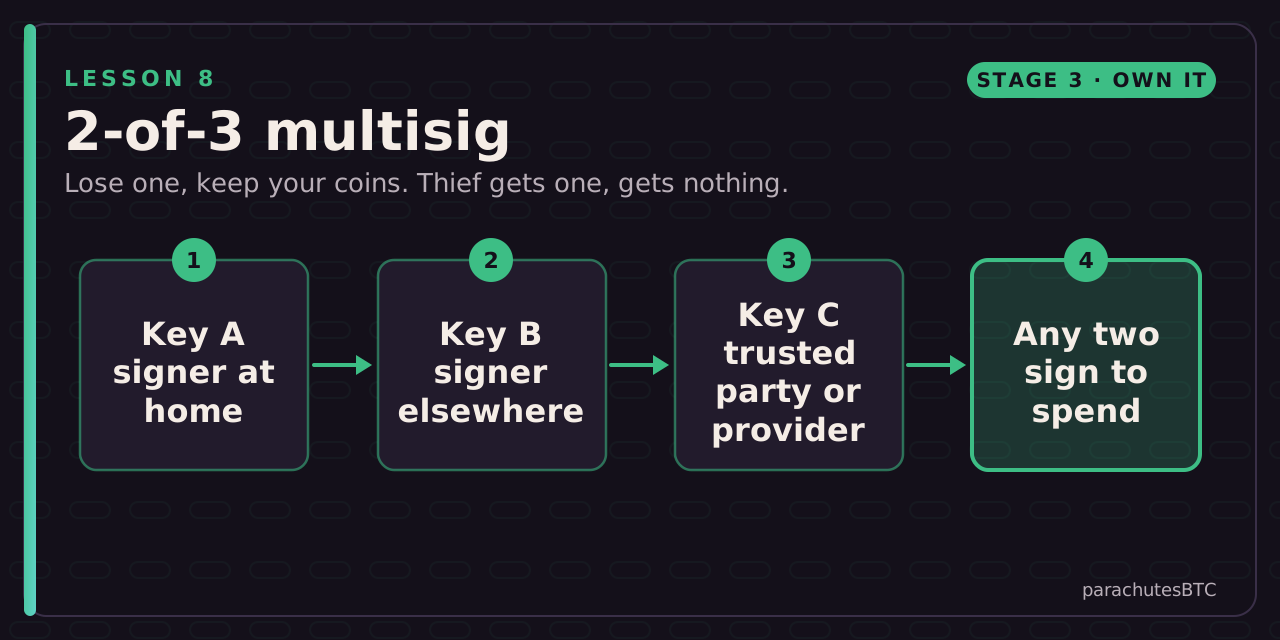
Multisig: when and how
Multisig needs several keys to spend. It removes single points of failure for larger holdings, at the cost of setup, maintenance and explaining it to heirs.
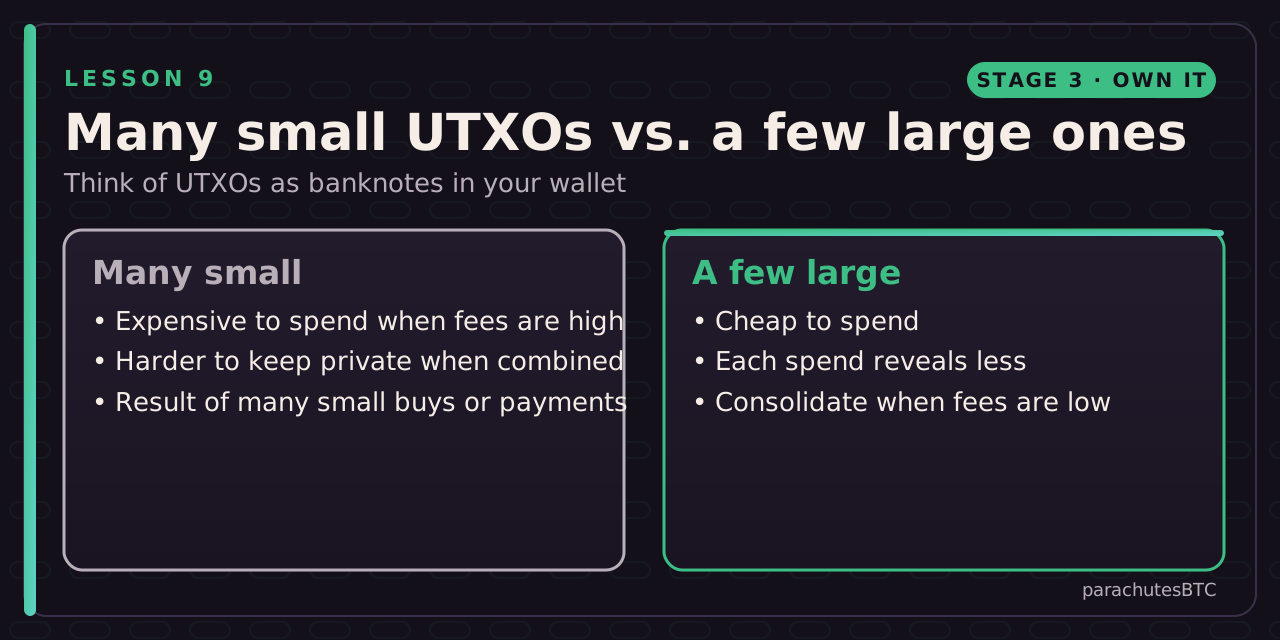
Managing UTXOs
Your wallet is a pile of UTXOs. Many small ones cost more to spend and leak privacy. Consolidate when fees are low; keep KYC and non-KYC coins apart.
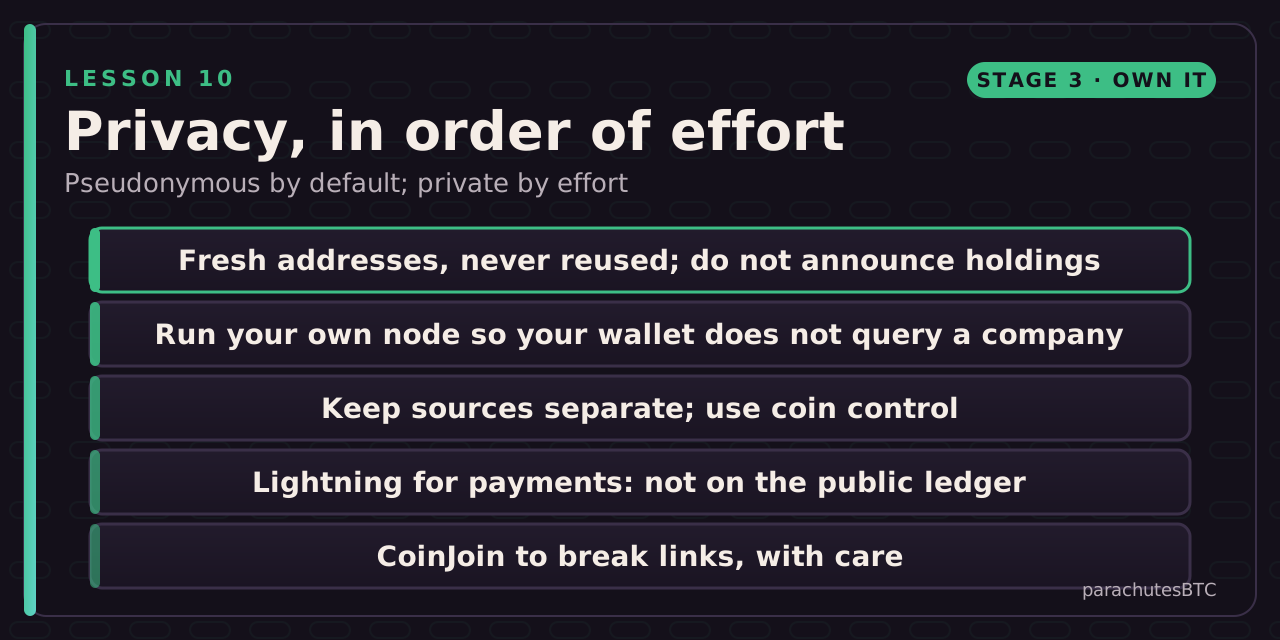
Privacy for holders
Bitcoin is pseudonymous. Fresh addresses, your own node, separated coins, Lightning and CoinJoin each add privacy. KYC purchases link your identity; plan around it.
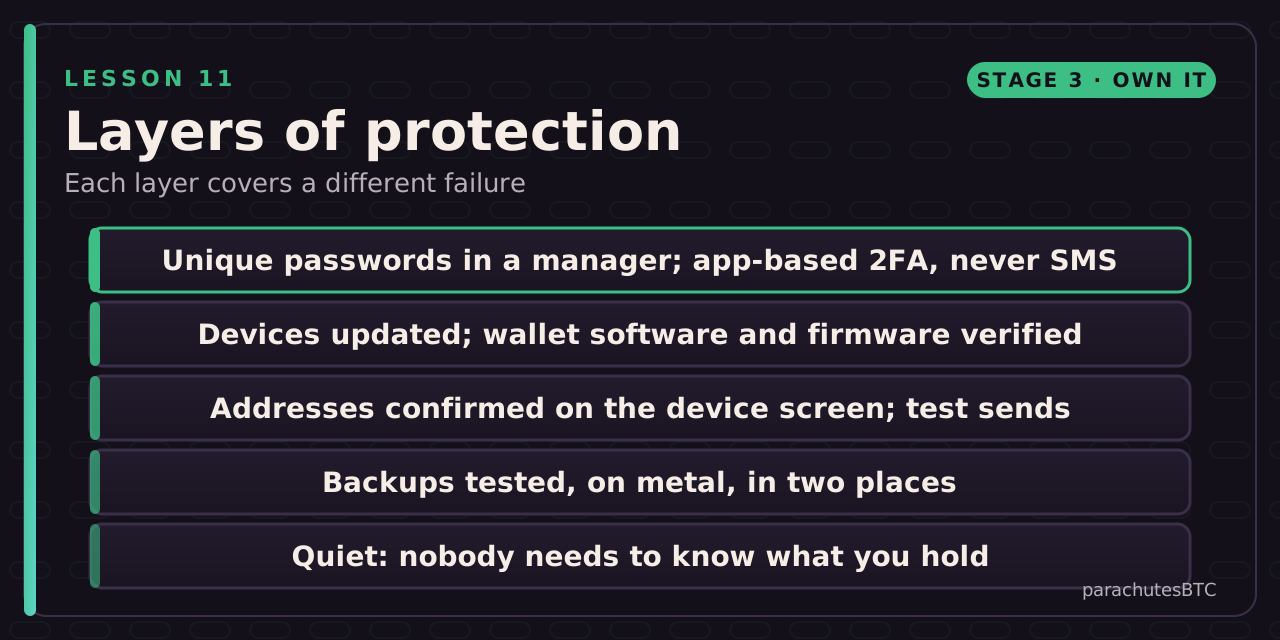
Security habits and threat models
Most losses are ordinary mistakes. Passwords, 2FA, updates, address checks, tested backups and discretion cover most of the risk. Know your threat model.
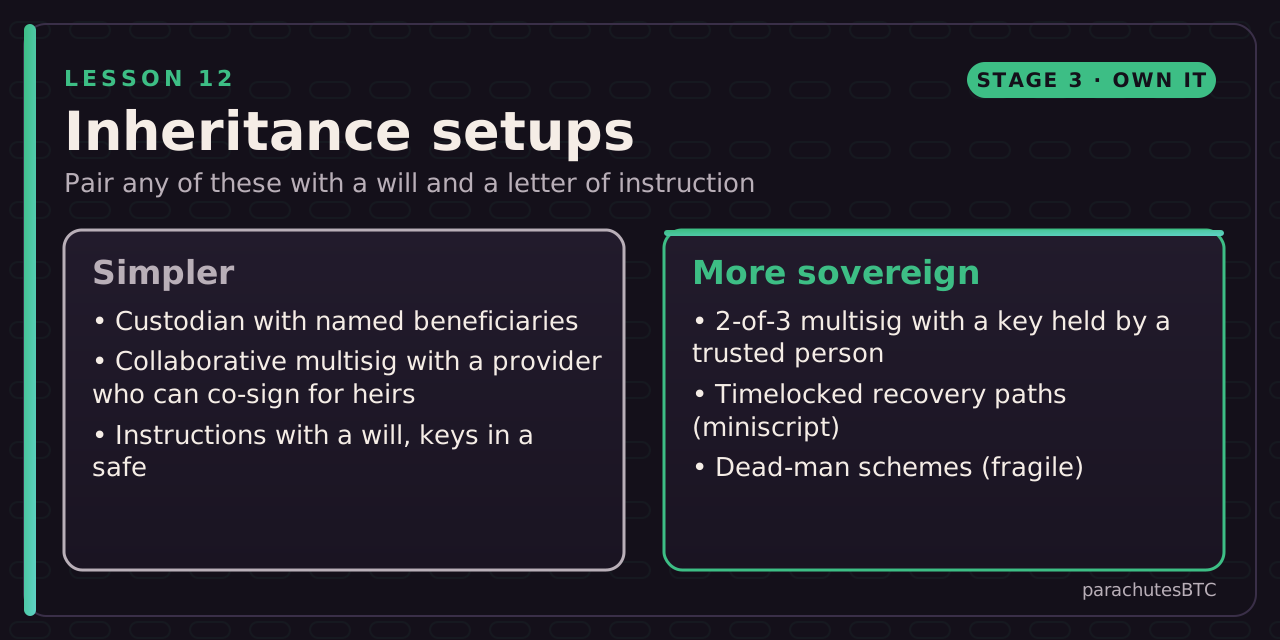
Inheritance: bitcoin that survives you
Self-custodied bitcoin without a plan dies with you. Choose a setup your heirs can actually execute, write instructions, and test them.
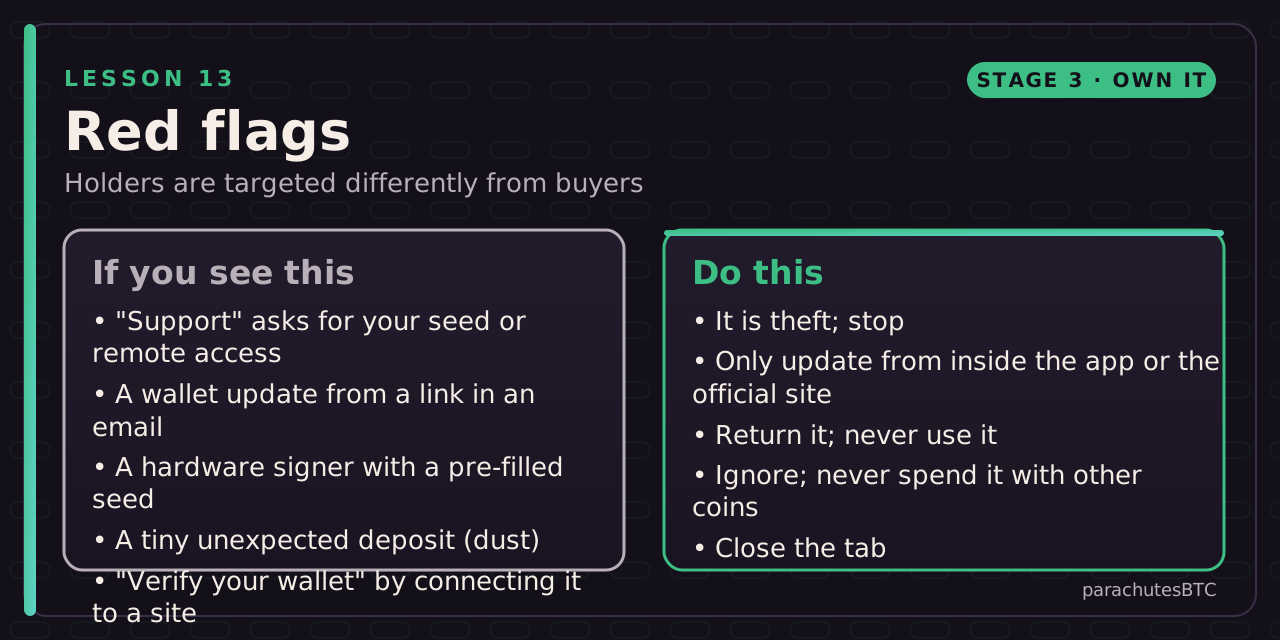
Scams aimed at holders
Holders face different scams from buyers: fake support, fake updates, tampered hardware, dust, and "connect your wallet" sites. Know the shapes.
STAGE 4 · GO DEEPUnder the hood: how the network works
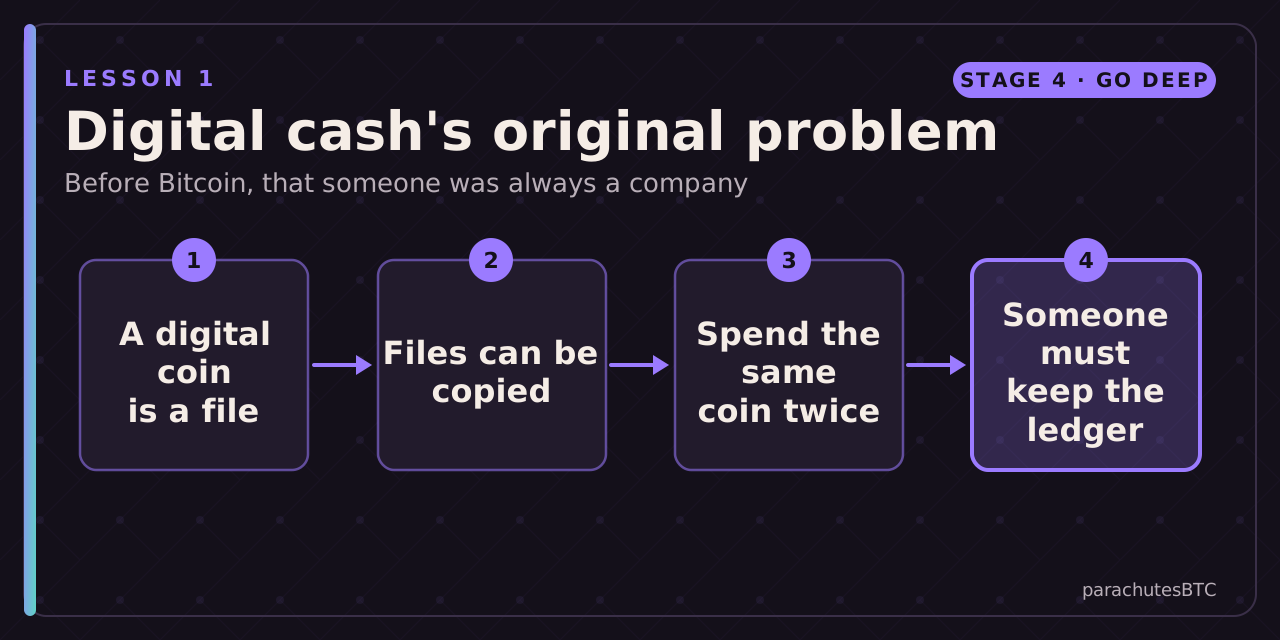
The problem: double spending
Digital things can be copied, so digital cash needs a ledger. Every system before Bitcoin needed a trusted party to keep it.
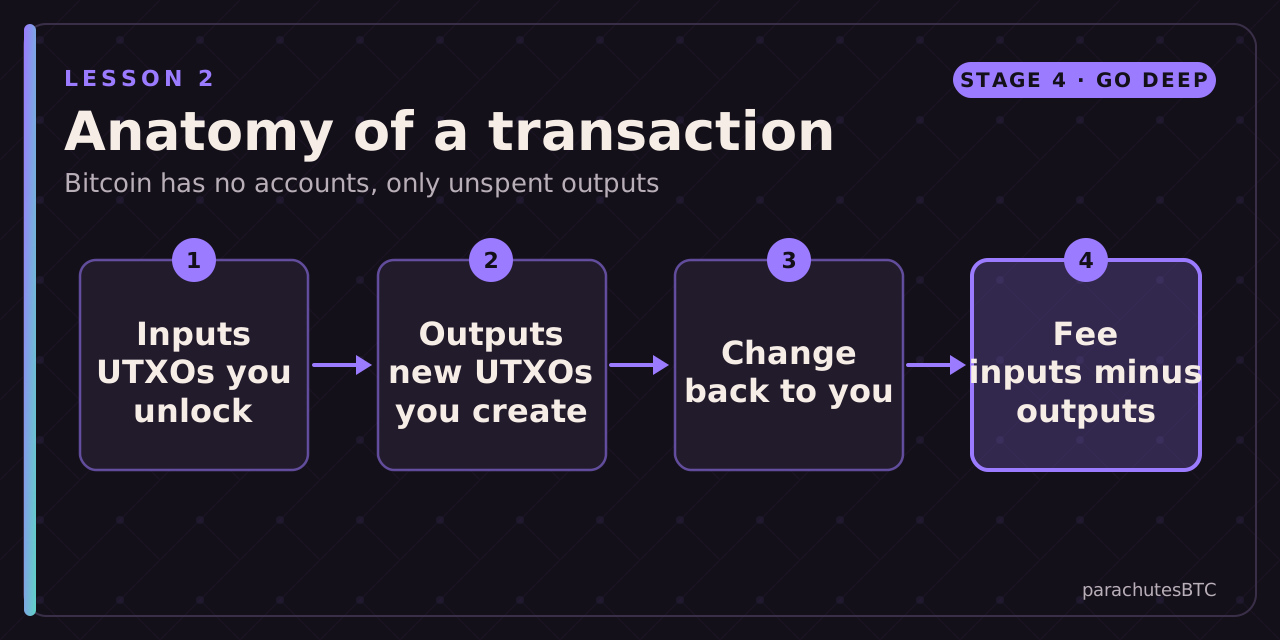
Transactions and UTXOs
Bitcoin has no account balances. It tracks unspent outputs. A payment unlocks whole outputs and creates new ones, with change back to you.
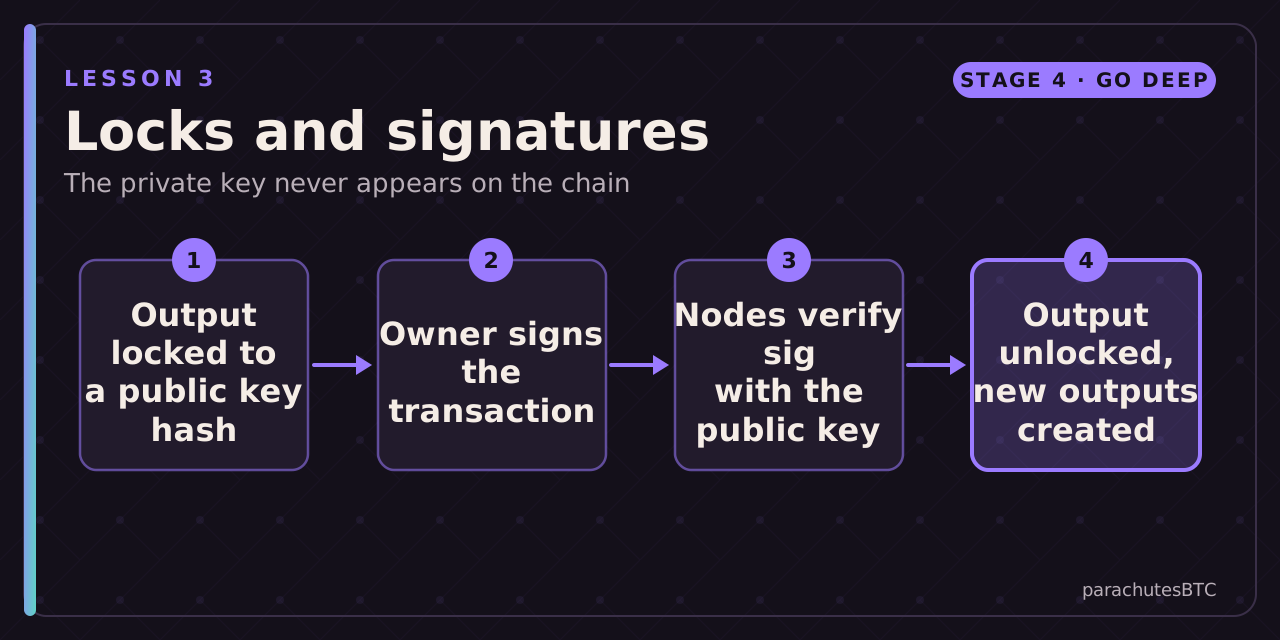
Keys, hashes and signatures
Outputs are locked to keys. A signature proves the holder authorised one exact transaction without revealing the key. Hashes tie everything together.
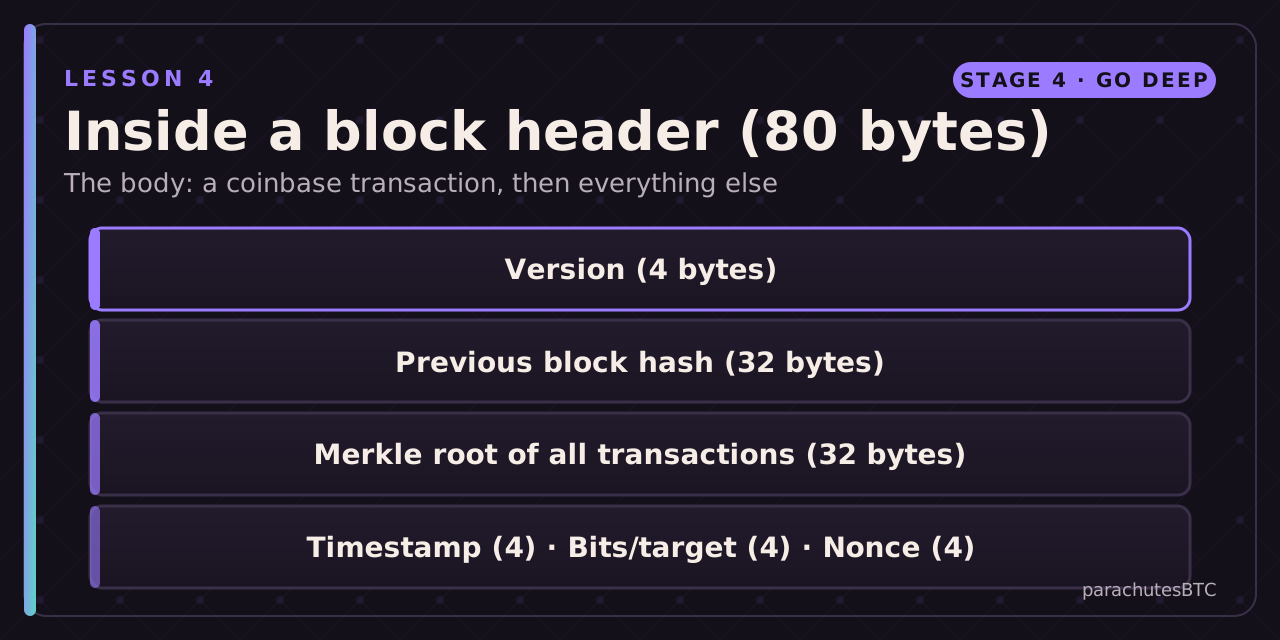
Blocks and the chain
A block is a header plus transactions. The header links to the previous block and commits to every transaction through a Merkle root.
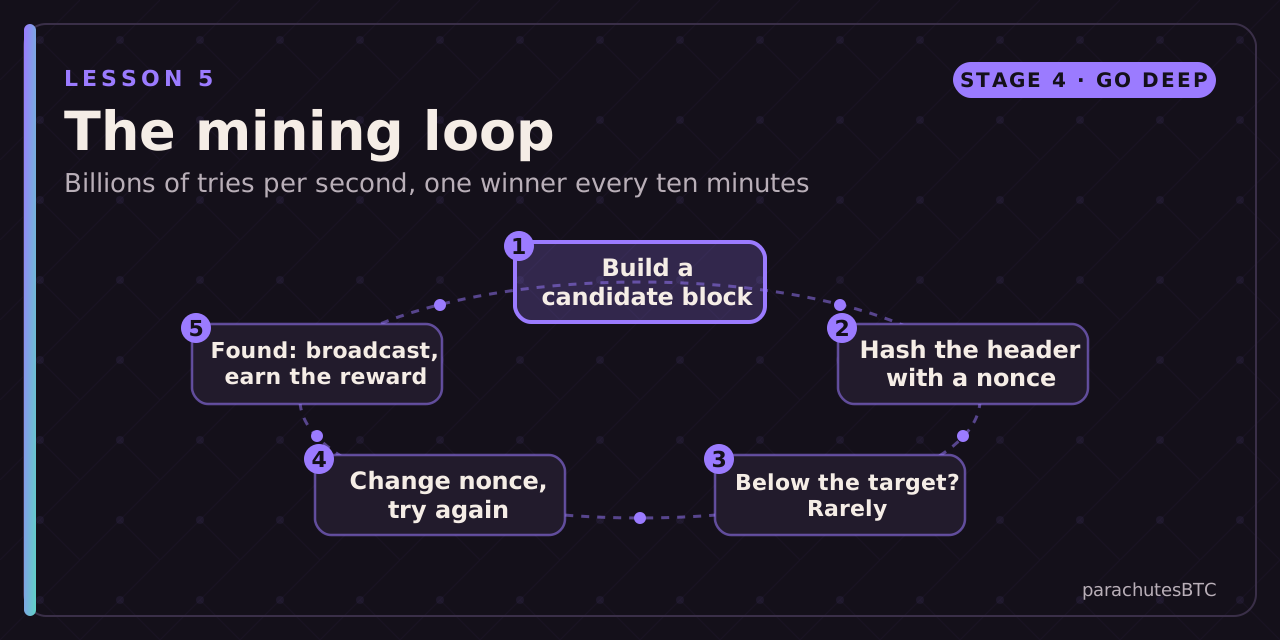
Mining and proof of work
Miners hash block headers until one falls below a target. The work is useless except as proof that it was done, which is exactly what makes history expensive to change.
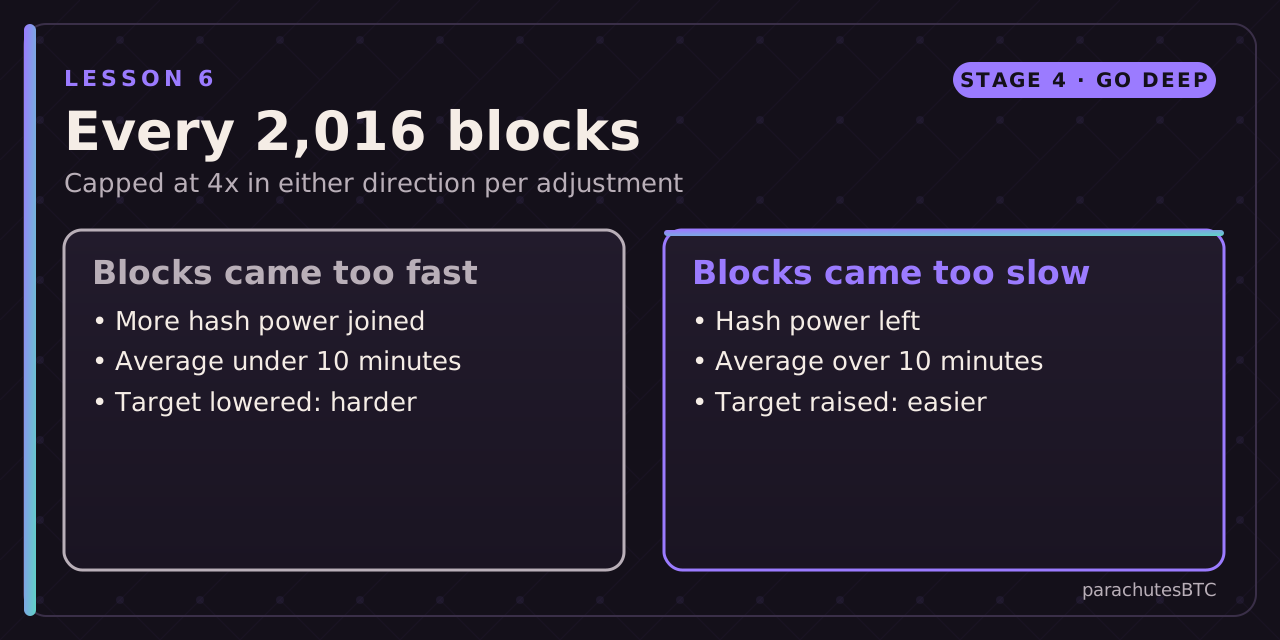
The difficulty adjustment
Every 2,016 blocks the network retunes the target so blocks keep arriving every ten minutes, whatever the hash rate. This keeps issuance on schedule.
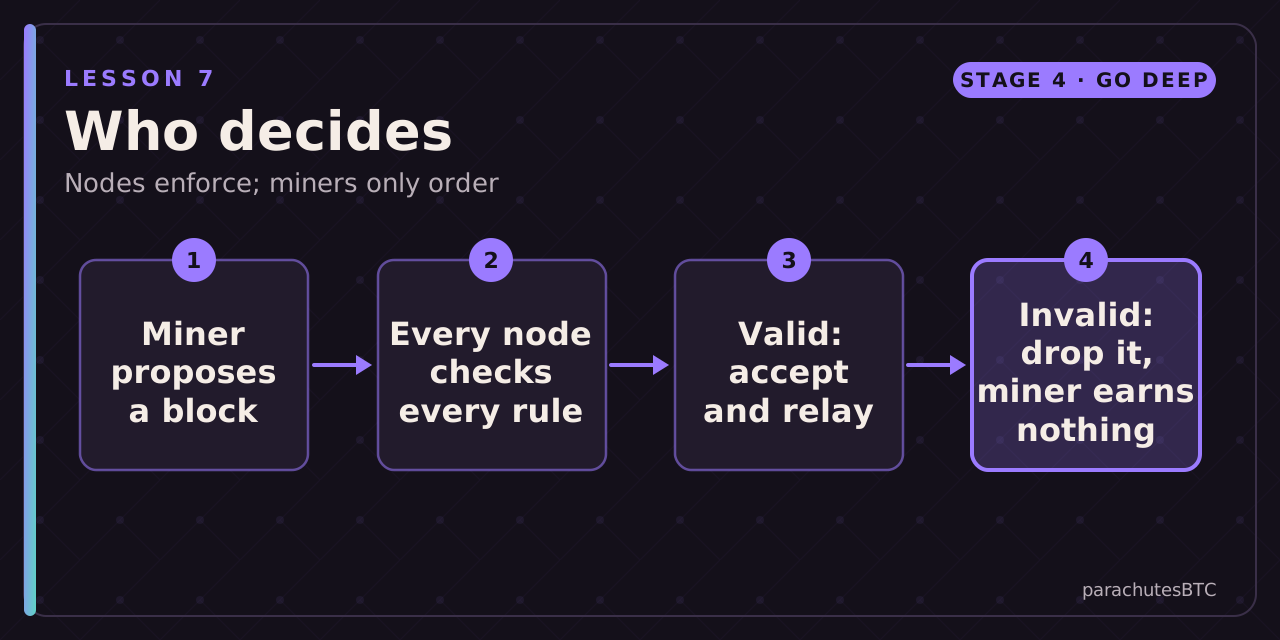
Nodes, consensus and the longest chain
Full nodes verify every rule and reject anything invalid, no matter how much work is behind it. The valid chain with the most work wins.
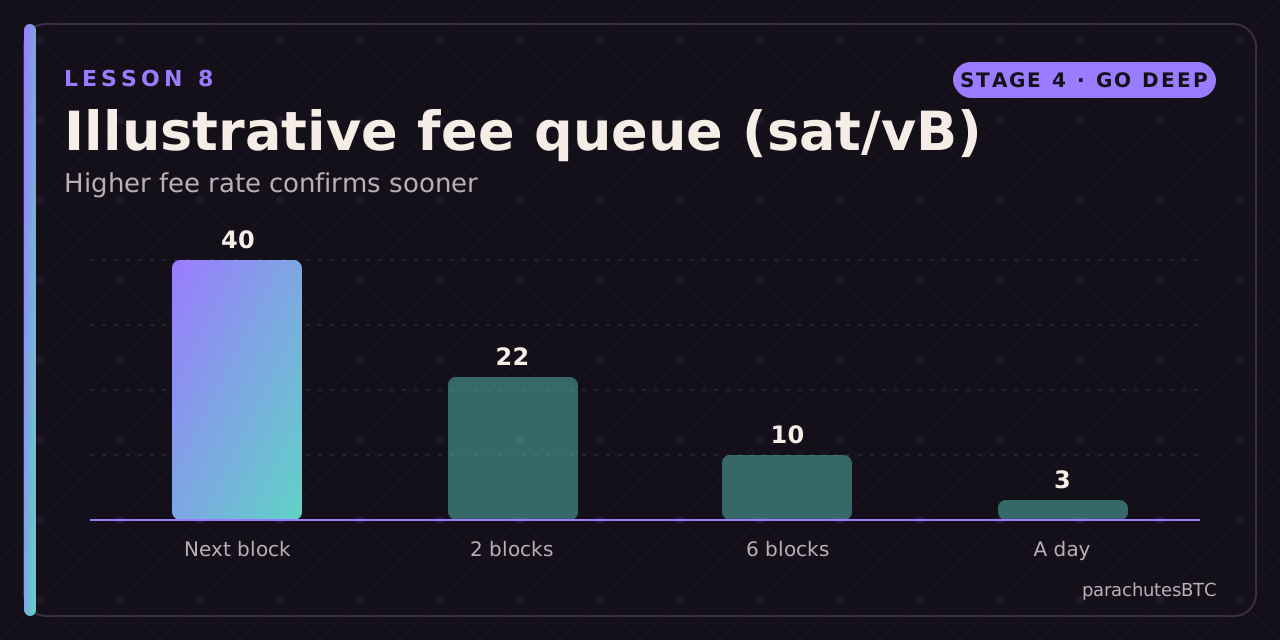
Fees and the mempool
Unconfirmed transactions wait in each node's mempool. Miners take the highest fee per byte first. Fees are the market for scarce block space.
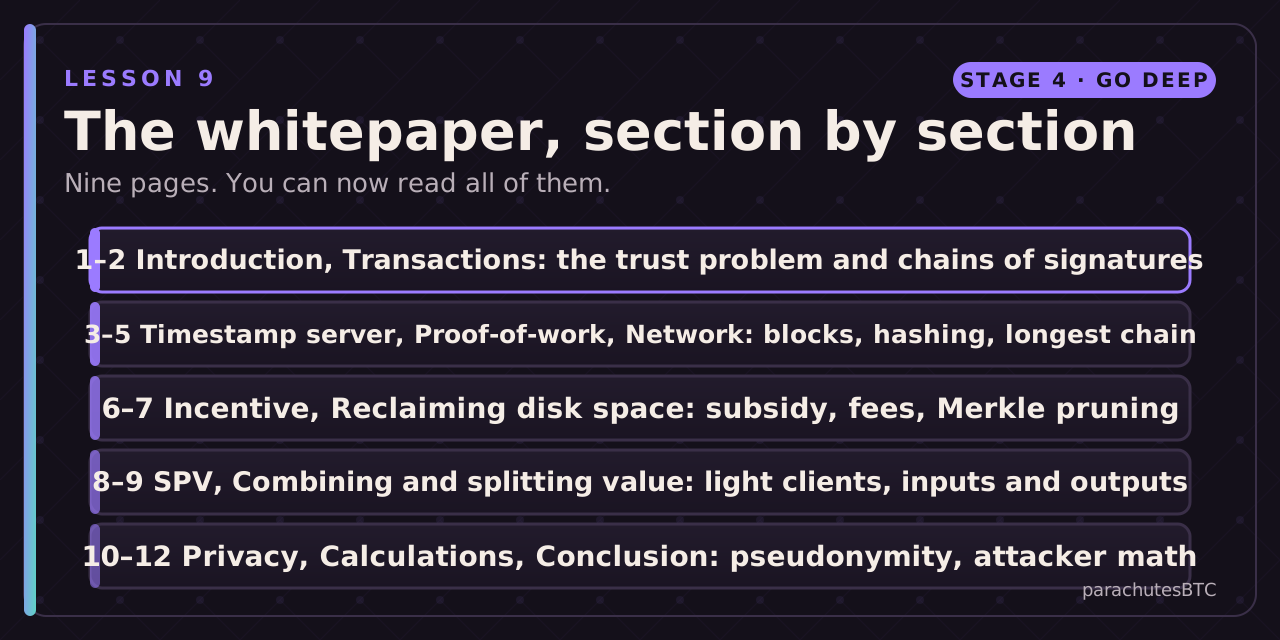
Reading the whitepaper
You now know every concept in the whitepaper. This lesson maps its twelve sections to what you have learned and sends you to read it.
STAGE 4 · GO DEEPBitcoin's monetary policy
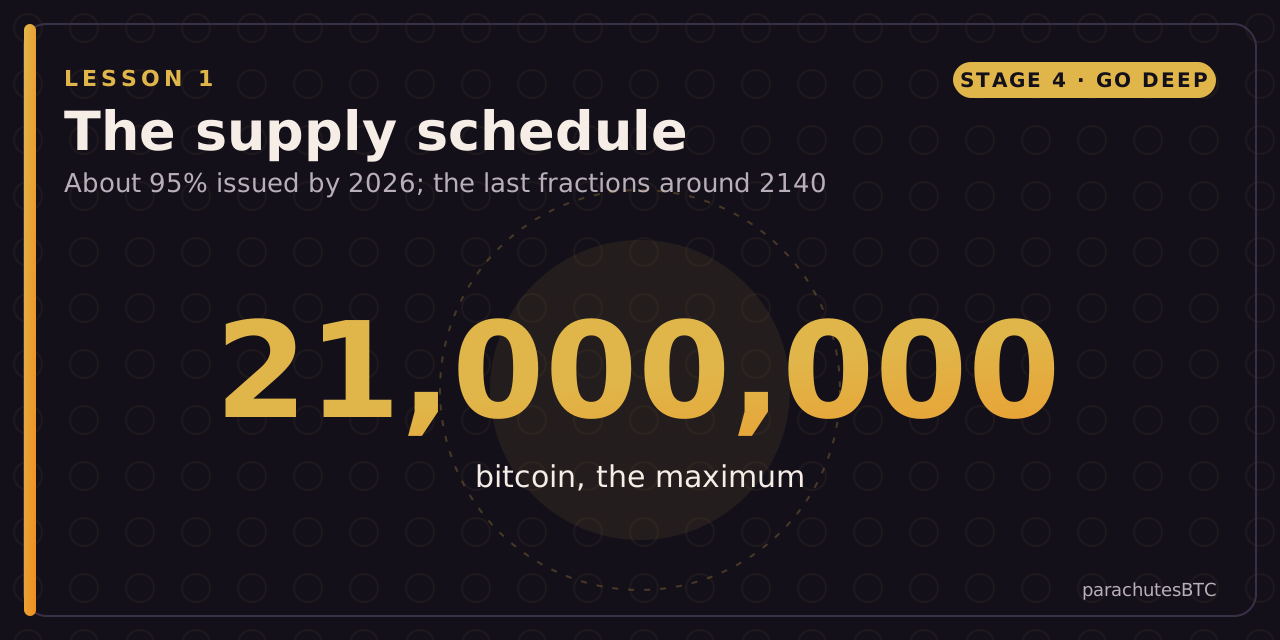
The supply schedule
New bitcoin is issued on a declining schedule anyone can compute. Roughly 95% exists already; the last fractions arrive around 2140.
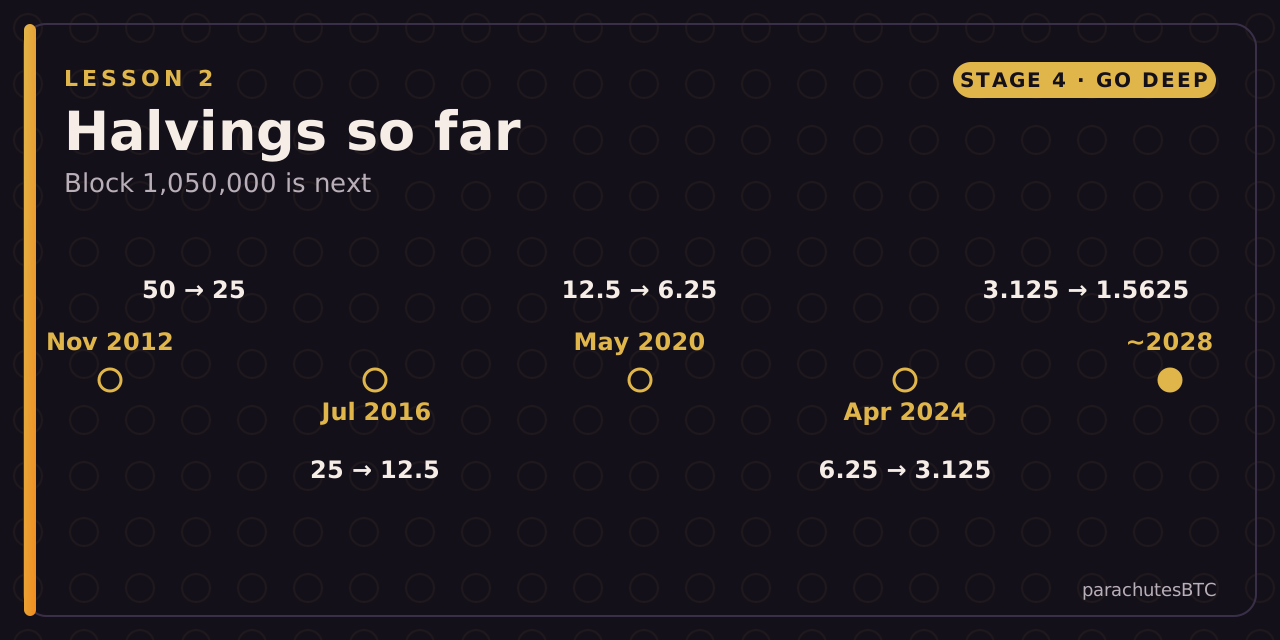
Halvings and issuance
Every 210,000 blocks the subsidy halves. Issuance falls, miners' subsidy income halves overnight, and the price is not part of the rule.
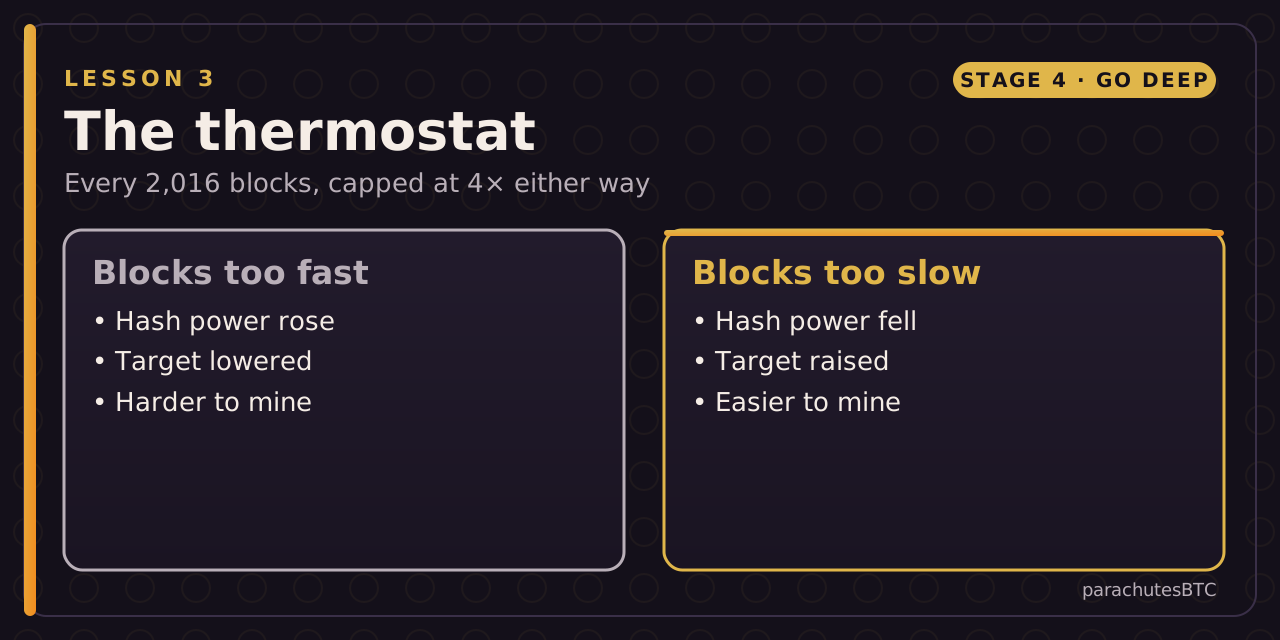
The difficulty adjustment
The difficulty adjustment keeps blocks near ten minutes regardless of hash power. It is what makes the supply schedule steady in time, not just in total.
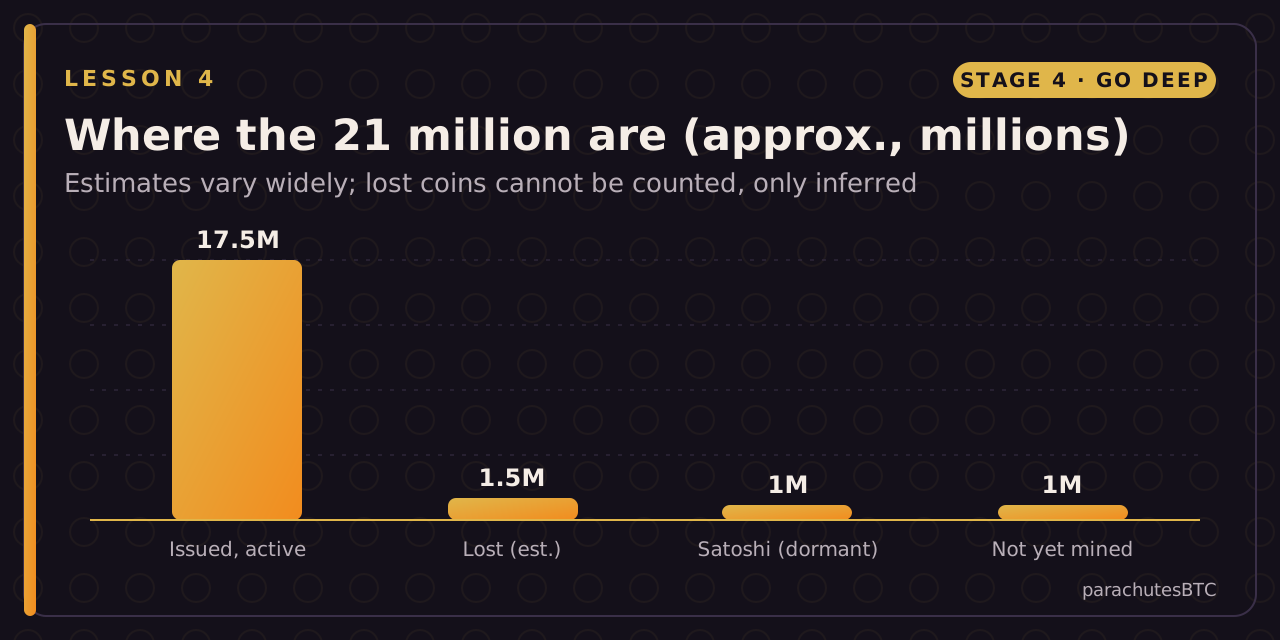
Lost coins and the real supply
Millions of bitcoin are probably lost forever, and Satoshi's million has never moved. The effective supply is smaller than 21 million, and nobody knows exactly by how much.
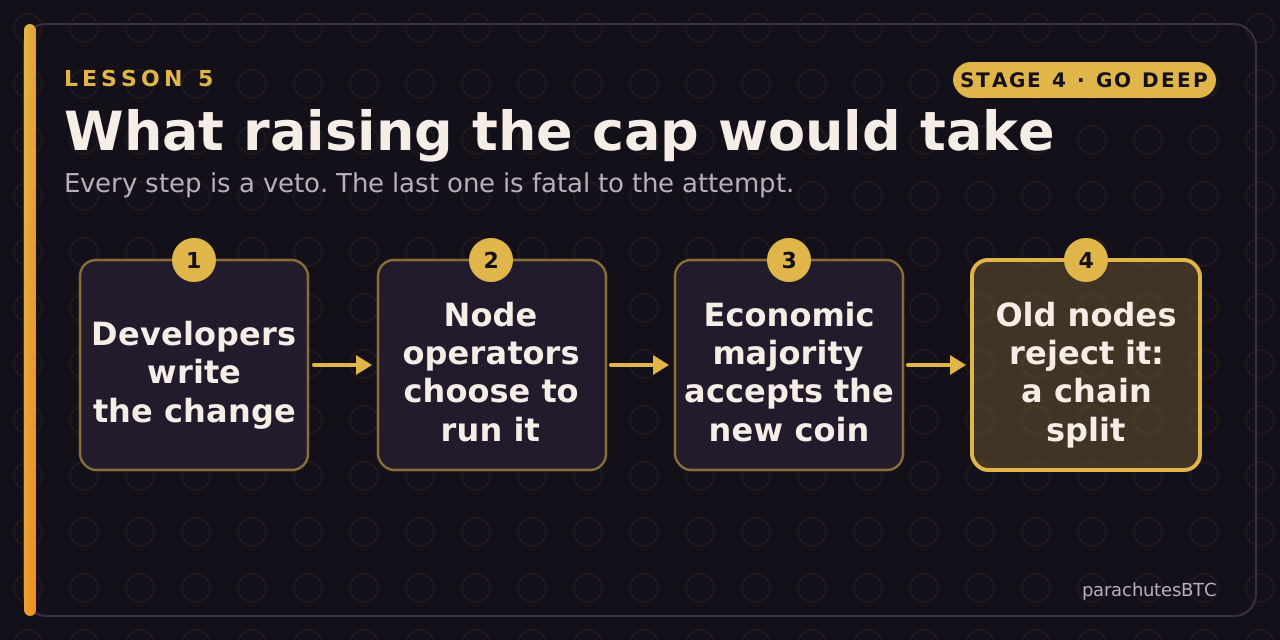
Can the 21 million cap be changed?
Technically yes, practically no. Changing the cap needs the people who hold bitcoin to run software that dilutes them, and anyone who refuses keeps the original chain.
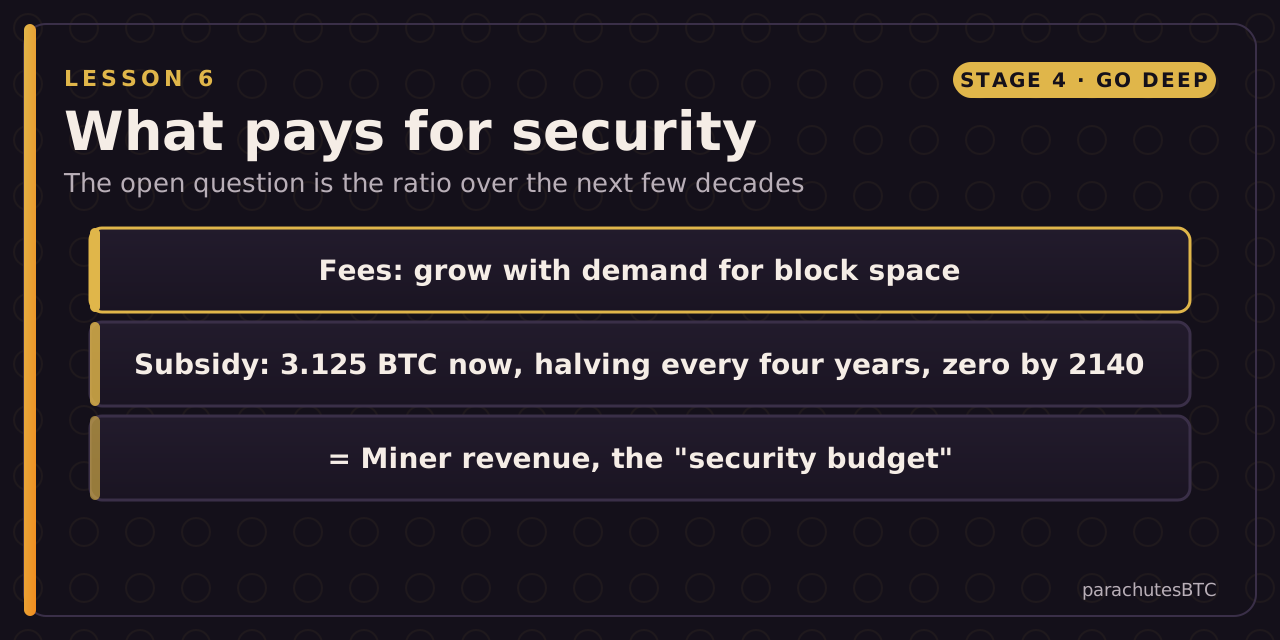
The security budget and fees
Miners are paid by subsidy plus fees. As the subsidy shrinks, security must come from fees. Whether they will suffice is Bitcoin's most serious open question.
STAGE 4 · GO DEEPMarkets and price
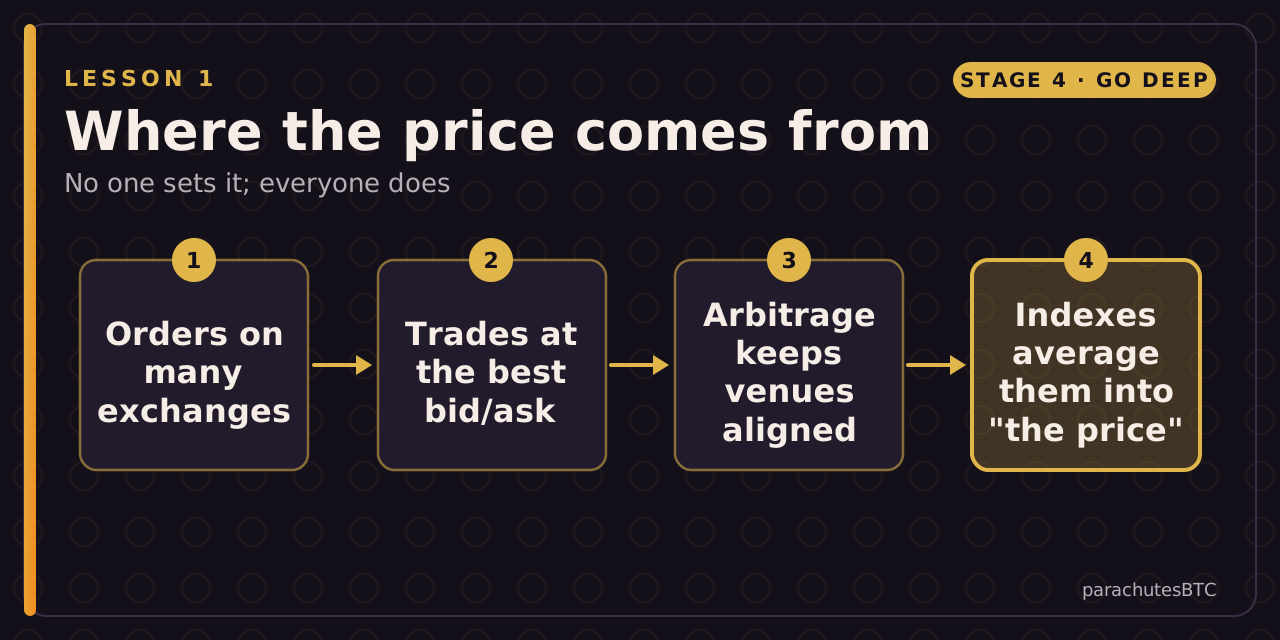
How the price is set
There is no official bitcoin price. It is set by trades on hundreds of exchanges, kept aligned by arbitrage and summarised by indexes.
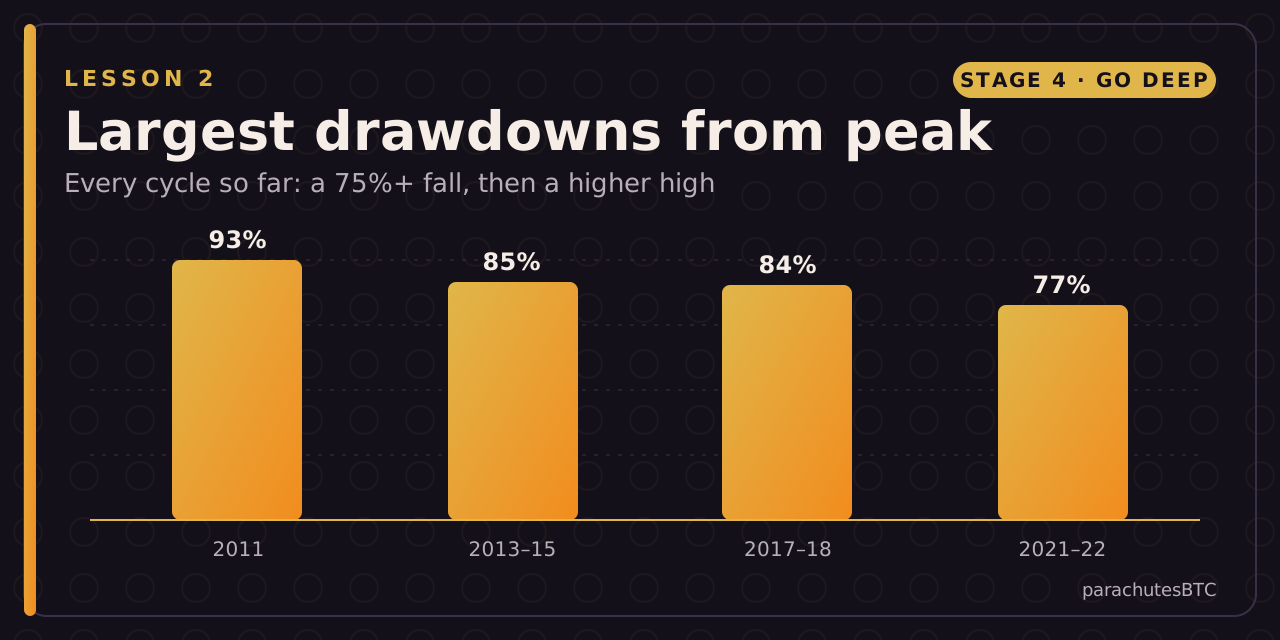
Volatility and drawdowns
Bitcoin has fallen more than 75% four times. Anyone holding it should expect that again. Each fall so far has ended above the previous cycle's peak.
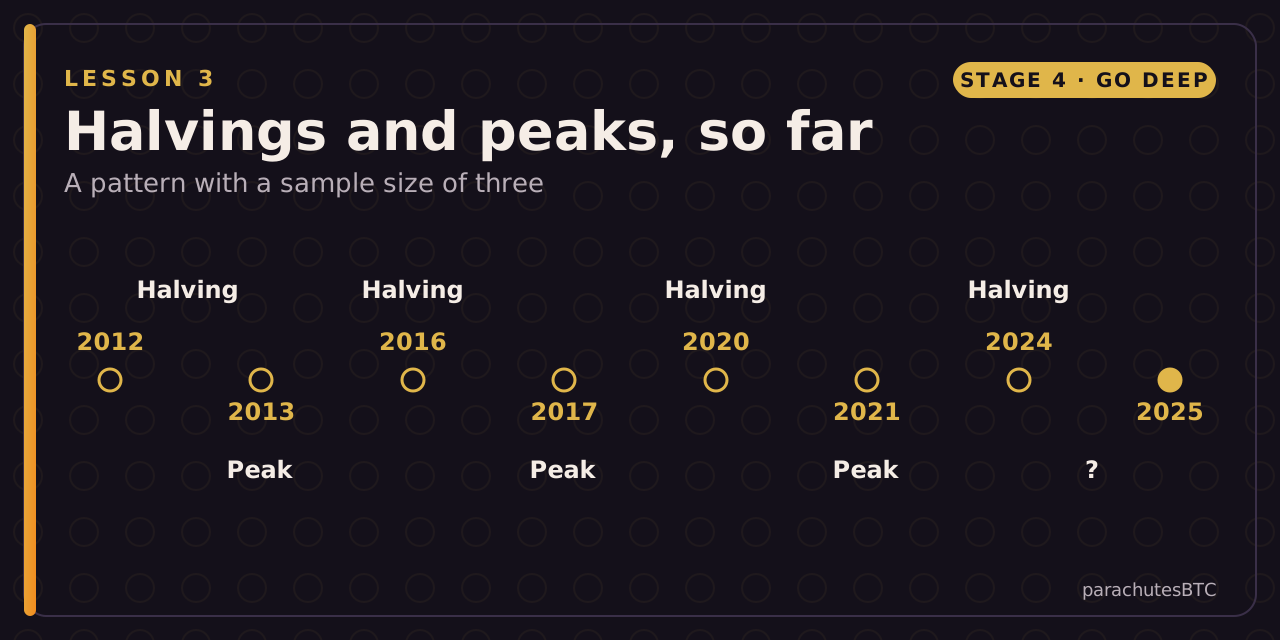
The four-year cycle
Peaks have followed halvings by about a year, three times. That is a pattern worth knowing and a sample too small to bet on.
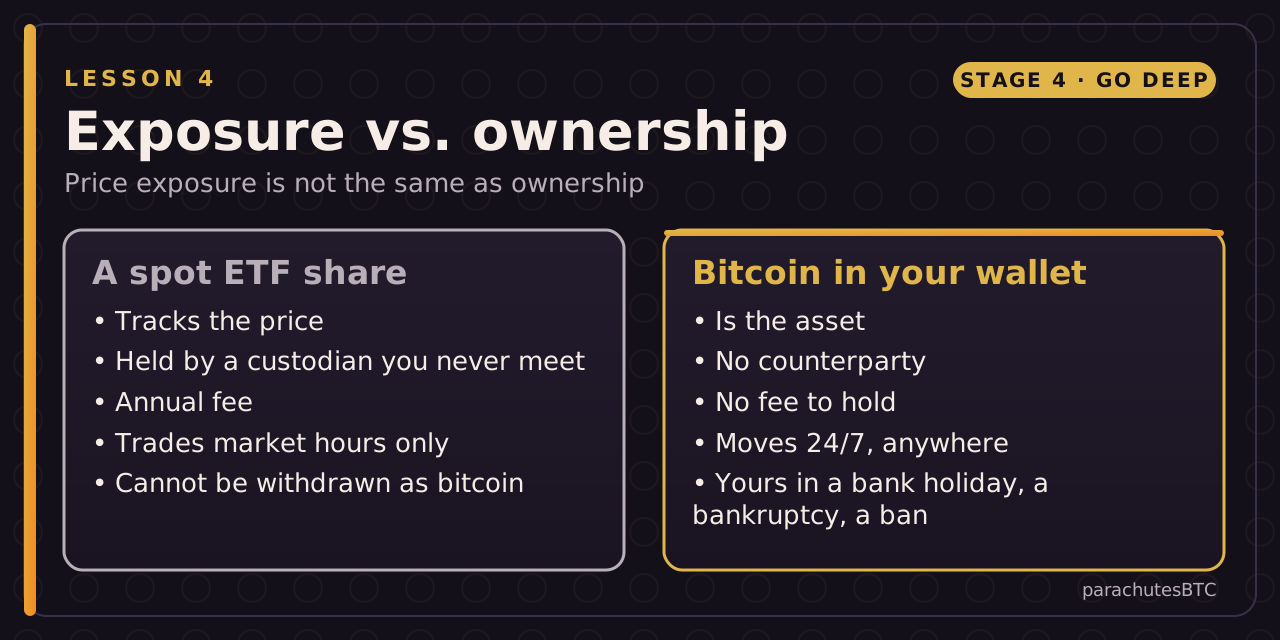
ETFs, IOUs and real bitcoin
ETFs give price exposure inside the traditional system, with a custodian and a fee. Real bitcoin is the asset. Know which one you want and why.
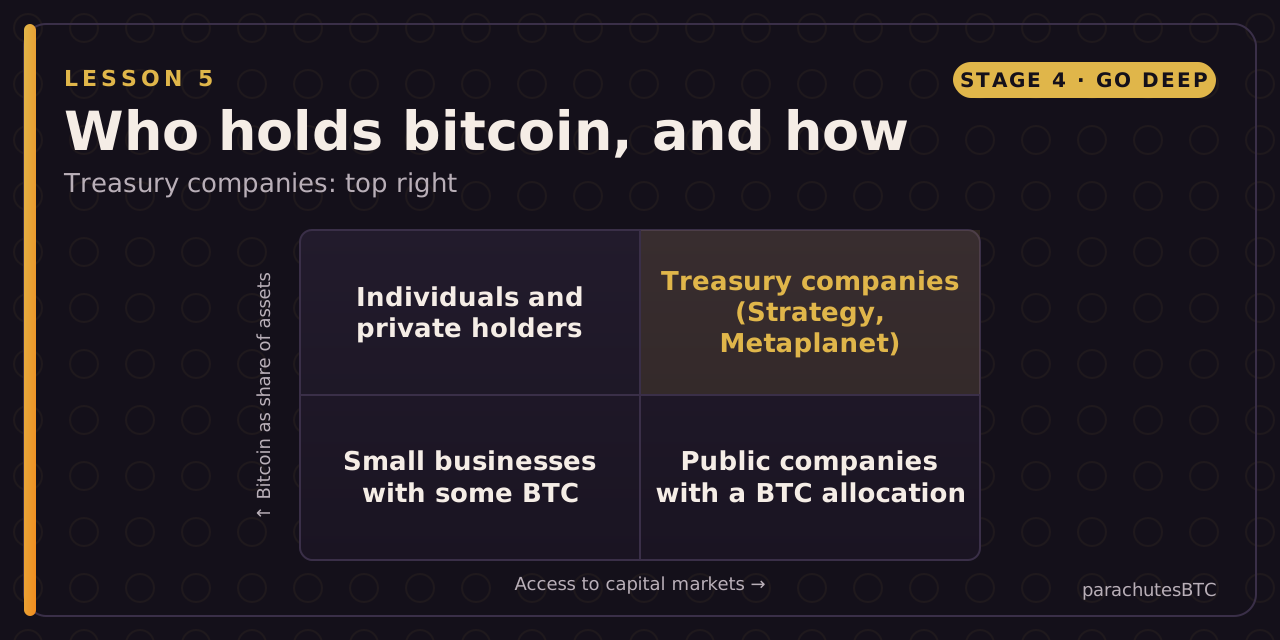
Treasury companies and corporate adoption
Treasury companies are public firms whose main asset is bitcoin, bought with stock and debt. Leveraged exposure for investors, with corporate risk attached.
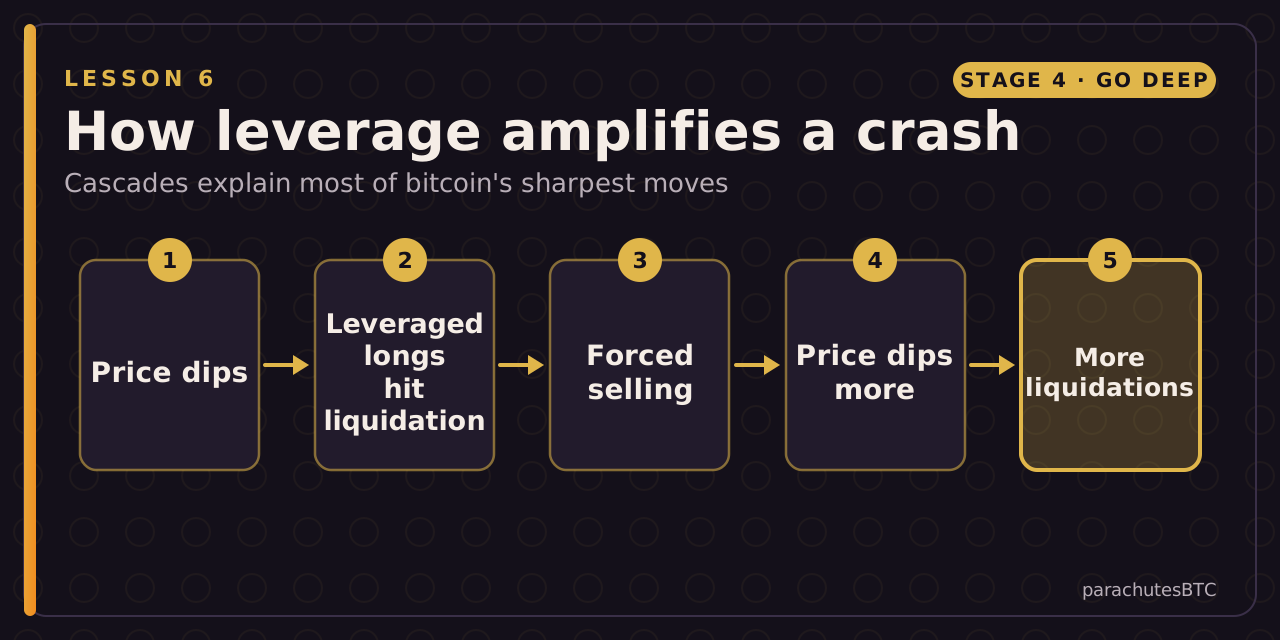
Derivatives, leverage and liquidations
Futures, perpetual swaps and options let traders bet with borrowed money. Liquidation cascades are why bitcoin moves 10% in an hour.
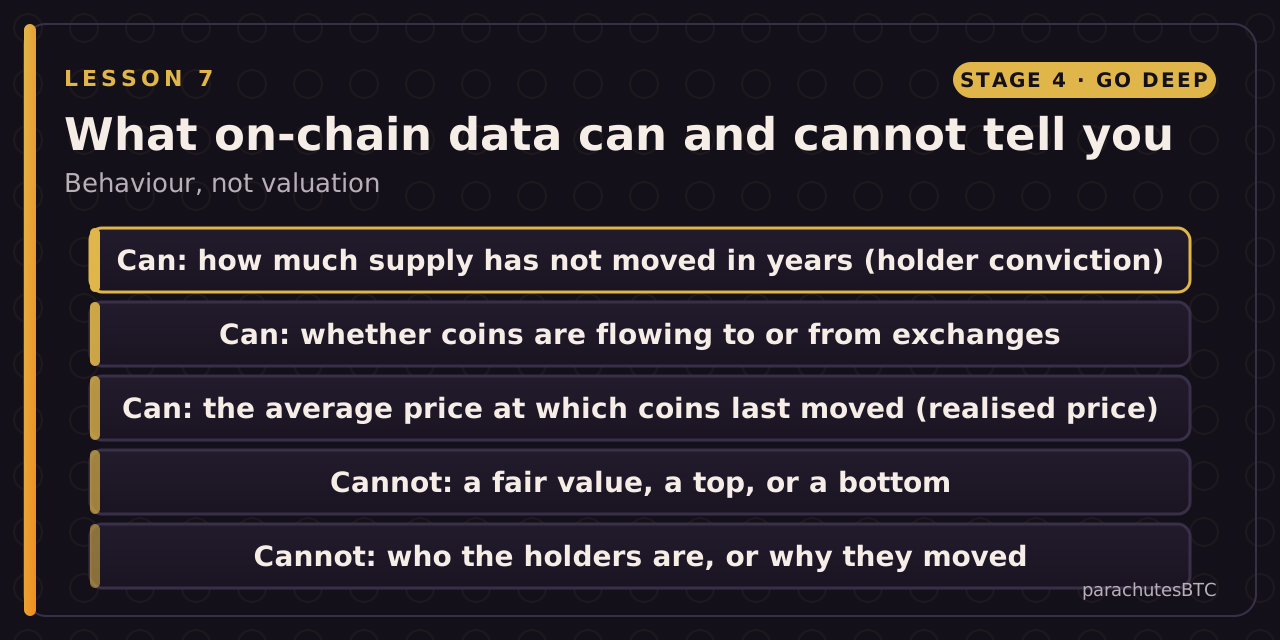
Reading on-chain data
The public ledger reveals holder behaviour: dormancy, exchange flows, realised price. It does not reveal fair value. Use it to understand, not to predict.
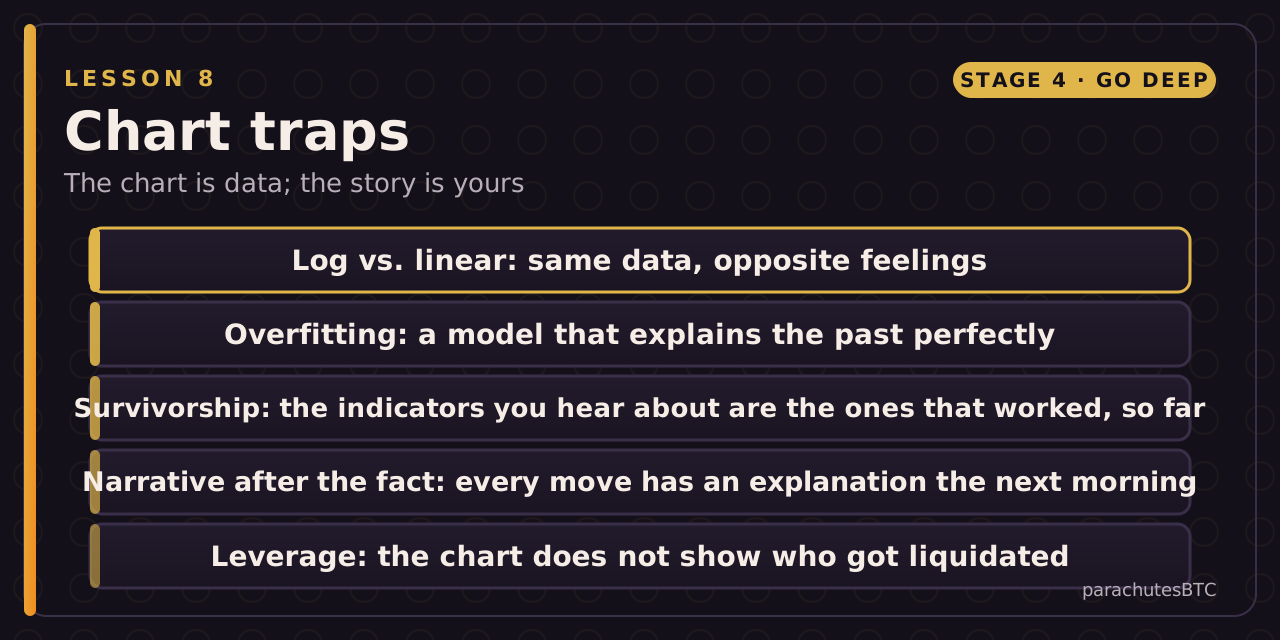
How people fool themselves with charts
Log scale, overfit models, survivorship bias and morning-after narratives. Learn the traps so the dashboard informs you instead of flattering you.
STAGE 4 · GO DEEPWhy Bitcoin only
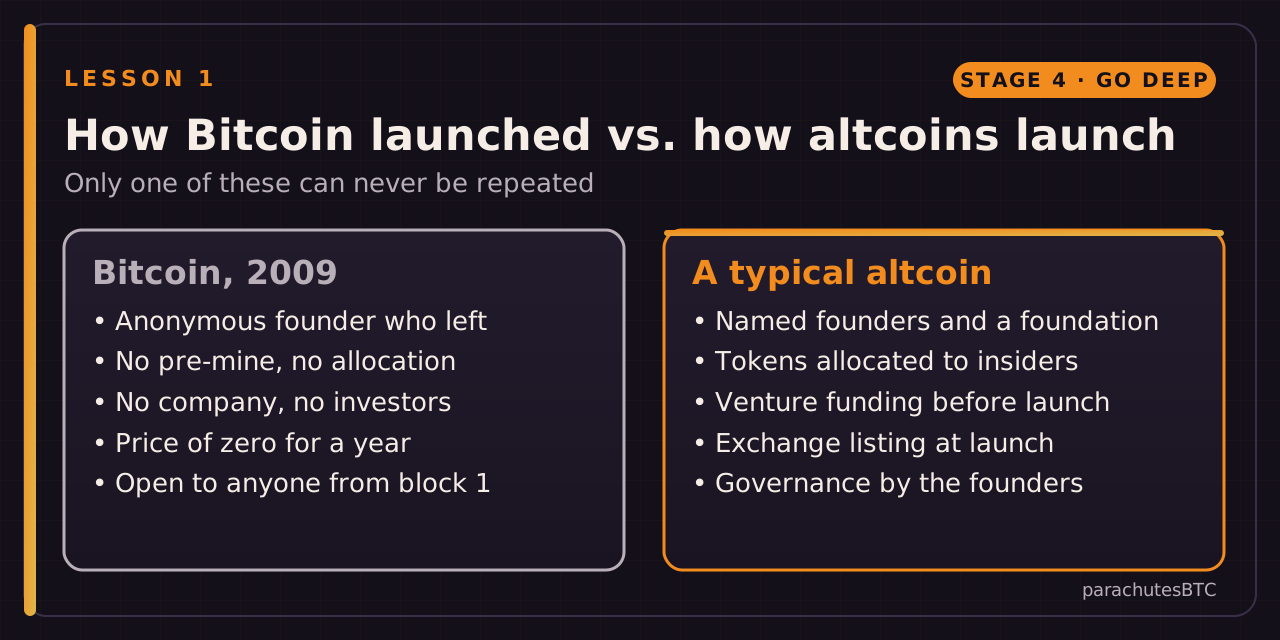
The immaculate conception
Bitcoin launched with no founder to lean on, no insiders, no company and no price. Every later coin had all four. That cannot be copied.
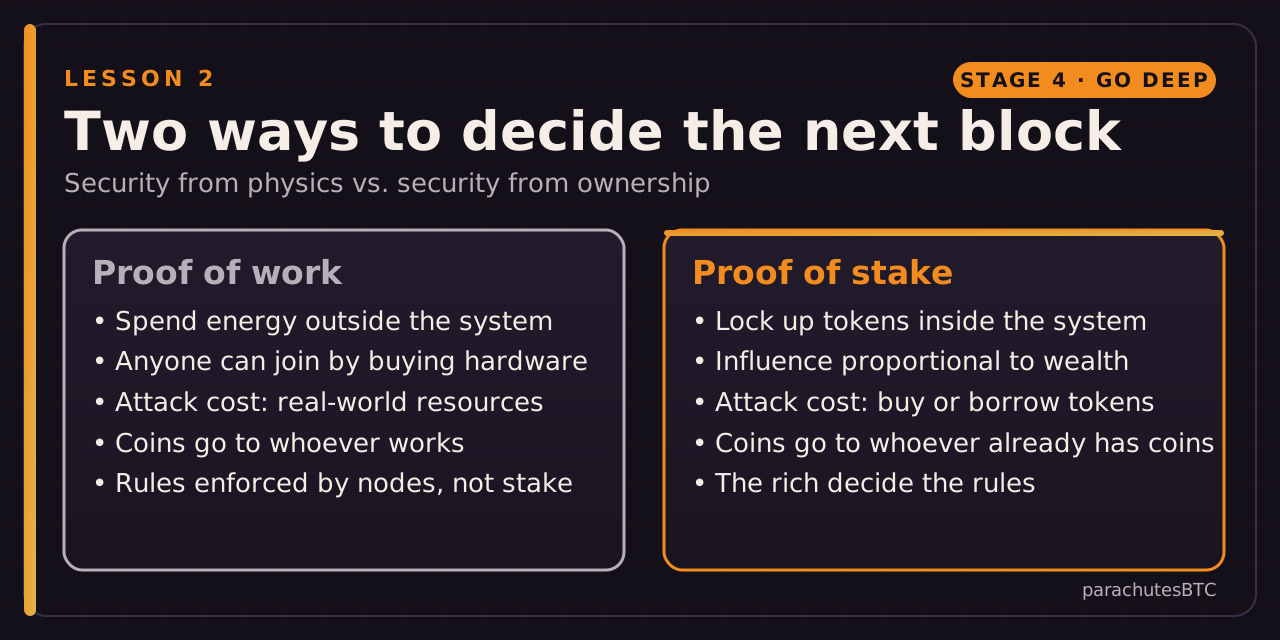
Proof of work versus proof of stake
Proof of work ties security to real resources anyone can buy. Proof of stake ties it to existing wealth, concentrates control and recreates the system it was meant to replace.
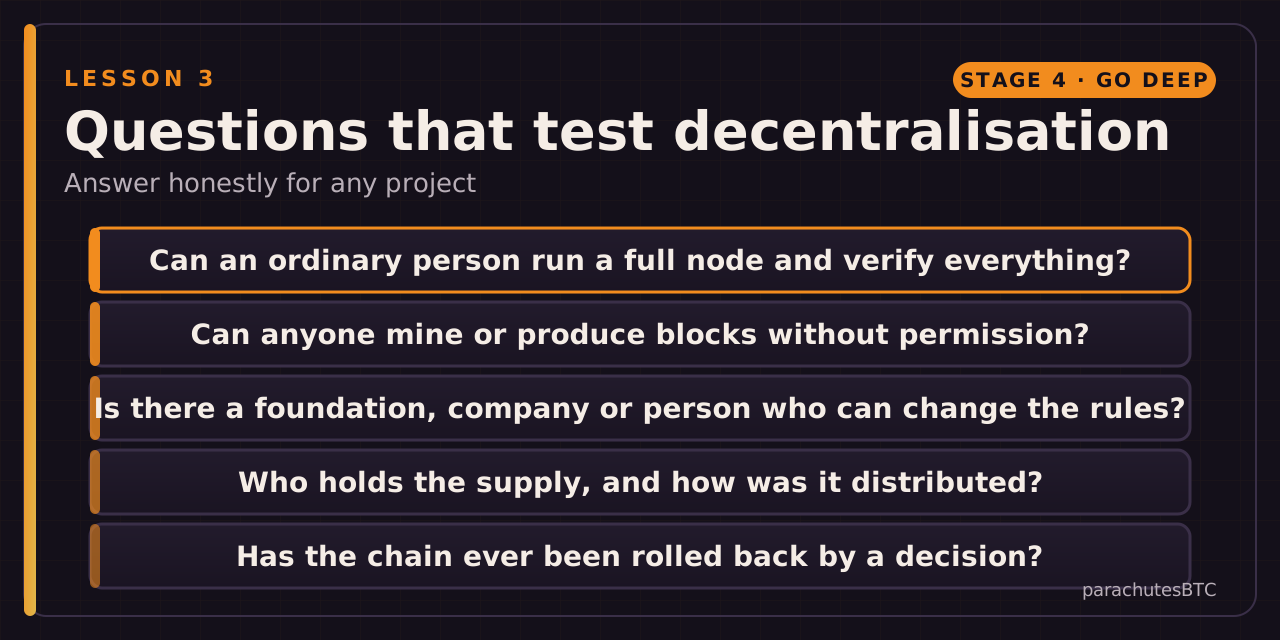
Decentralisation is not a spectrum
Either someone can change the rules or no one can. Five questions separate systems that are decentralised from systems that say they are.
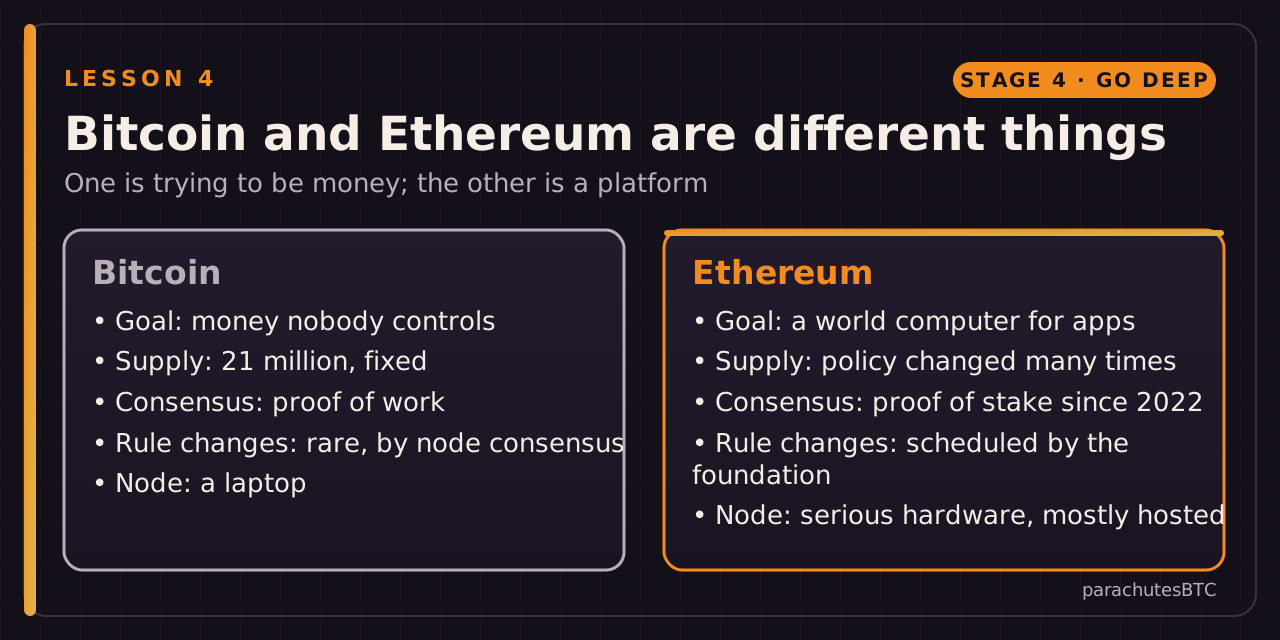
Why Ethereum is not a better Bitcoin
Ethereum is a platform with a foundation, a changing monetary policy and a rolled-back chain. It is a different project, not a better Bitcoin.
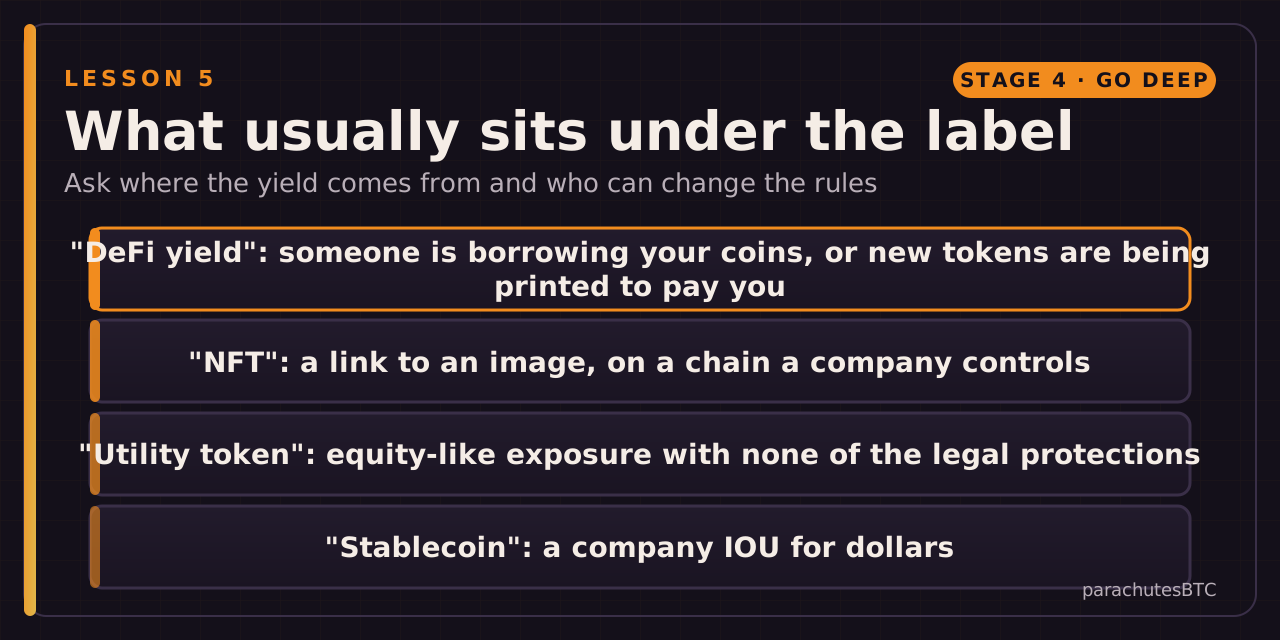
DeFi, NFTs and tokens
Most of "crypto" is finance with the protections removed. Yield comes from lending or token printing; NFTs are links; tokens are unregistered equity.
Network effects and Lindy
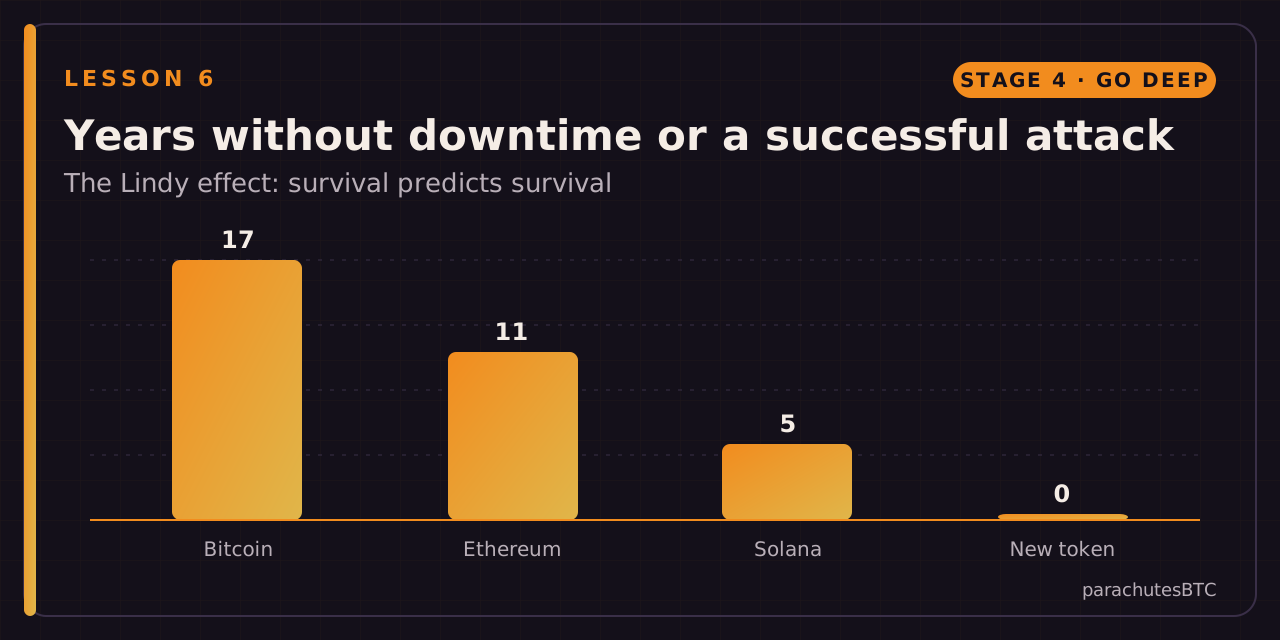
Money is the strongest network effect there is. Bitcoin has the users, the hash rate, the infrastructure and the longest record of just working.
Is there a second best?
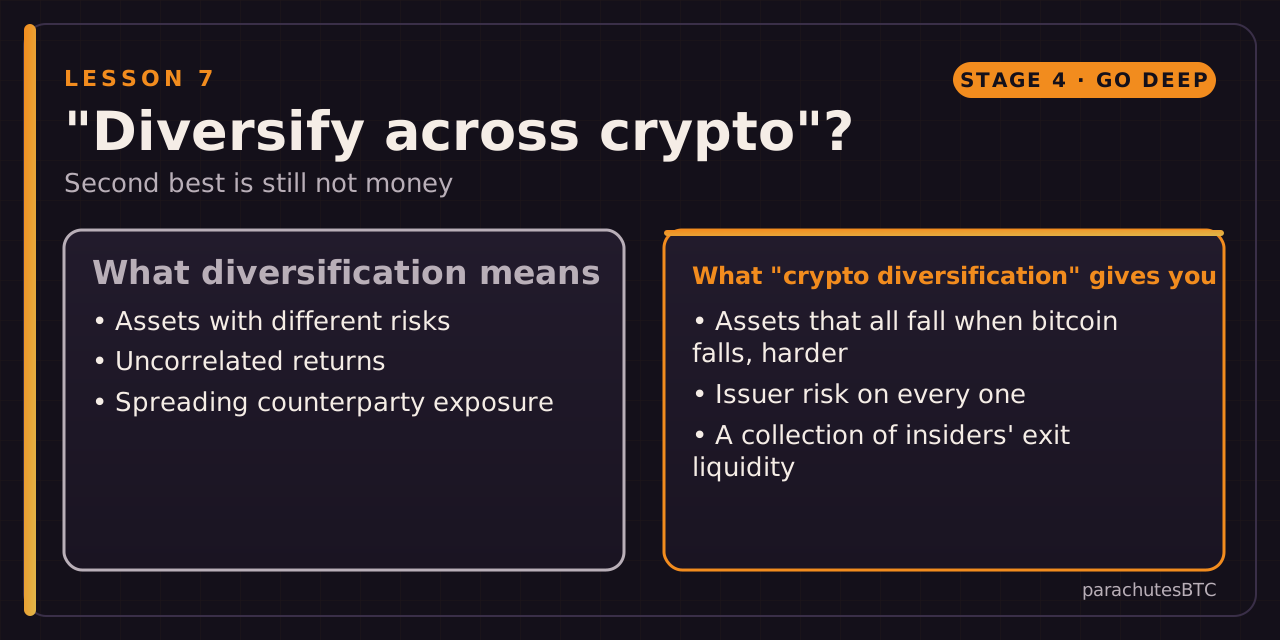
There is no second best because the category has one member. Diversifying across tokens adds issuer risk and correlation, not safety.
Why bitcoiners are "toxic"
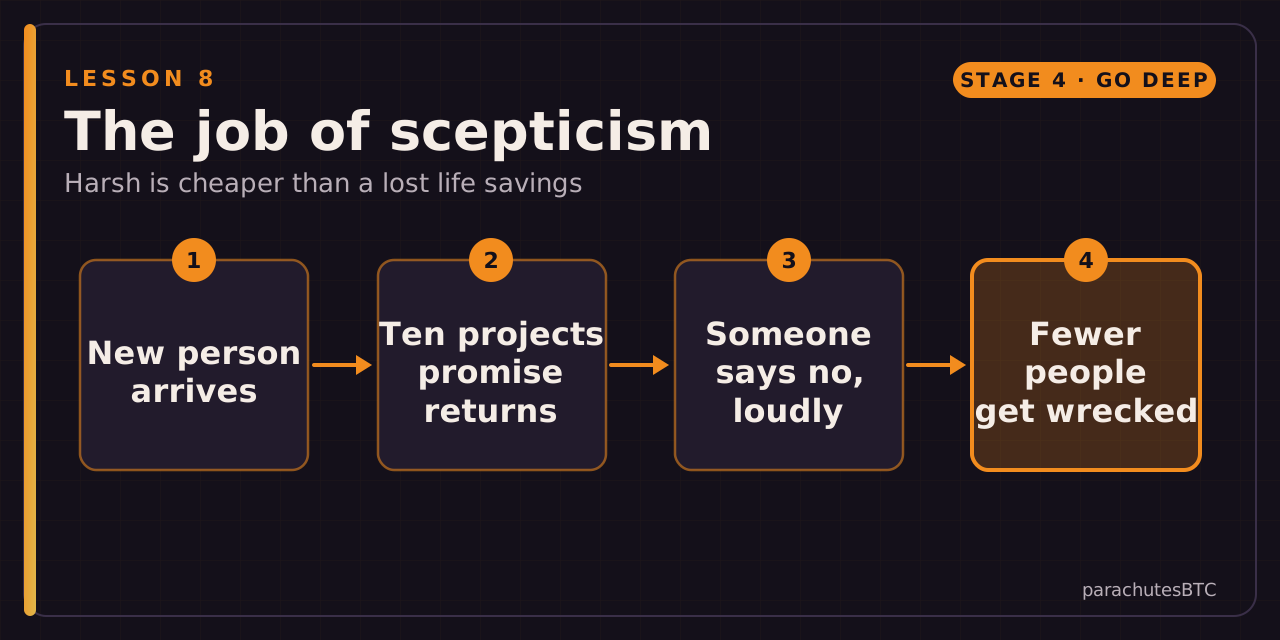
The reputation for harshness has a cause: the industry around bitcoin has separated millions of people from their savings, and politeness did not stop it.
STAGE 4 · GO DEEPLightning and layers
Why layers?
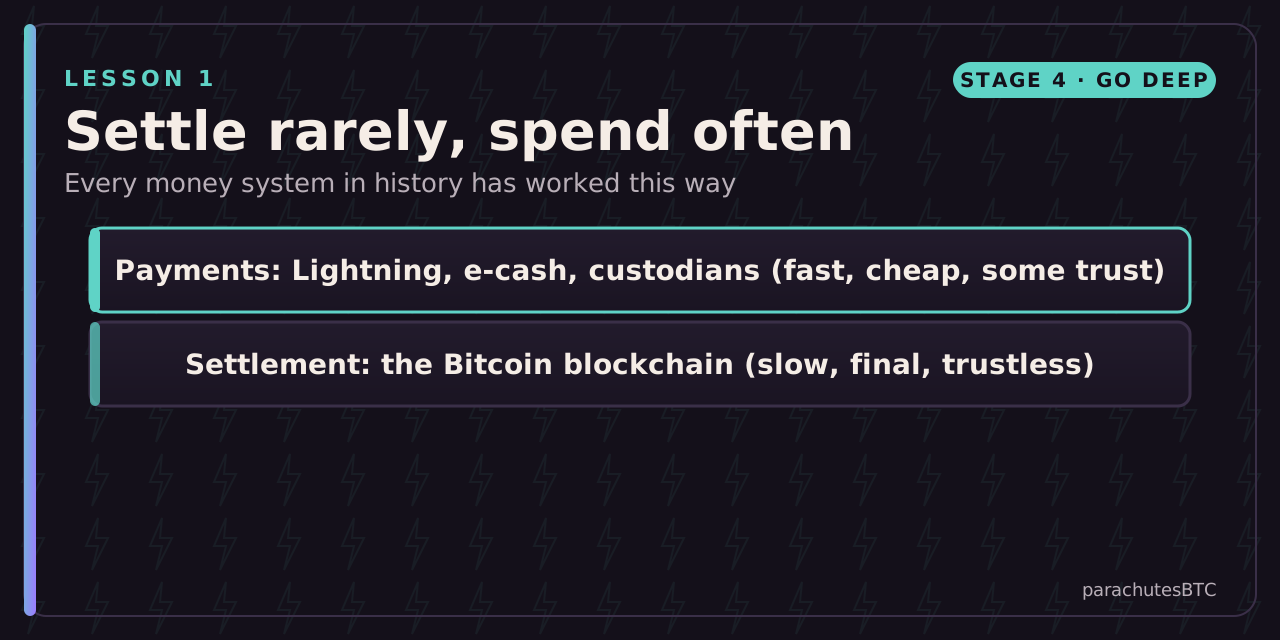
Every node checks every transaction, so the base layer is capped. Layers move everyday payments off-chain and settle on it when needed.
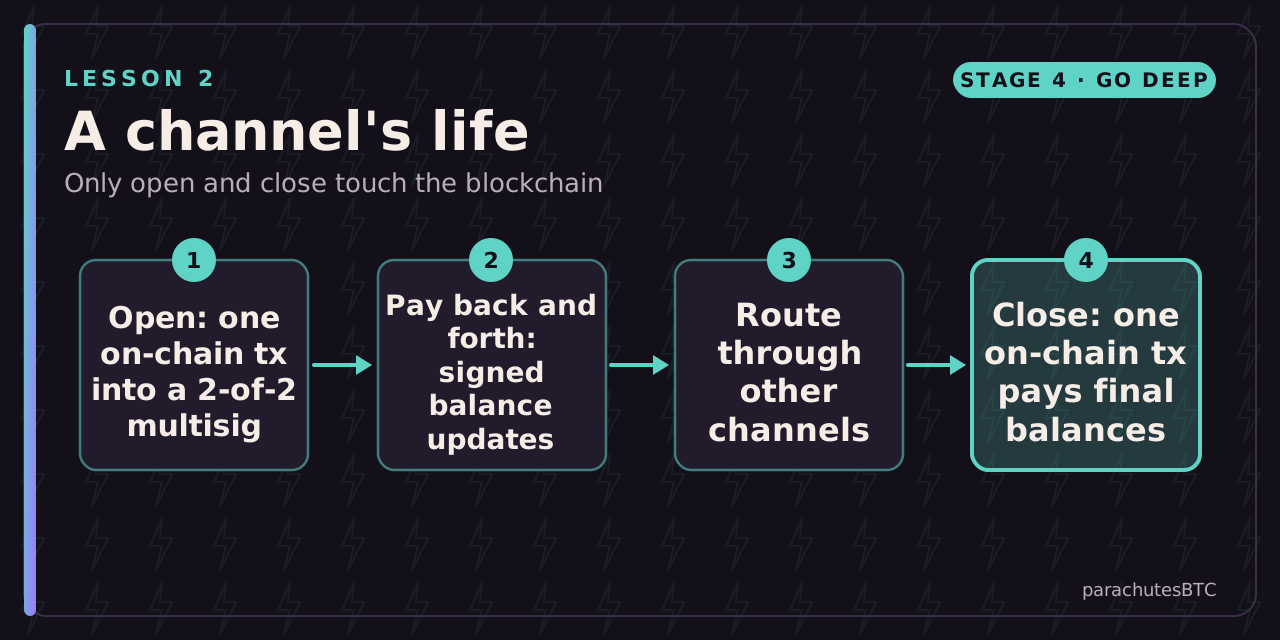
How Lightning works
Two parties lock bitcoin in a shared output and update who owns what by signing new balances. Payments hop across channels using HTLCs, so no hop can steal.
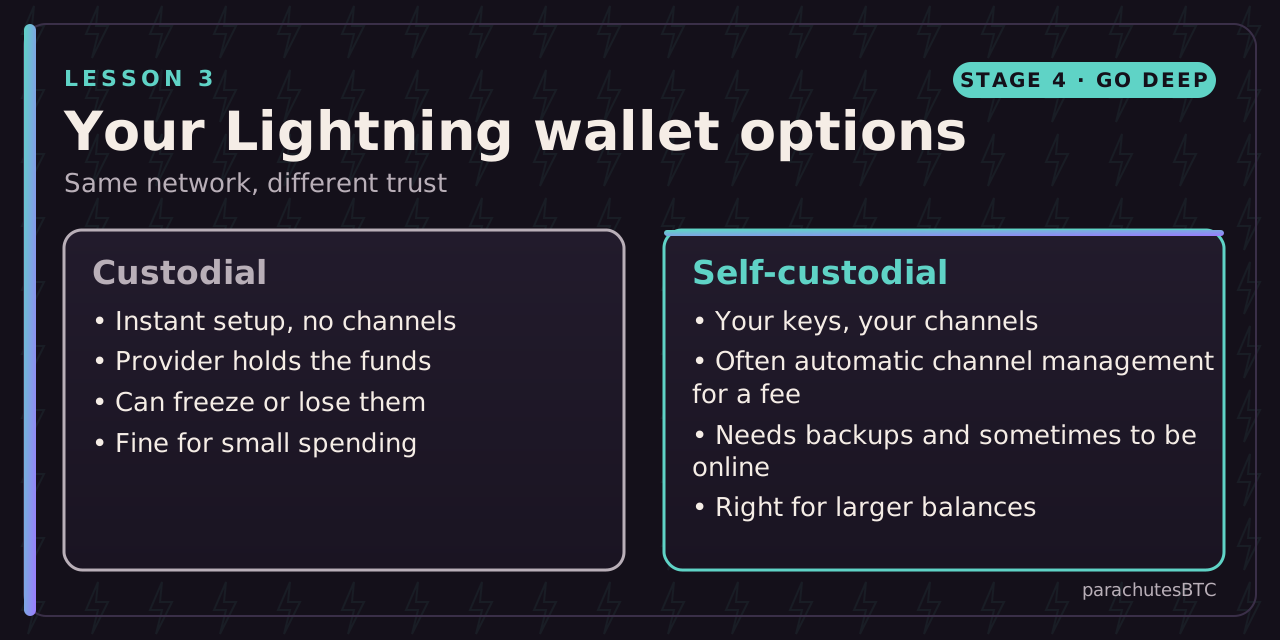
Using Lightning as a person
Custodial Lightning wallets are instant and trusting; self-custodial ones give you keys and channels. Keep spending money on Lightning, savings on-chain.
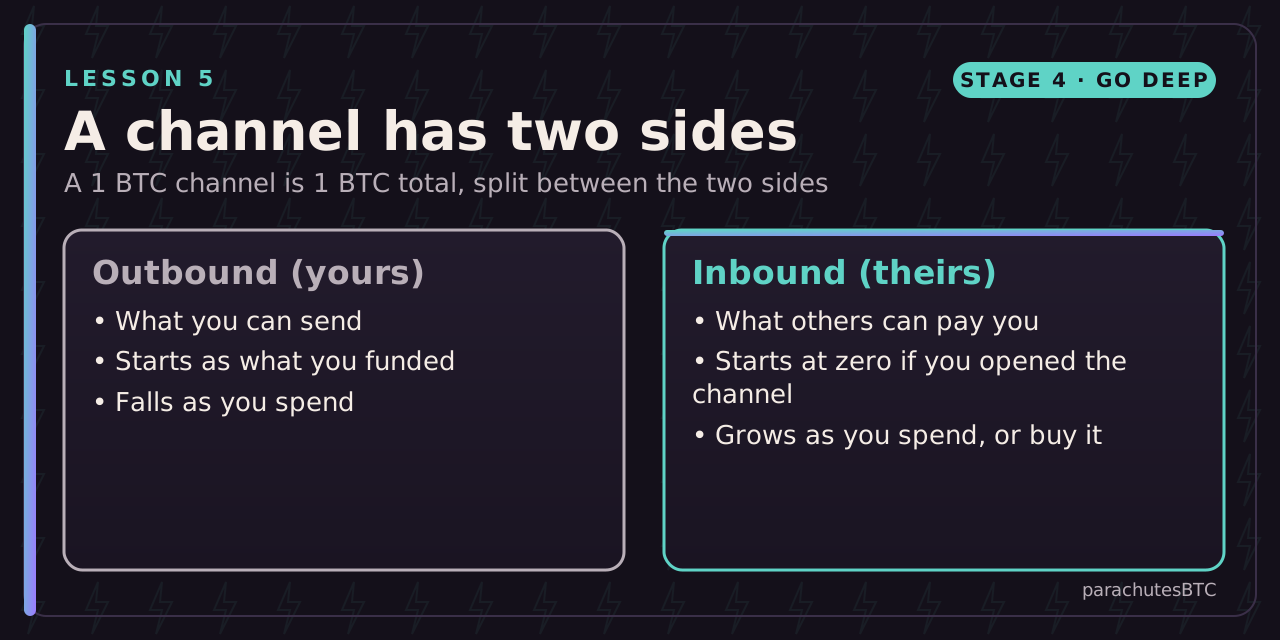
Liquidity: the thing nobody explains
A channel's capacity is shared between the two sides. You can only receive what is on the other side. New users must get inbound liquidity to be paid.
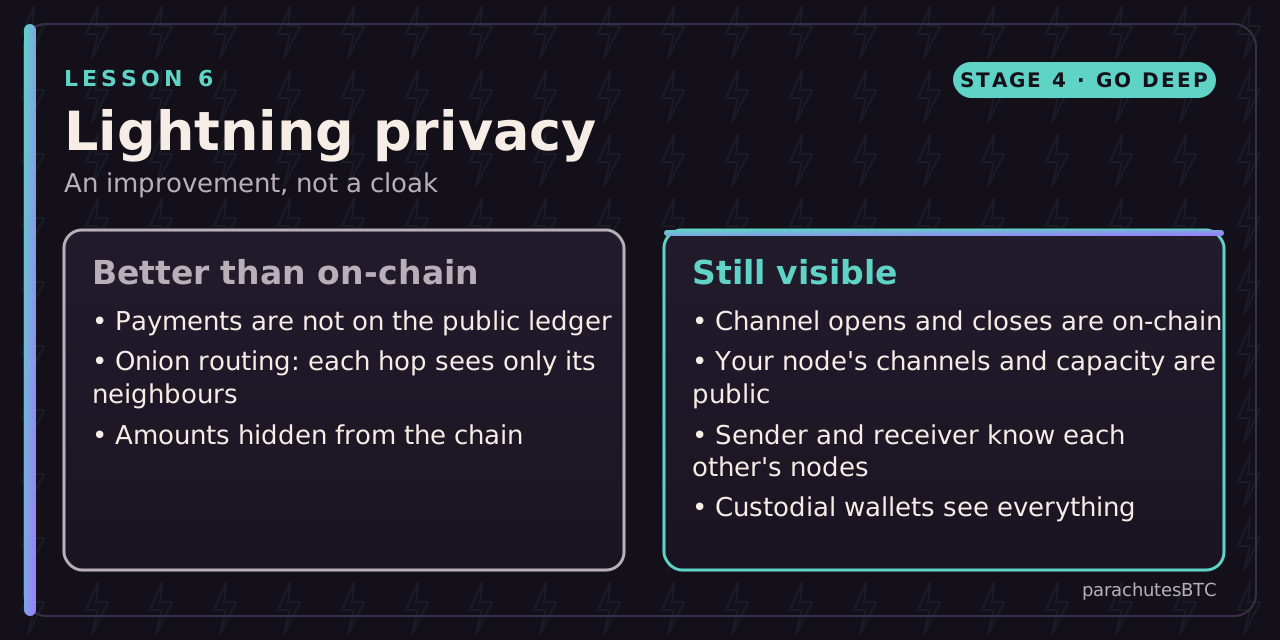
Privacy and honest limits
Lightning payments are off the public ledger and onion-routed, which beats on-chain. Channels are still public, and custodial wallets see everything.
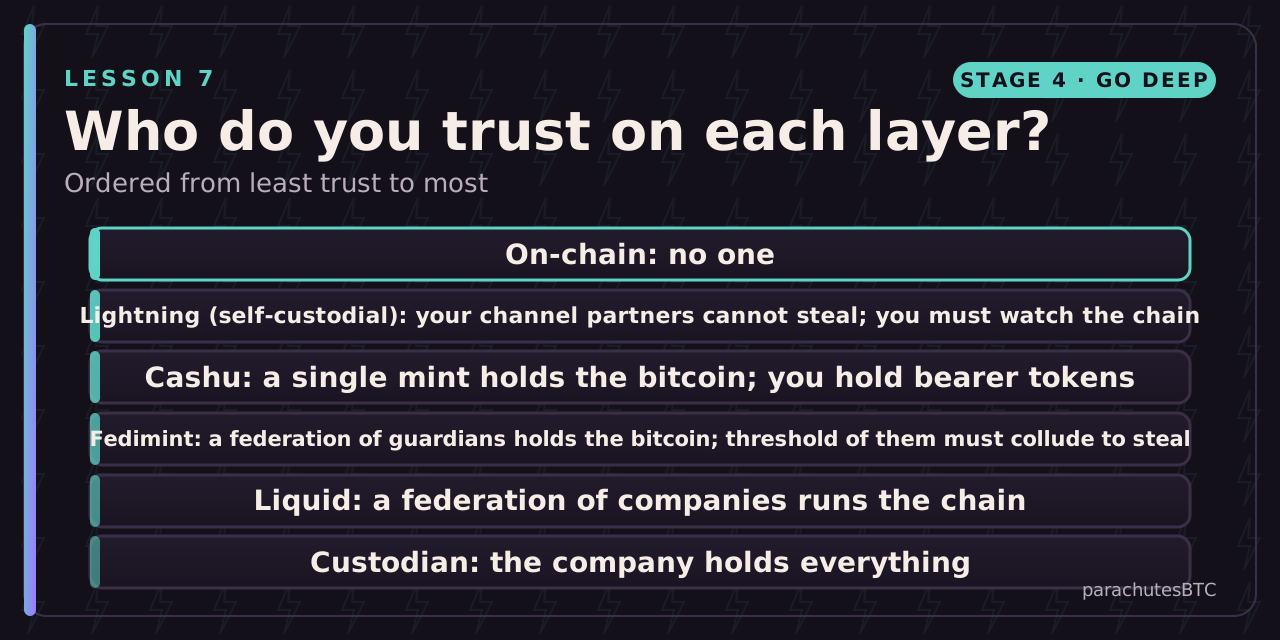
Liquid, Fedimint, Cashu and custodians
Beyond Lightning: Liquid is a federated sidechain, Fedimint a community-run e-cash federation, Cashu single-mint e-cash. Each trades trust for privacy and ease.
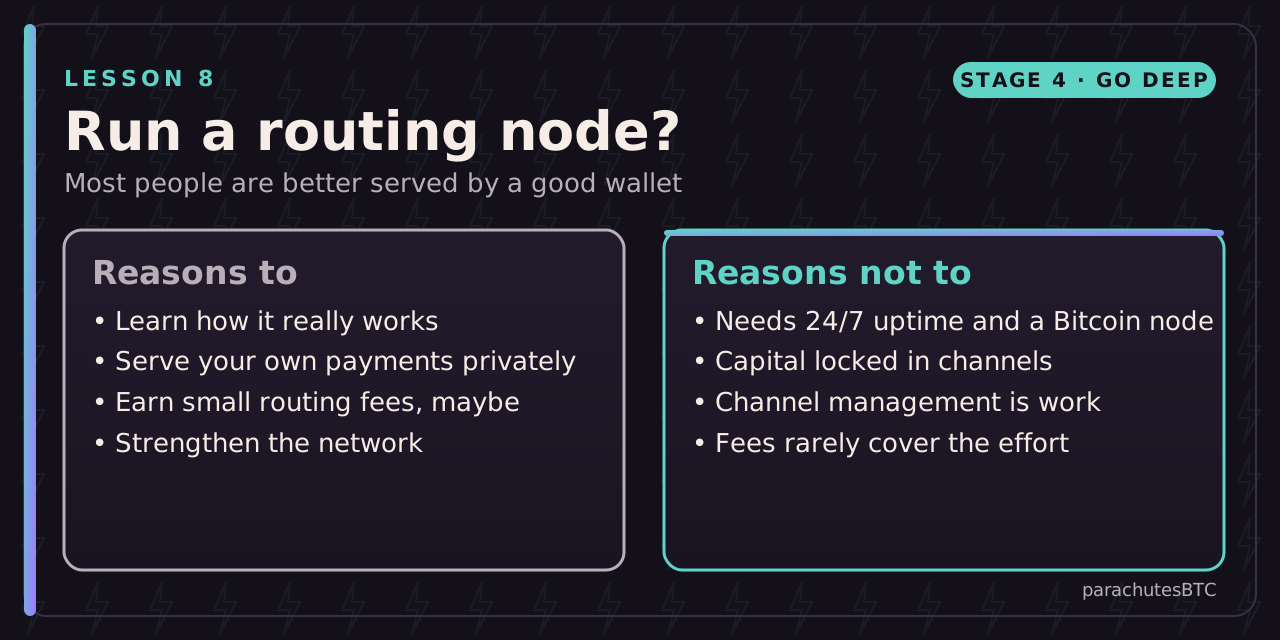
Should you run a Lightning node?
Running a Lightning node teaches you the system and serves your own payments. As a business it rarely pays. Most people should use a good wallet instead.
STAGE 4 · GO DEEPBitcoin mining
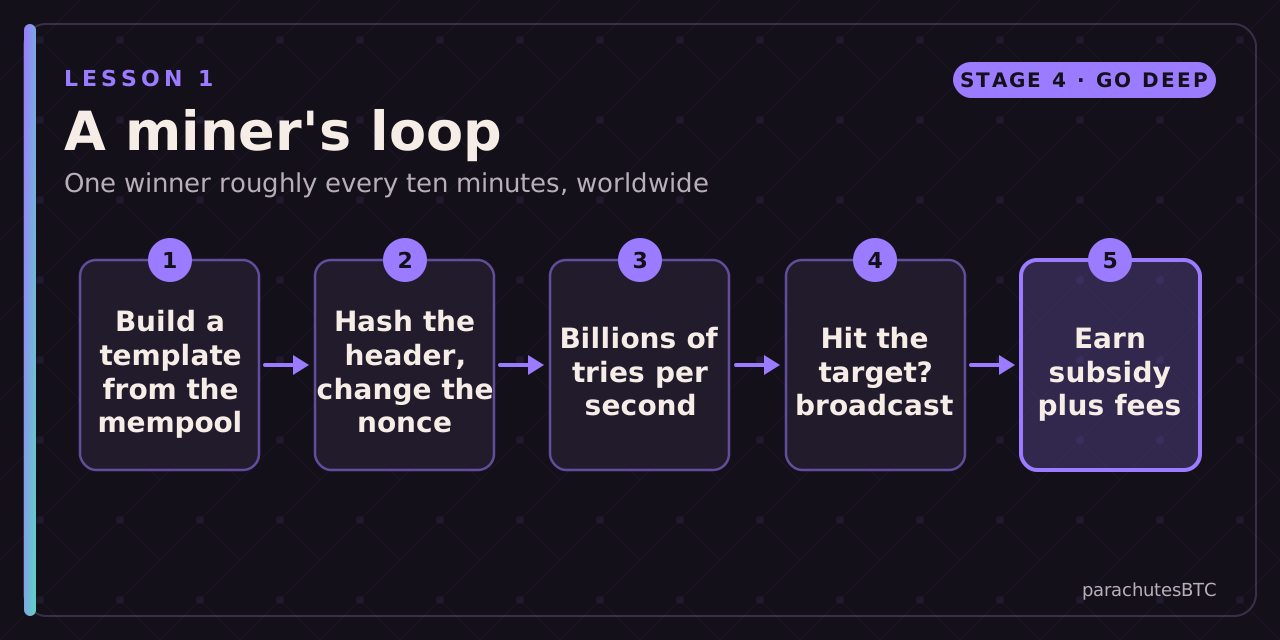
What a miner actually does
A miner assembles a candidate block, hashes its header trillions of times per second with different nonces, and broadcasts when one hash is below the target.
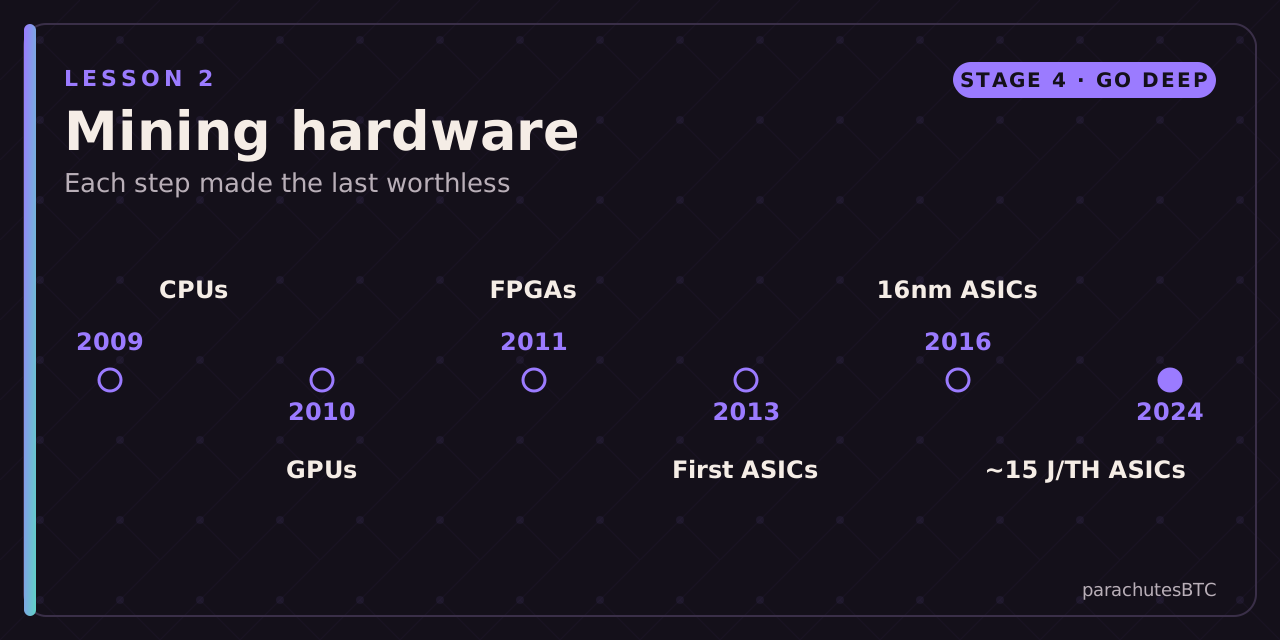
From CPUs to ASICs
Mining moved from CPUs to GPUs to ASICs, chips that only compute SHA-256. Efficiency in joules per terahash decides who survives.
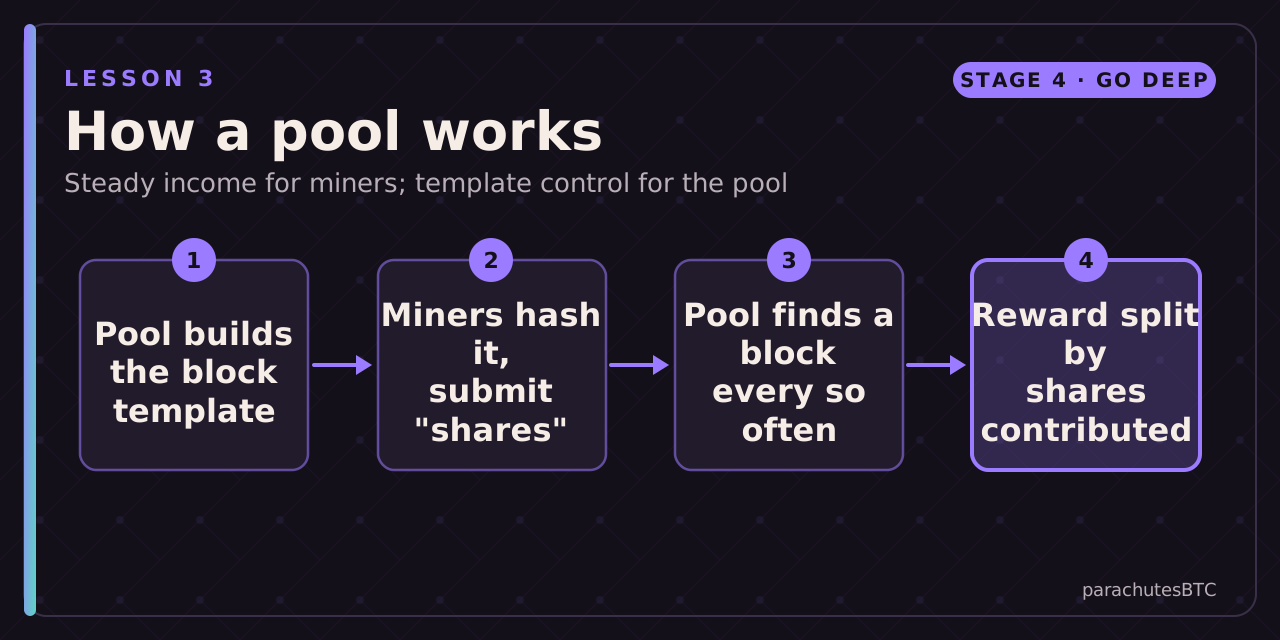
Mining pools and Stratum V2
Pools combine hash power so miners get steady income. The pool chooses the transactions, which concentrates power; Stratum V2 hands that choice back to miners.
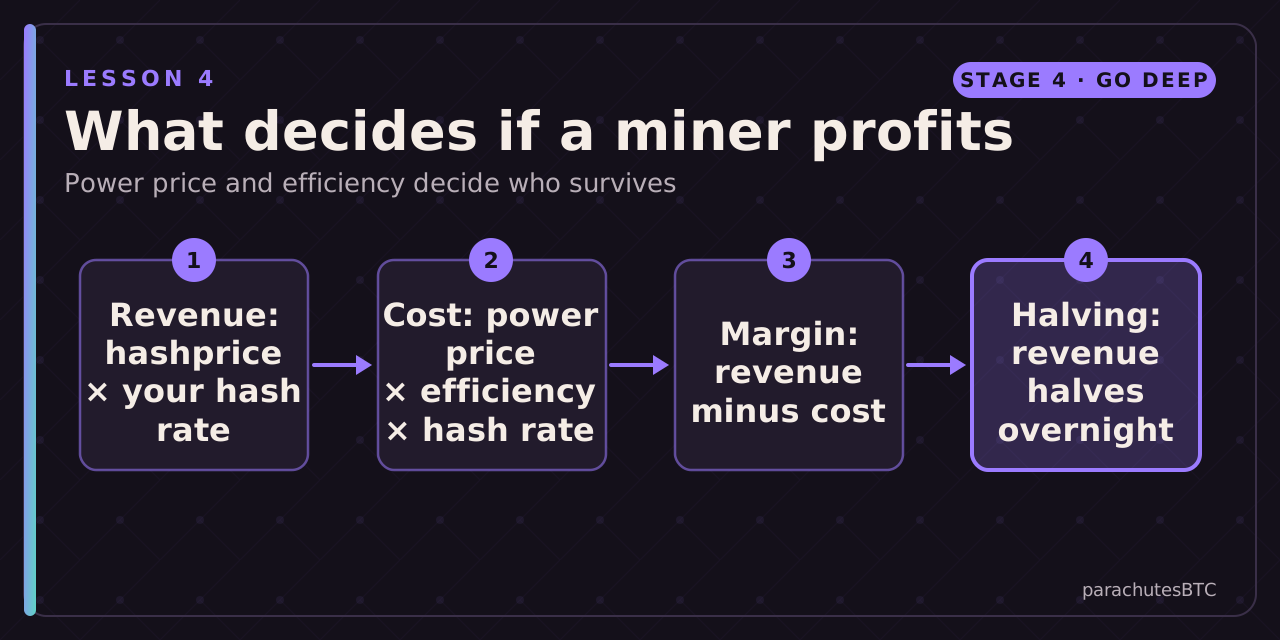
The economics: hashprice and halvings
Hashprice (dollars per terahash per day) times your hash rate is revenue; power price times efficiency is cost. Halvings cut revenue in half; survivors are the efficient.
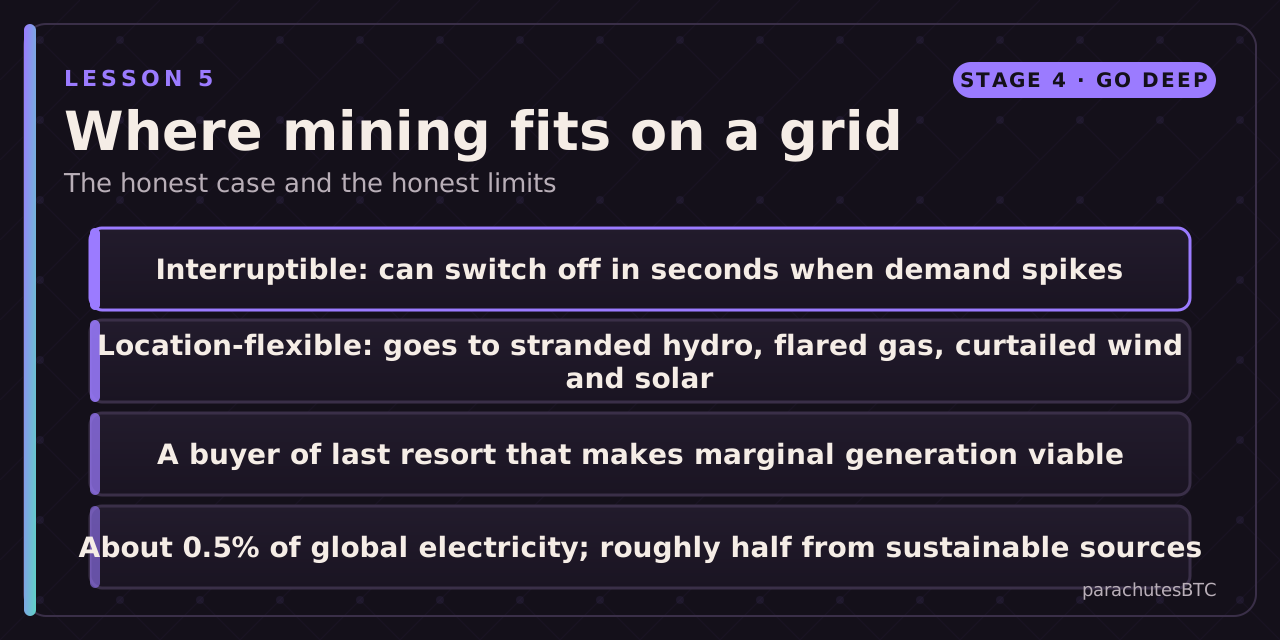
The energy debate, in depth
Mining is a flexible, location-agnostic electricity buyer, which lets it use stranded and surplus power and stabilise grids. It also uses real energy, and the trade is a judgment.
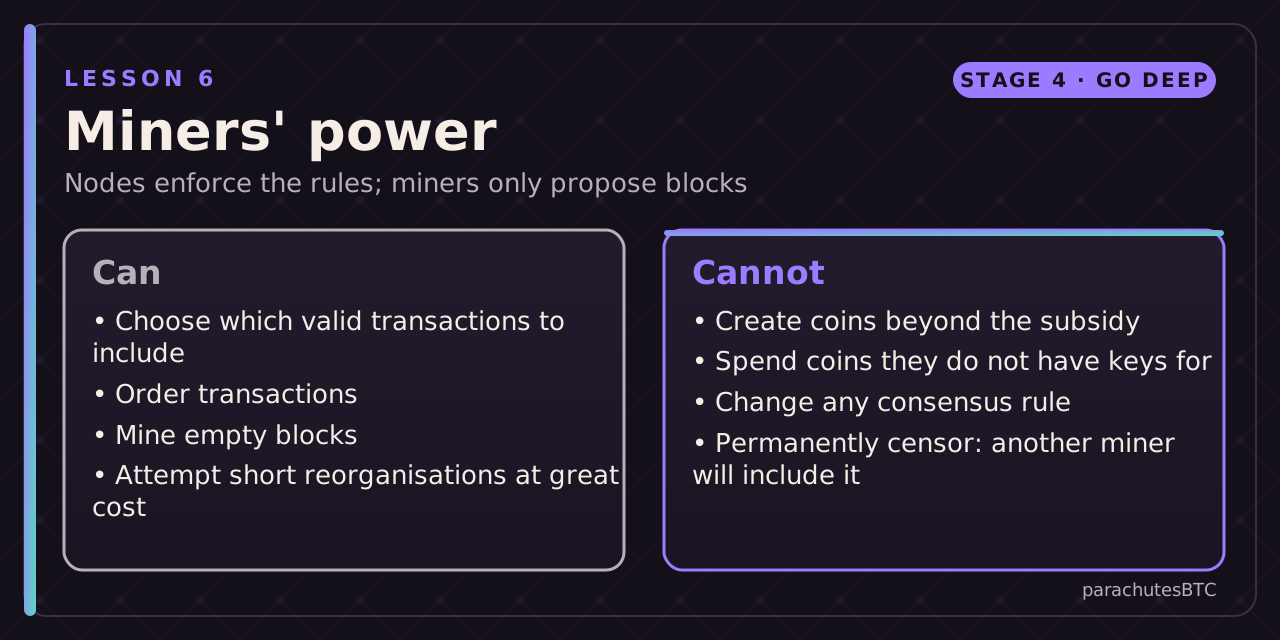
What miners can and cannot do
Miners order transactions and can briefly censor or reorganise at great cost. They cannot print coins, spend others' coins or change the rules. 2017 proved it.
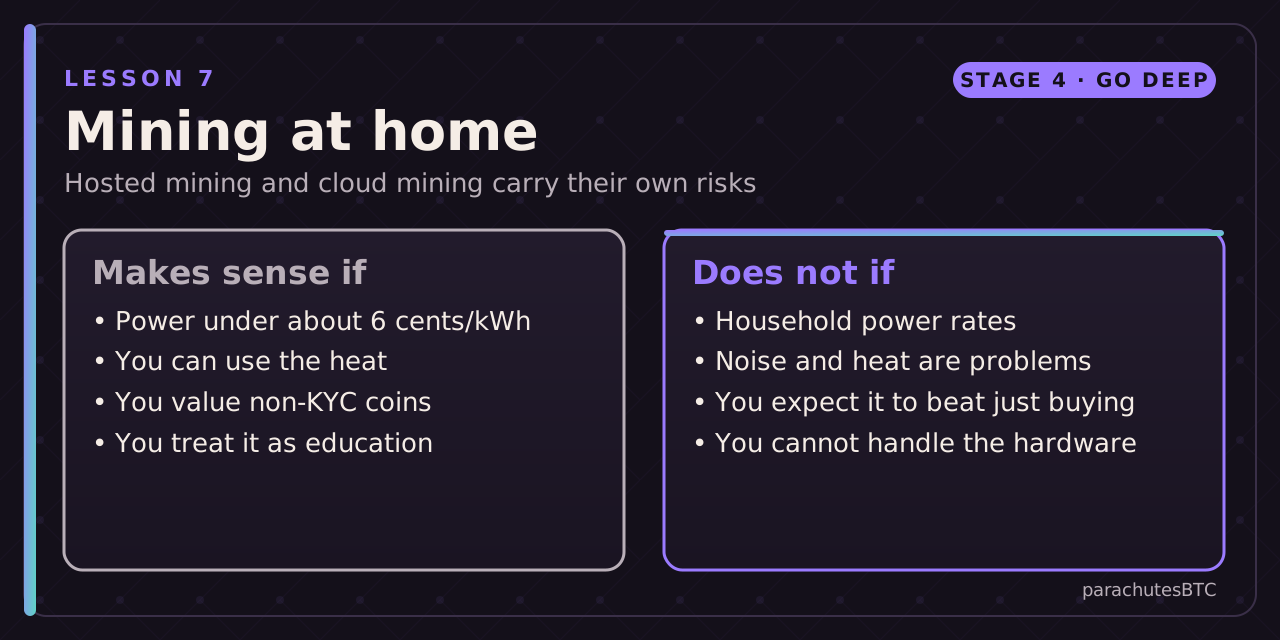
Should you mine at home?
At household power rates, home mining loses money against simply buying. It makes sense with cheap power, useful heat, a desire for non-KYC coins, or as education.
STAGE 5 · MASTERKeys, addresses and Script
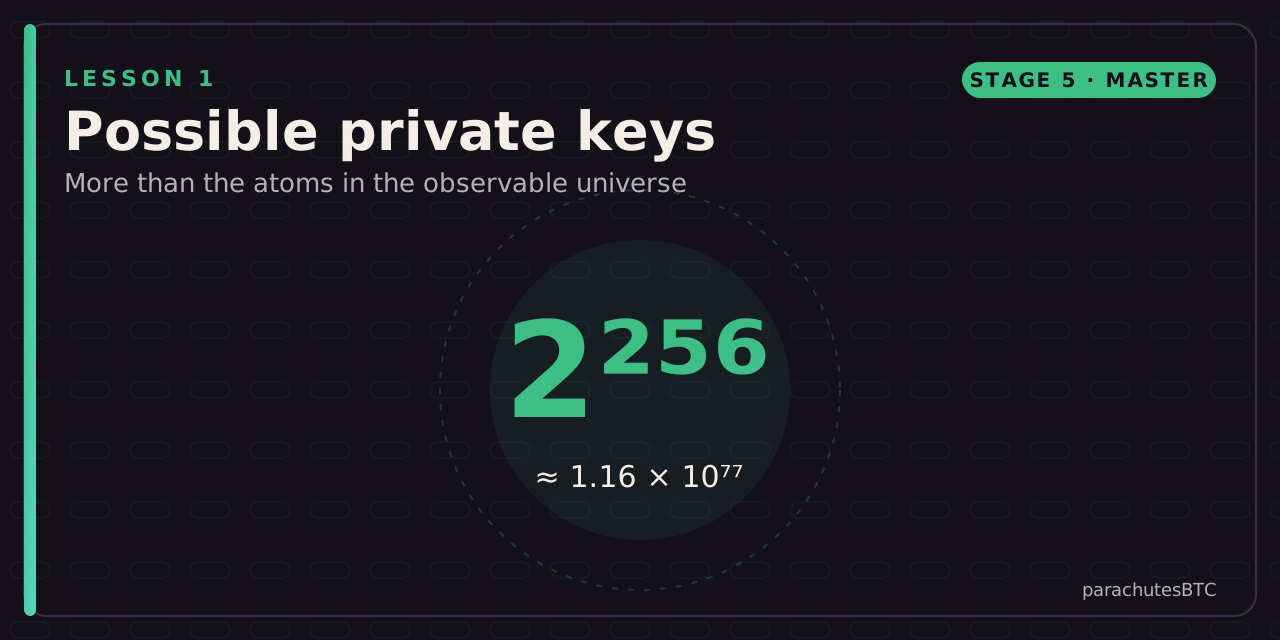
Private keys: 256 bits of randomness
A private key is a random number between 1 and about 1.16 × 10⁷⁷. Its security rests entirely on the randomness that made it.
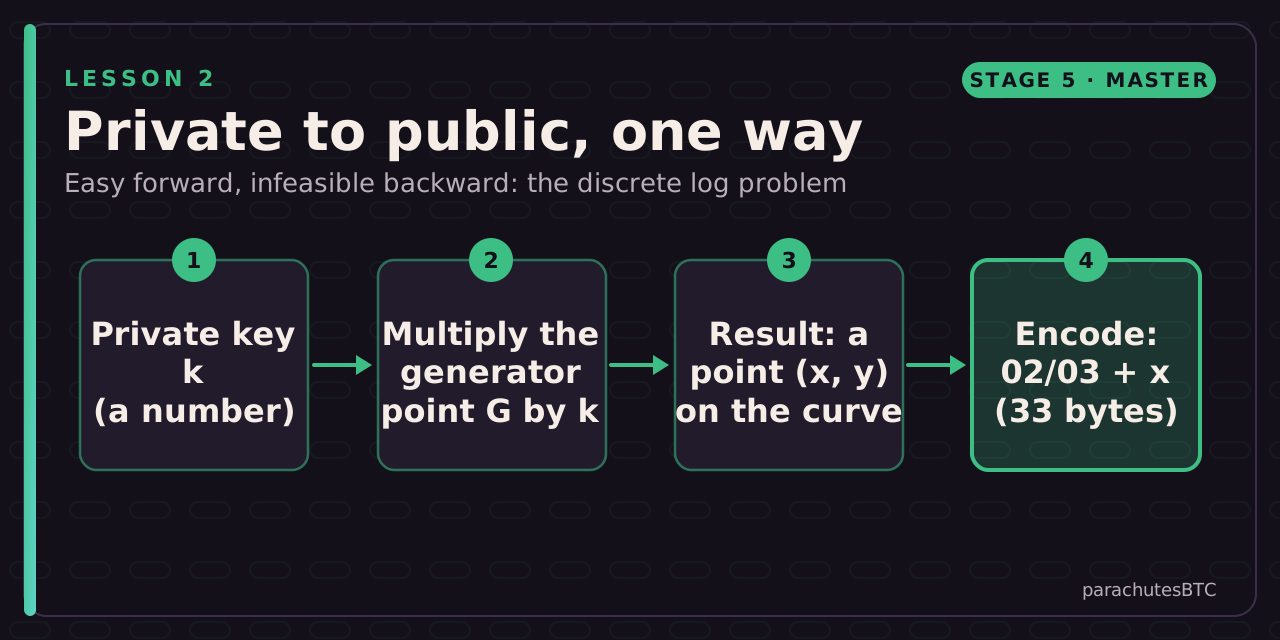
Public keys and the curve
A public key is the generator point of the secp256k1 curve multiplied by the private key. Easy to compute, infeasible to reverse, and 33 bytes when compressed.
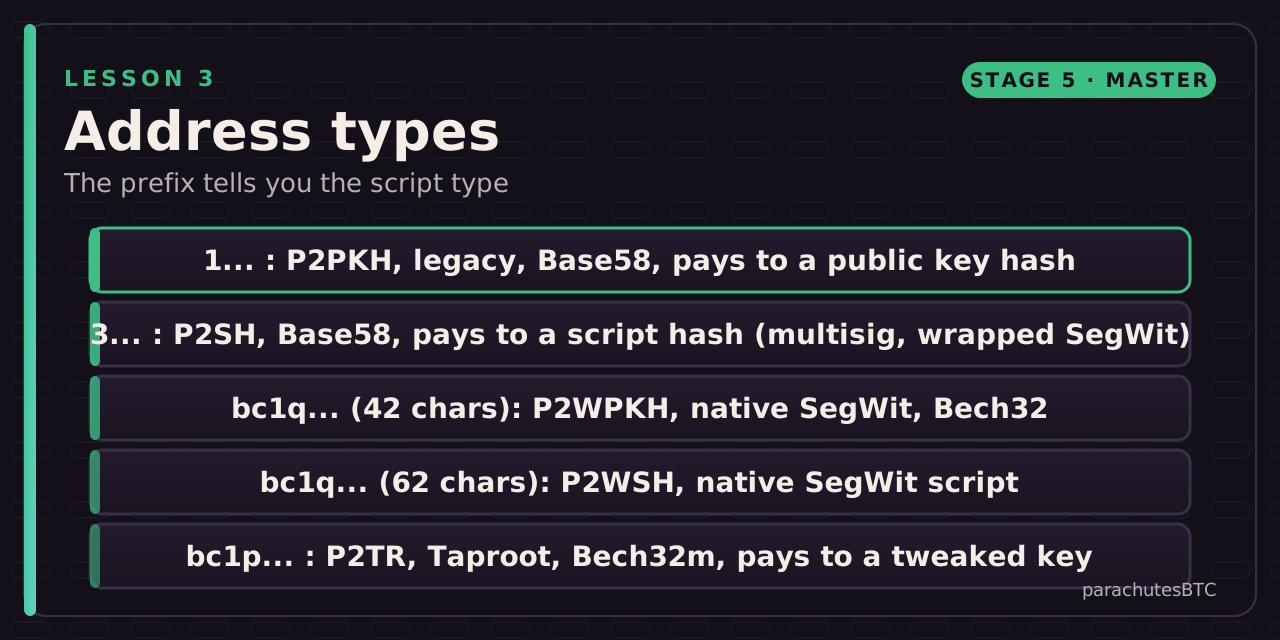
Addresses: every format explained
An address is an encoding of a script template plus a hash or key. The prefix tells you which: 1 for P2PKH, 3 for P2SH, bc1q for SegWit, bc1p for Taproot.
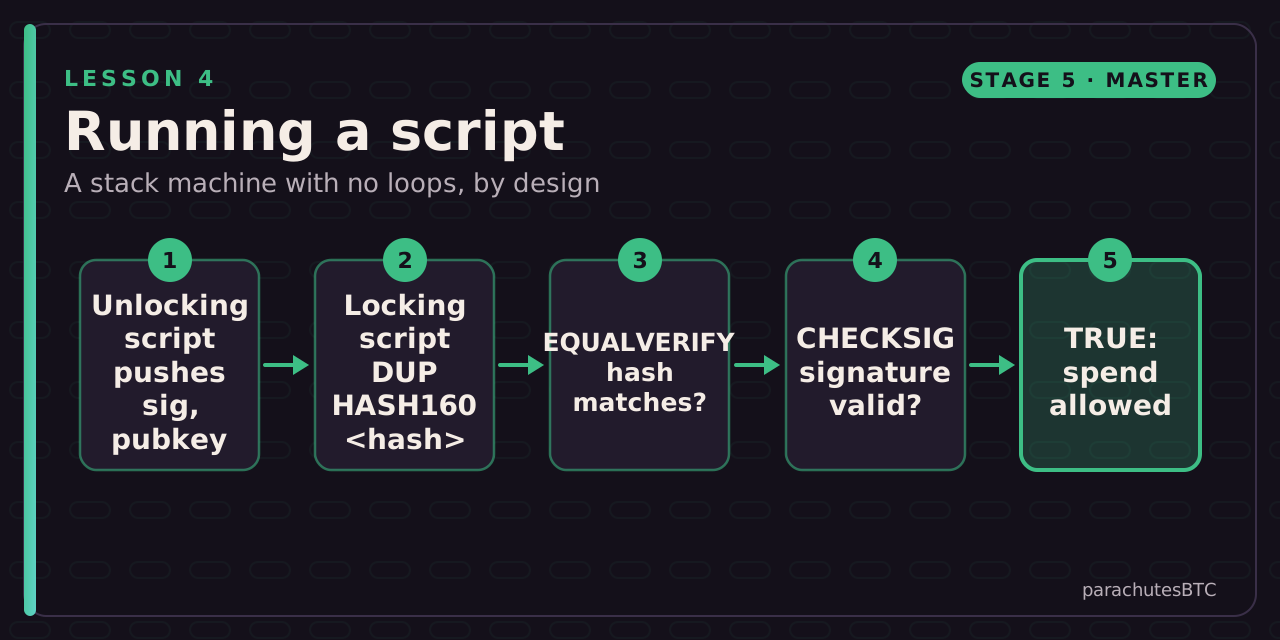
Bitcoin Script: locks and keys
Every output carries a locking script; every input provides an unlocking script. Nodes run them on a stack machine. Script has no loops, which keeps it predictable.
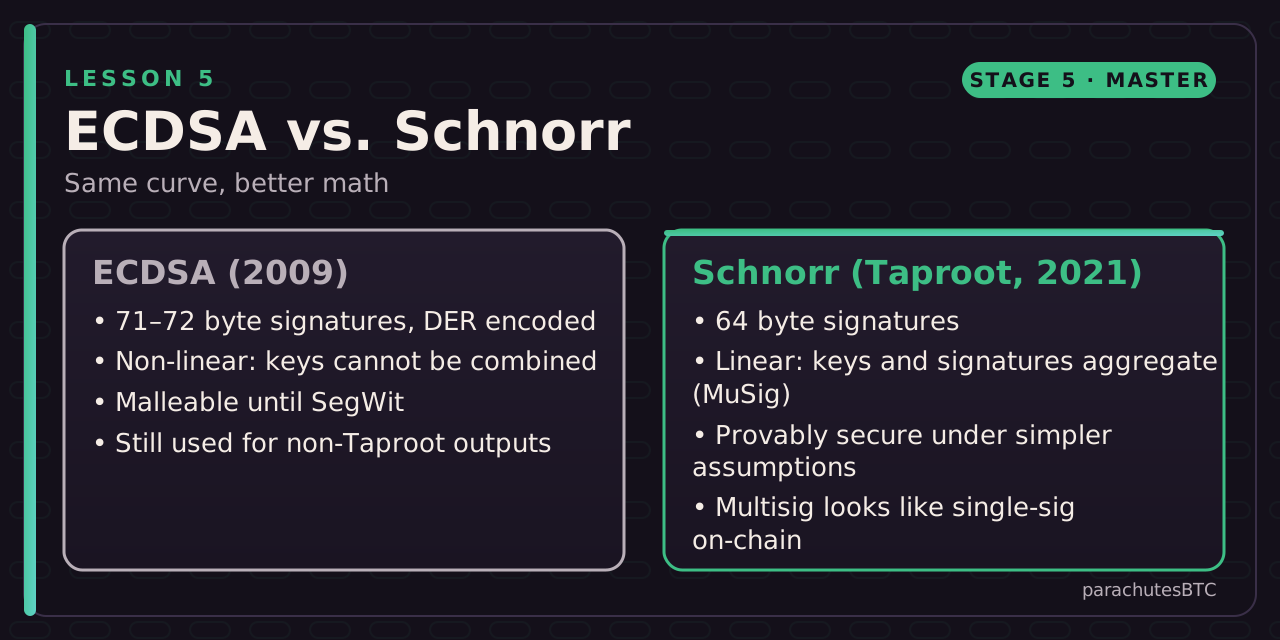
Signatures: ECDSA and Schnorr
A signature proves knowledge of a private key for one exact message. ECDSA was Bitcoin's original scheme; Schnorr, added with Taproot, is smaller and lets keys combine.
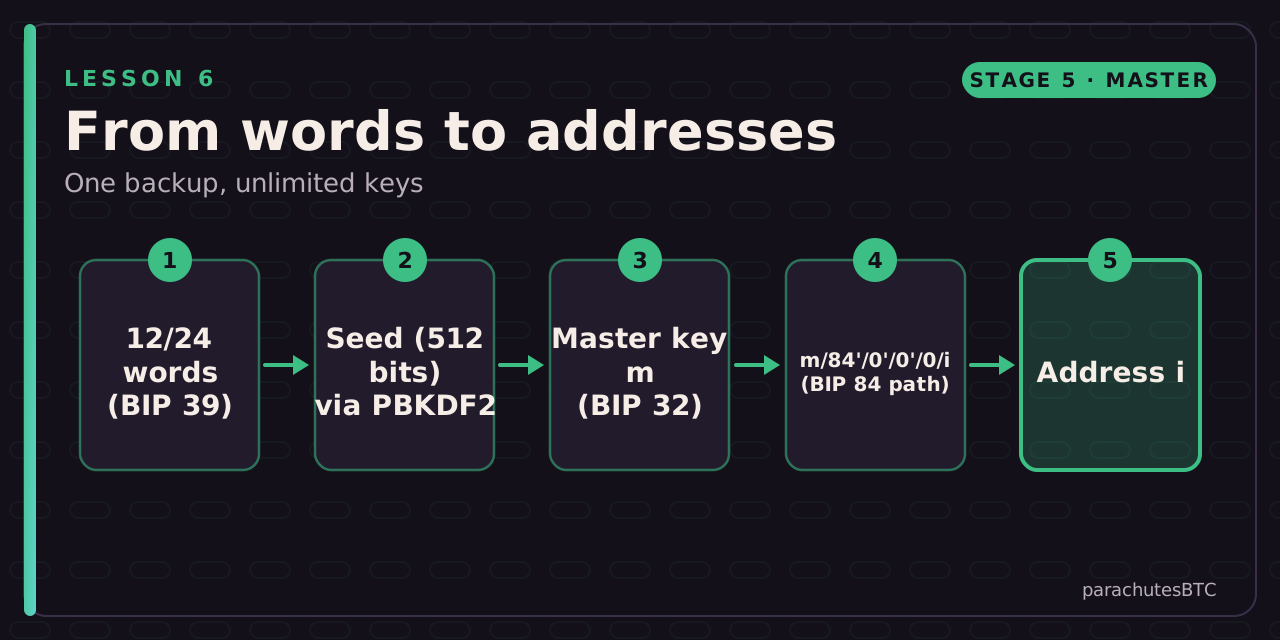
HD wallets, seeds and derivation paths
A seed phrase becomes a master key that derives a tree of keys. The derivation path says where in the tree; without the right path, the right words find an empty wallet.
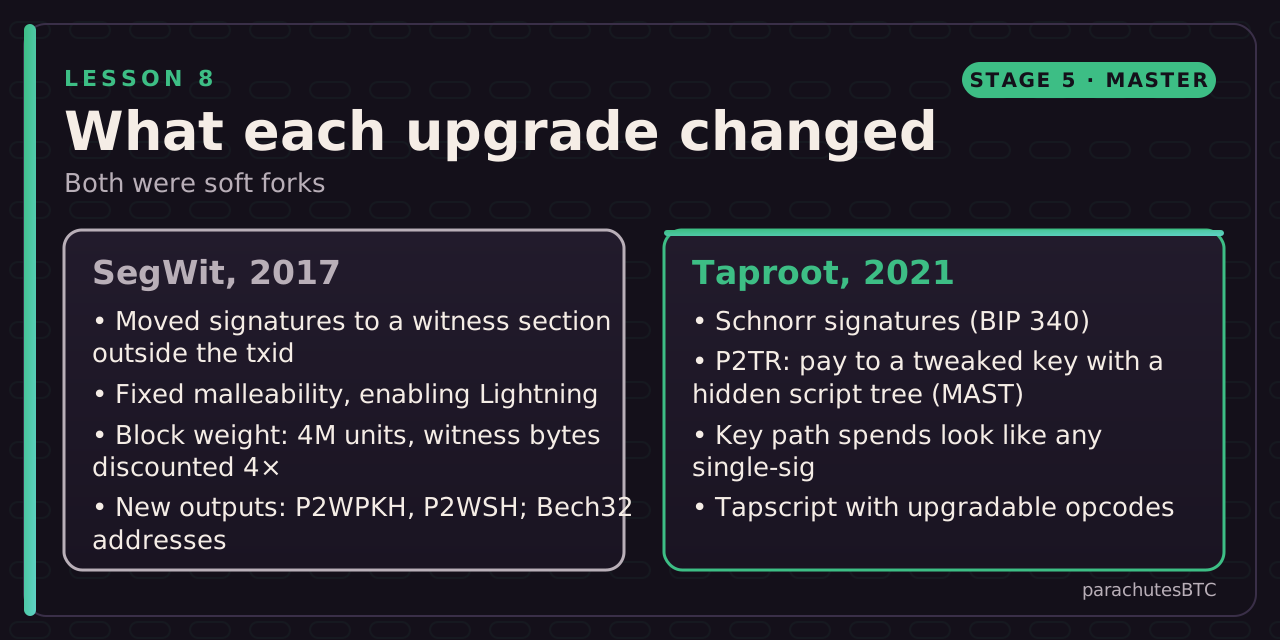
SegWit and Taproot under the hood
SegWit separated signatures from the transaction ID and introduced block weight. Taproot added Schnorr and lets complex spending conditions hide behind a single key.
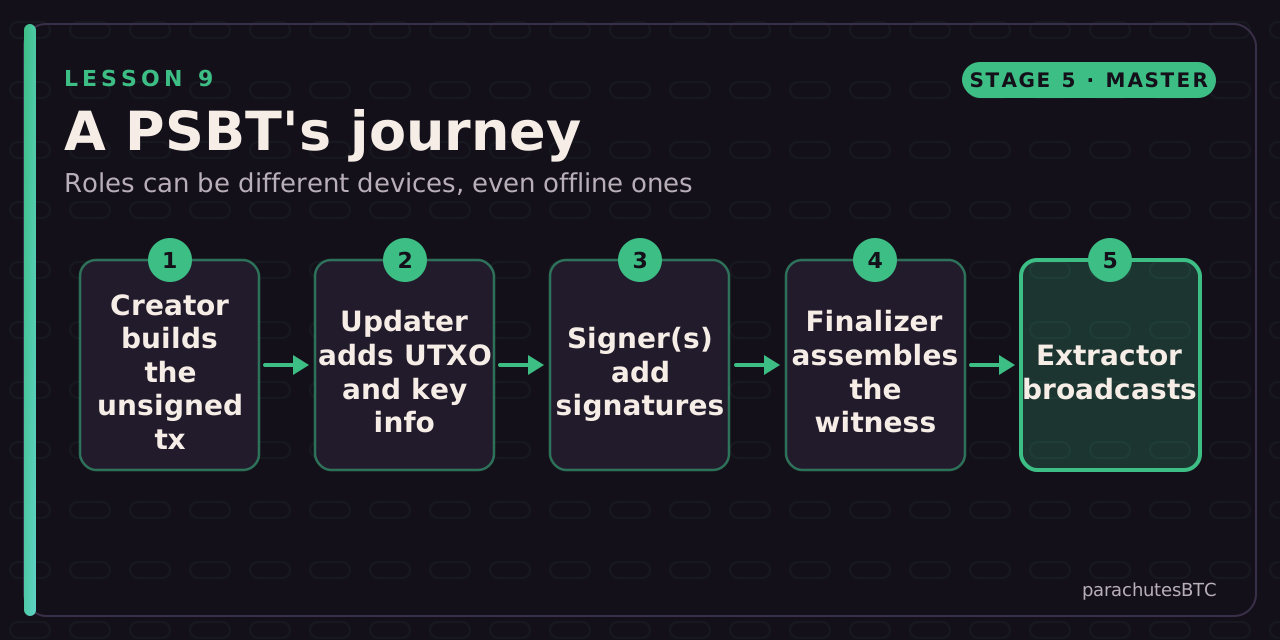
PSBTs and air-gapped signing
A PSBT is a standard container for a transaction that is not fully signed yet. It lets hardware wallets, air-gapped devices and multisig co-signers each do their part.
STAGE 5 · MASTERRunning a node
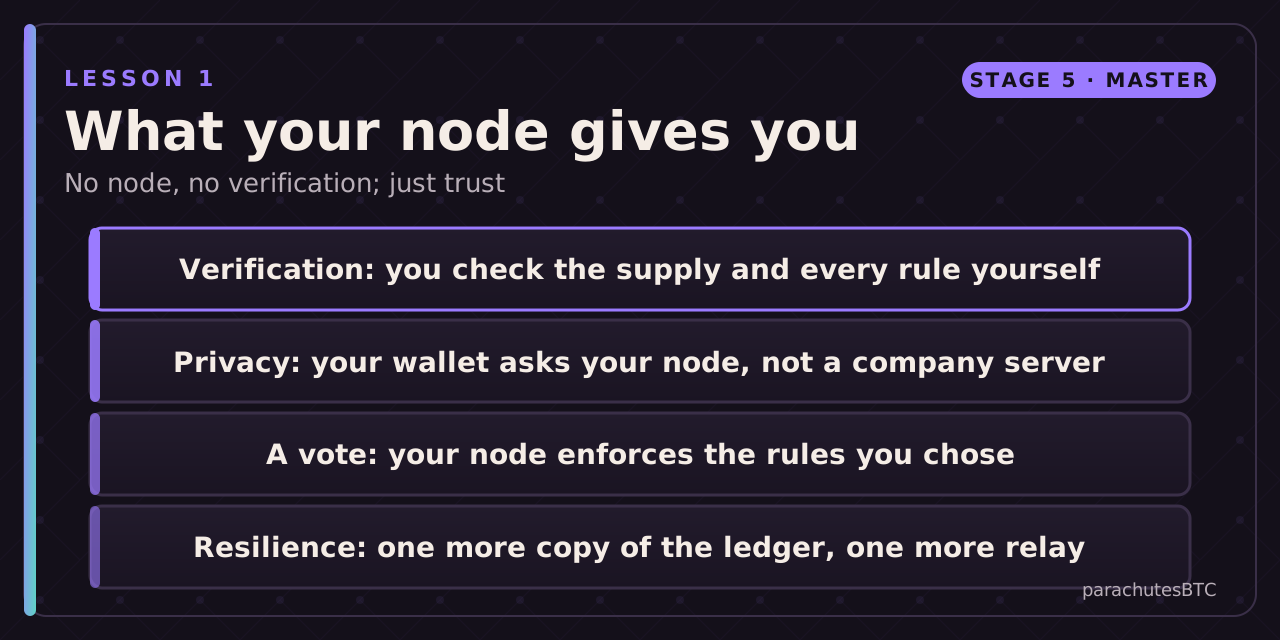
Why run a node
A node checks every rule, including the 21 million cap, for you. Without one you trust someone else's node. It also protects your privacy and gives you a say.
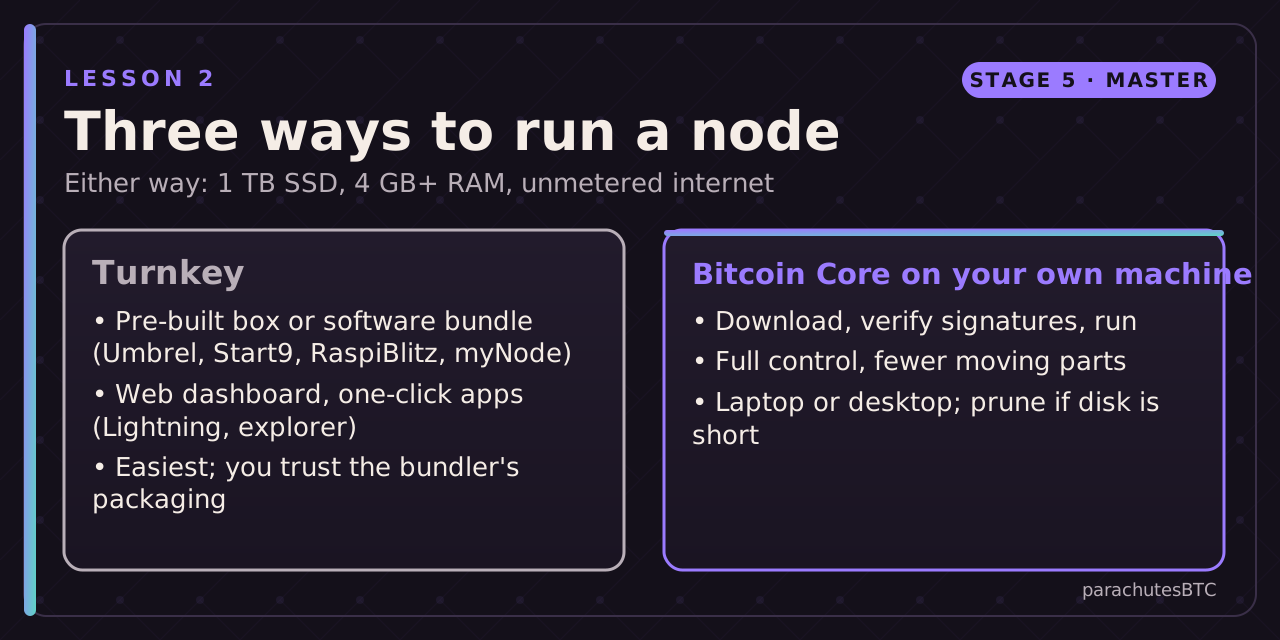
Hardware and setup paths
A node needs about a terabyte of SSD, a few gigabytes of RAM and patience. Turnkey bundles give a dashboard; Bitcoin Core on your own machine gives control.
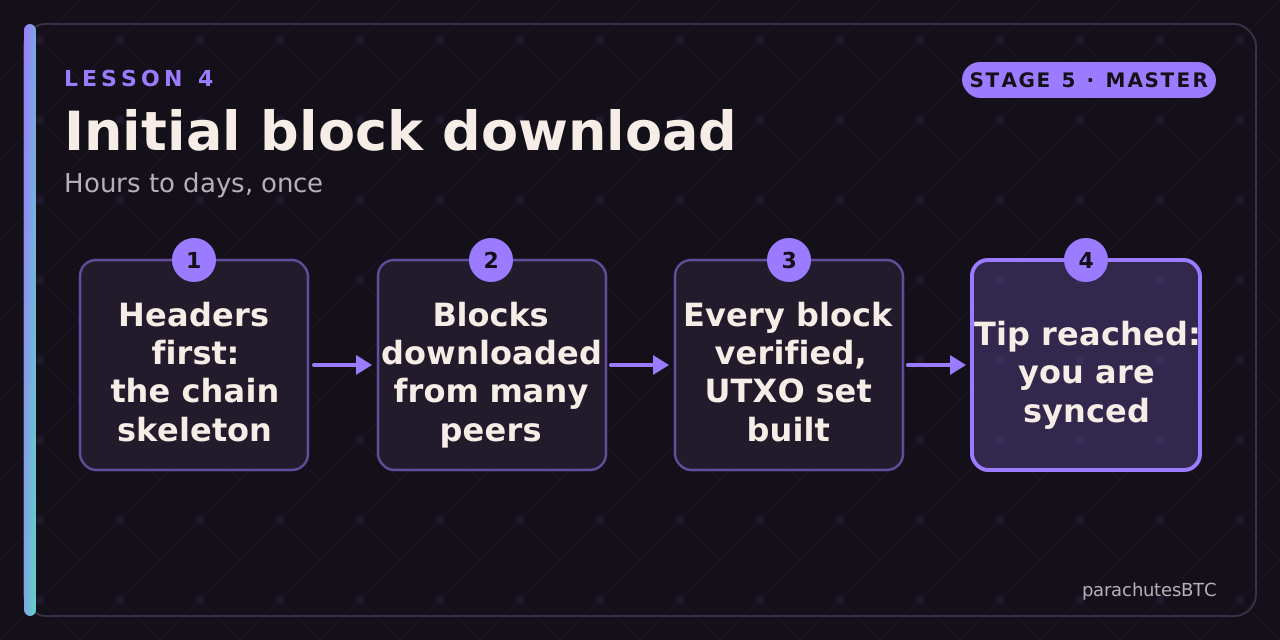
The initial block download
The first sync downloads and verifies seventeen years of blocks. It takes hours to days, and when it finishes your node has independently rebuilt the entire state of Bitcoin.
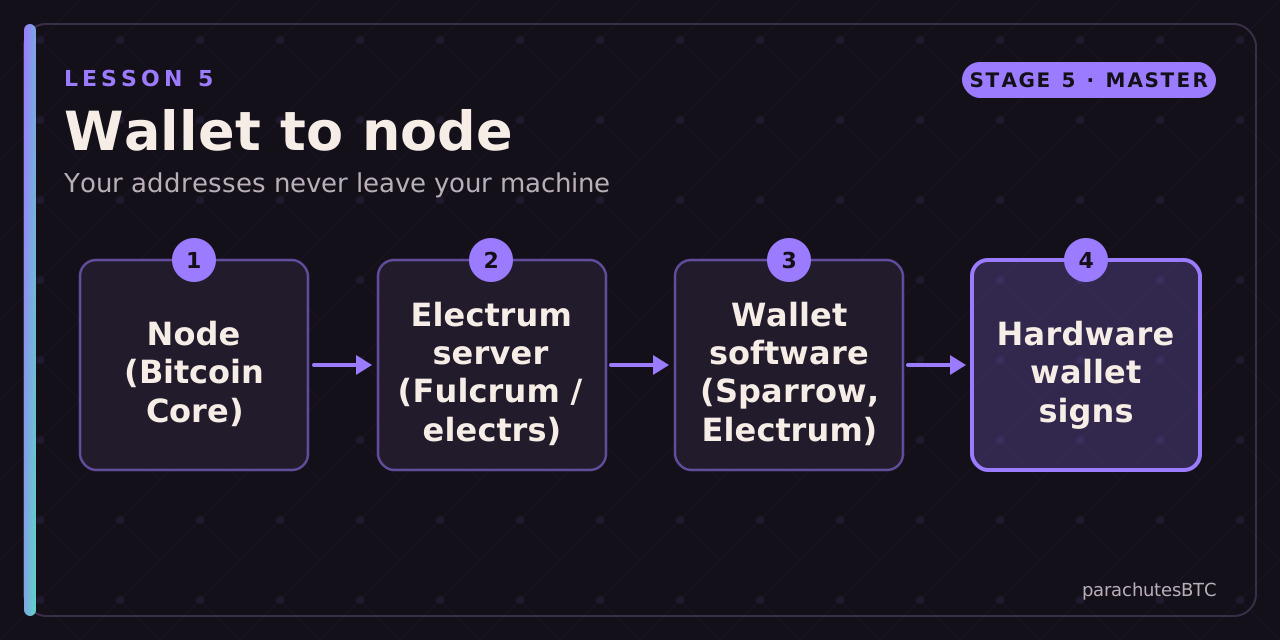
Connecting your wallet to your node
Most wallets talk to an Electrum-style server. Run one against your node and point your wallet at it; your addresses then never leave your house.
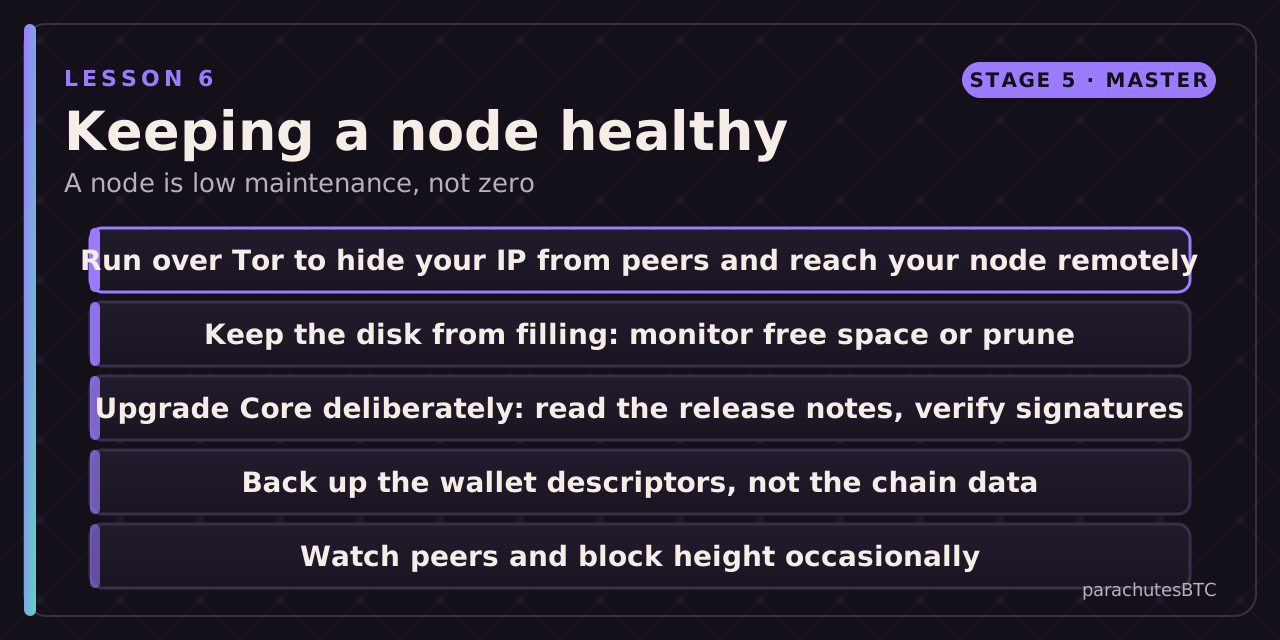
Tor, uptime and upkeep
Run over Tor for privacy and remote access, watch disk space, upgrade on purpose after reading the notes, and back up descriptors rather than chain data.
STAGE 5 · MASTERUpgrades and governance
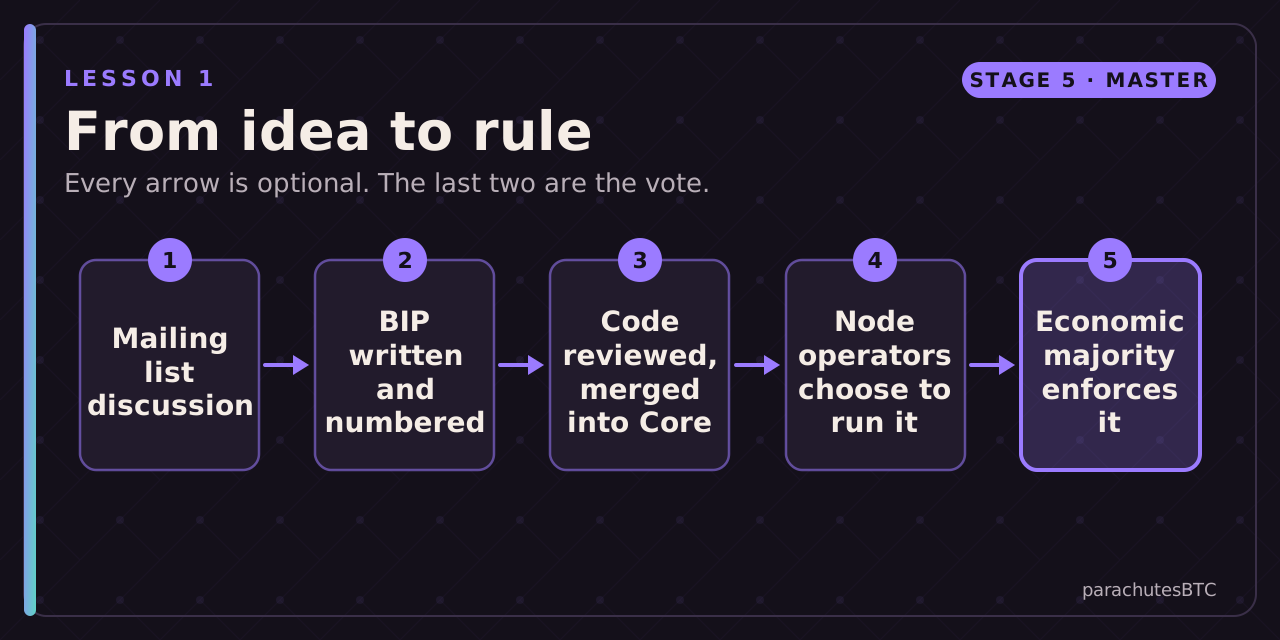
How changes happen: BIPs and the people
Changes are proposed publicly as BIPs, reviewed, coded and released. They become rules only when node operators run them. Developers write; users decide.
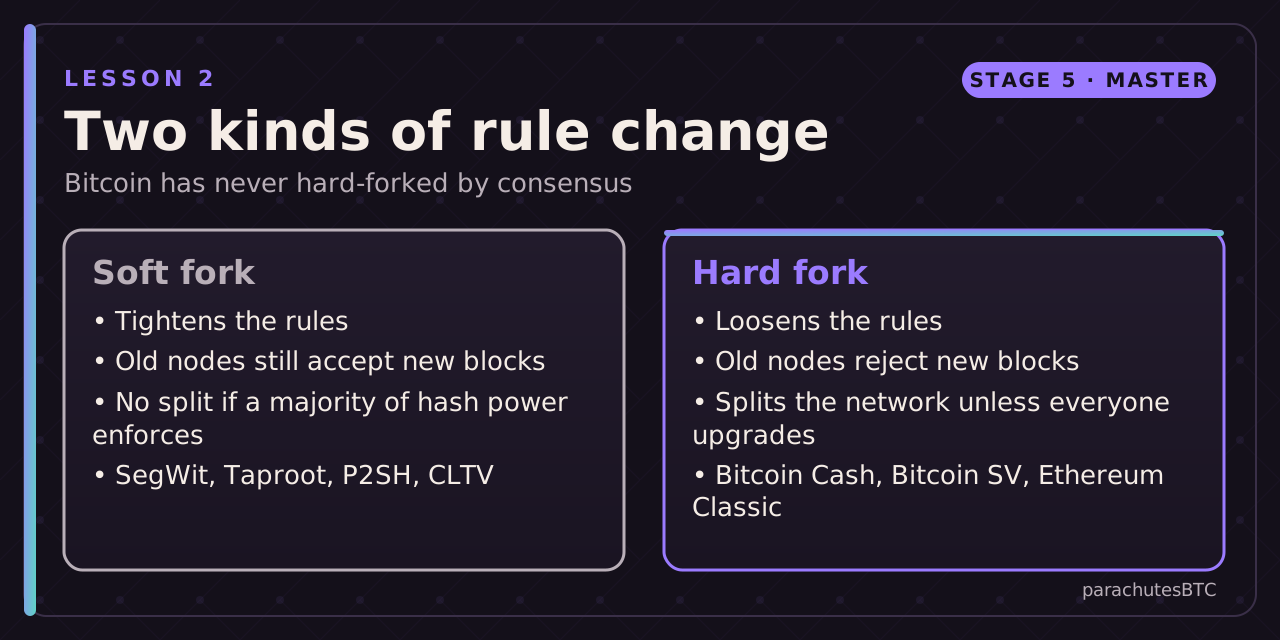
Soft forks, hard forks and activation
Soft forks make rules stricter and stay compatible; hard forks loosen them and split anyone who does not upgrade. Activation methods decide when and who enforces.
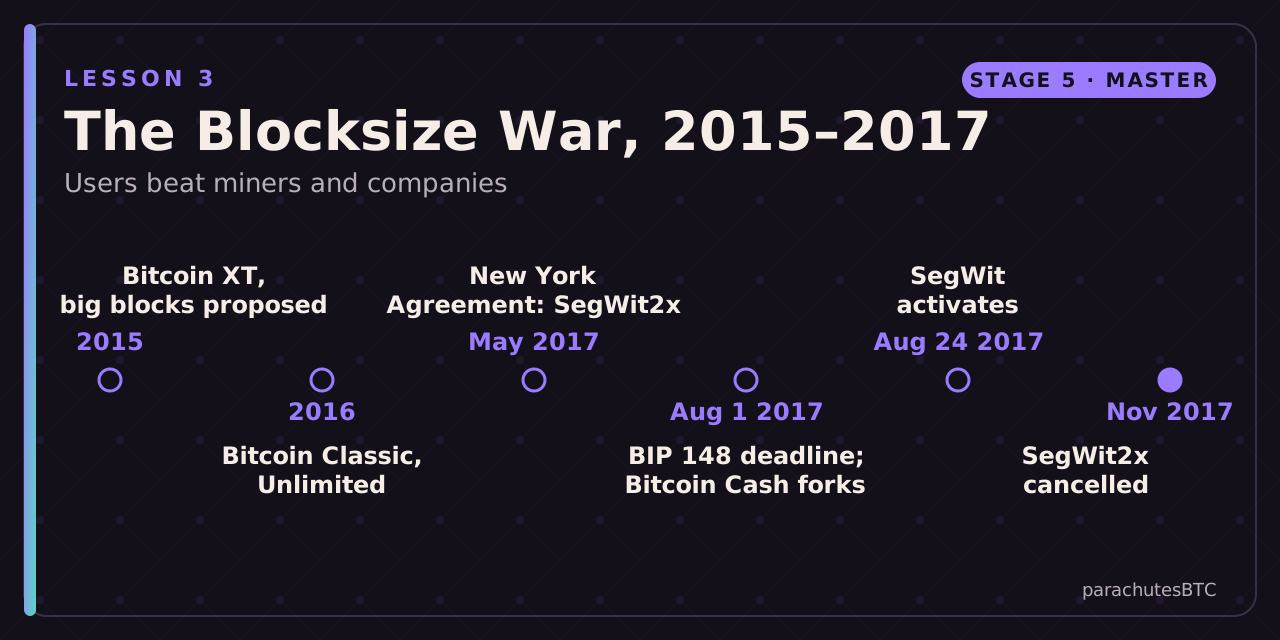
The Blocksize War
From 2015 to 2017 big-block proposals backed by most miners and businesses tried to change Bitcoin. Node operators refused, enforced SegWit themselves, and won. It defined who rules.
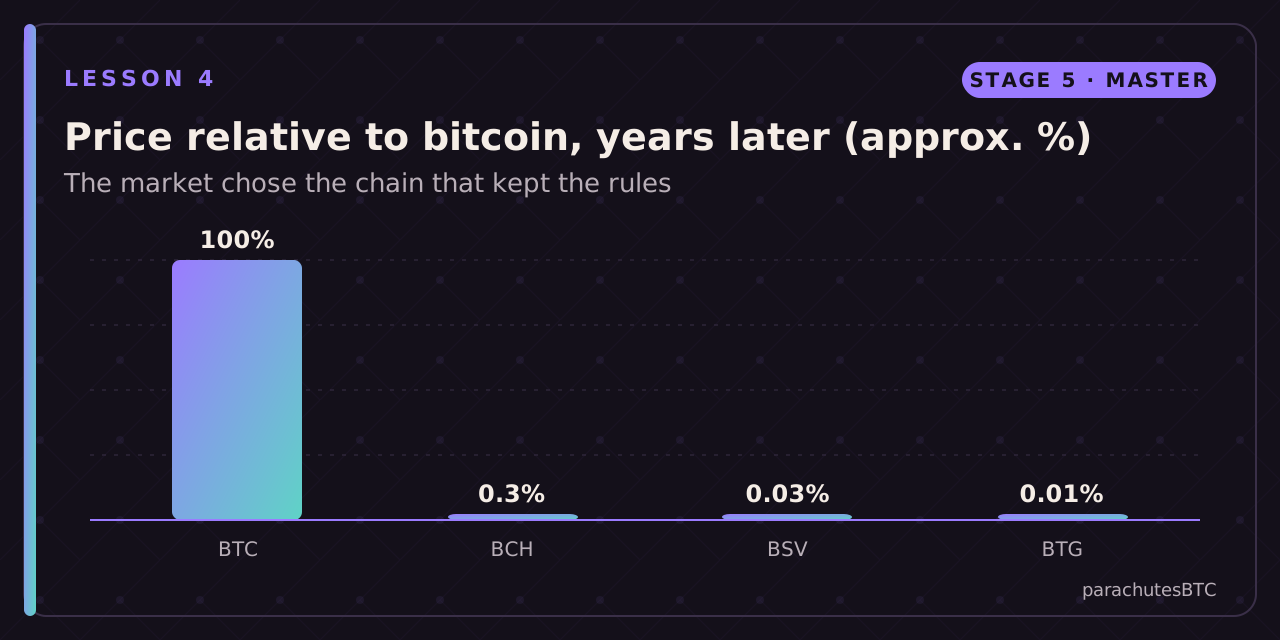
Forks that became altcoins
Bitcoin Cash, Bitcoin SV, Bitcoin Gold and others forked the chain with changed rules. Each kept Bitcoin's history and lost its network. The market chose the original.
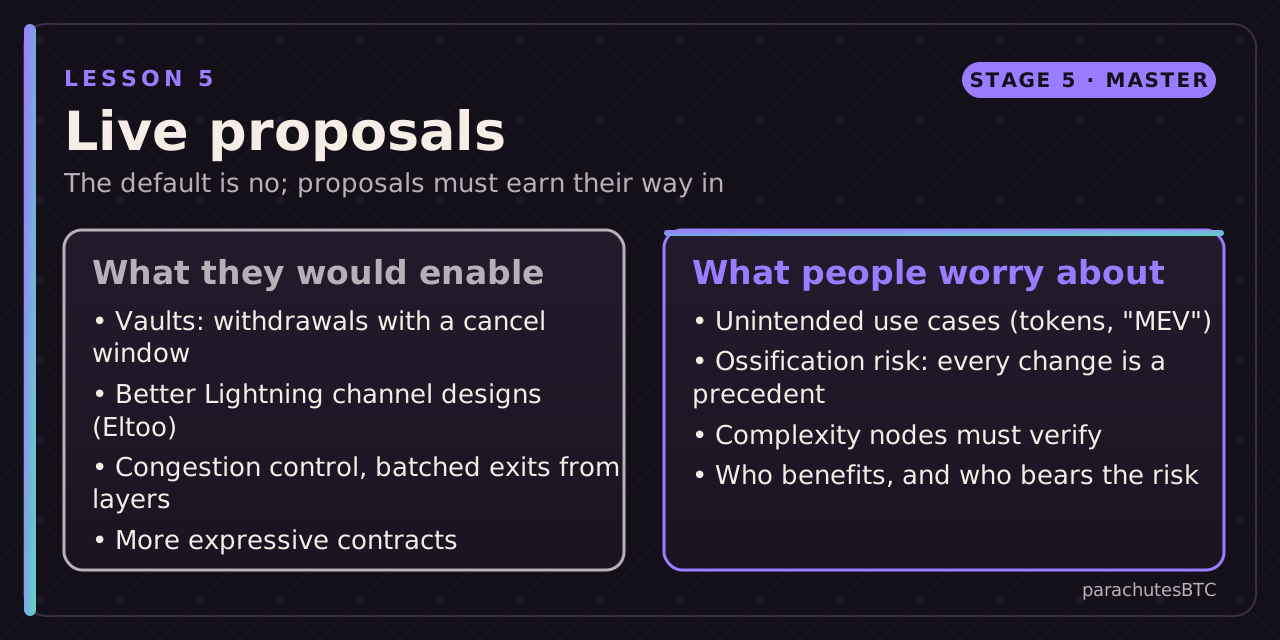
Current debates: covenants, OP_CAT, inscriptions
Covenant proposals (CTV, OP_CAT and others) would let coins restrict their own future spending. Inscriptions and OP_RETURN limits are fights over what block space is for.
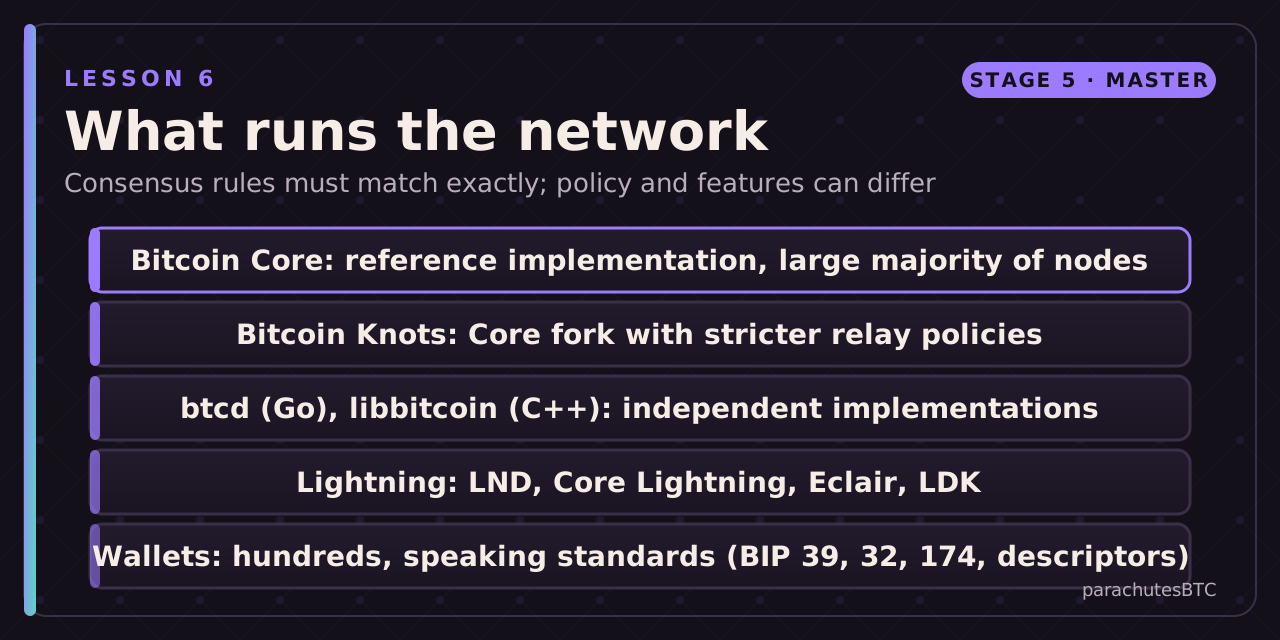
Core, Knots and the client ecosystem
Bitcoin Core runs most nodes; Knots and others differ in policy, not consensus. Diversity is healthy as long as everyone agrees on what is valid.
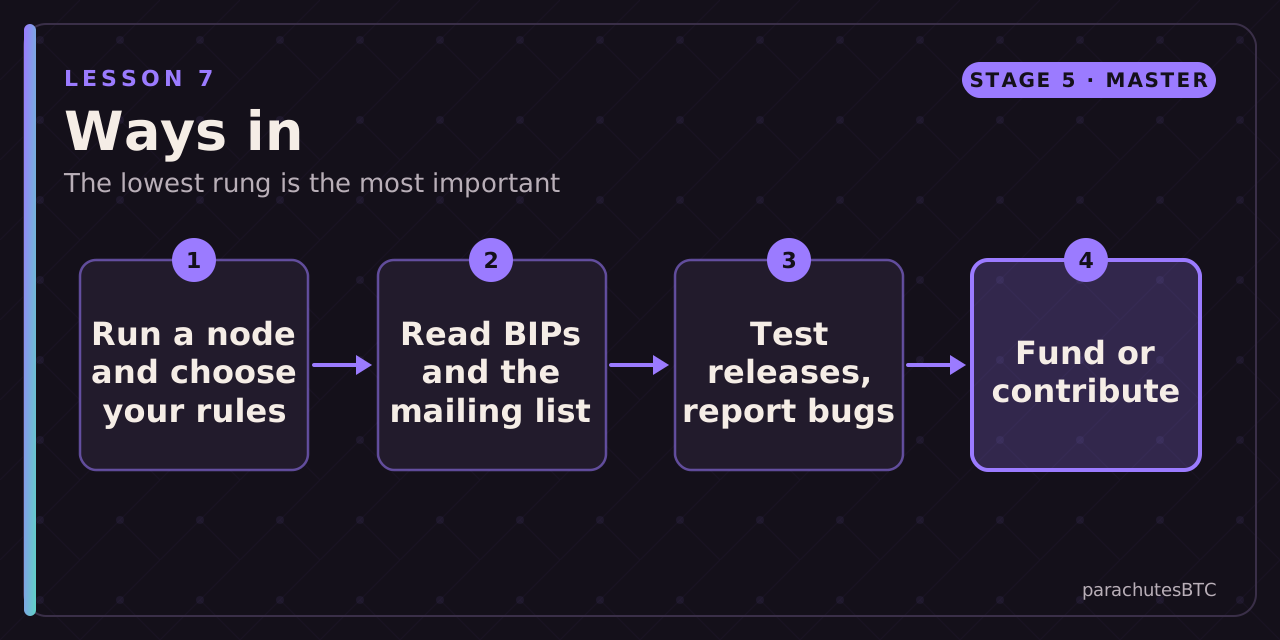
How to participate
Governance is not a spectator sport. Running a node is a vote; reading proposals is informed consent; testing and funding keep development independent.
STAGE 5 · MASTERLightning internals
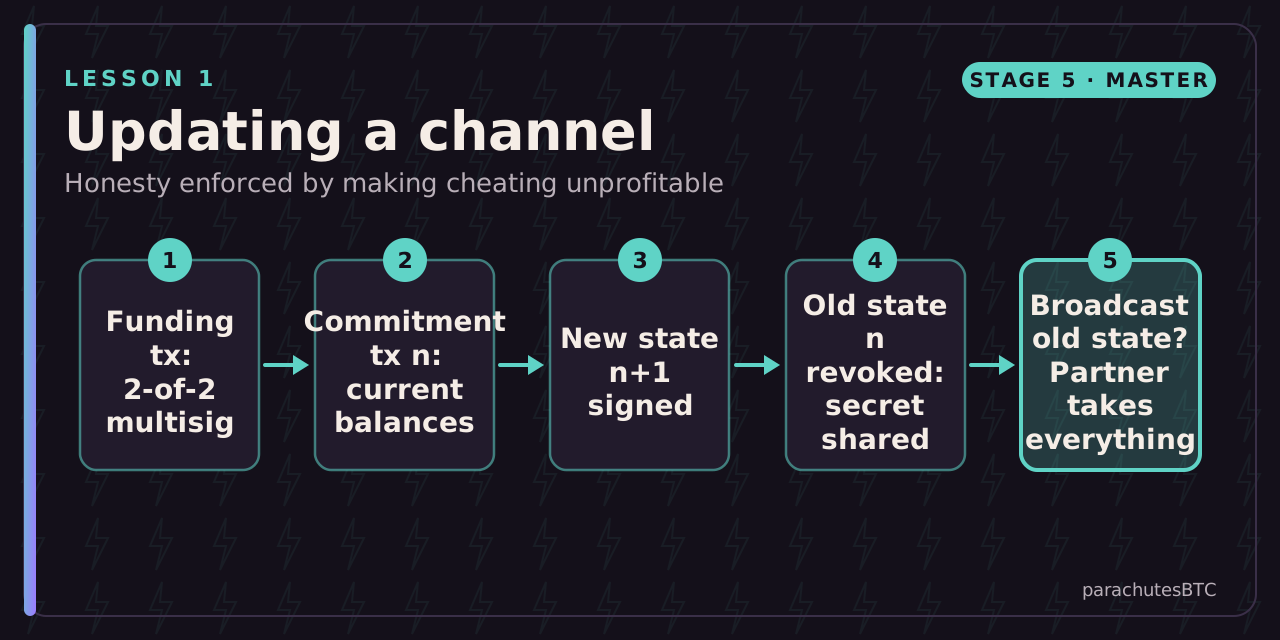
Channel state and the penalty
Each channel state is a pre-signed commitment transaction. Updating means signing a new one and revoking the old by sharing a secret that lets the partner punish any attempt to use it.
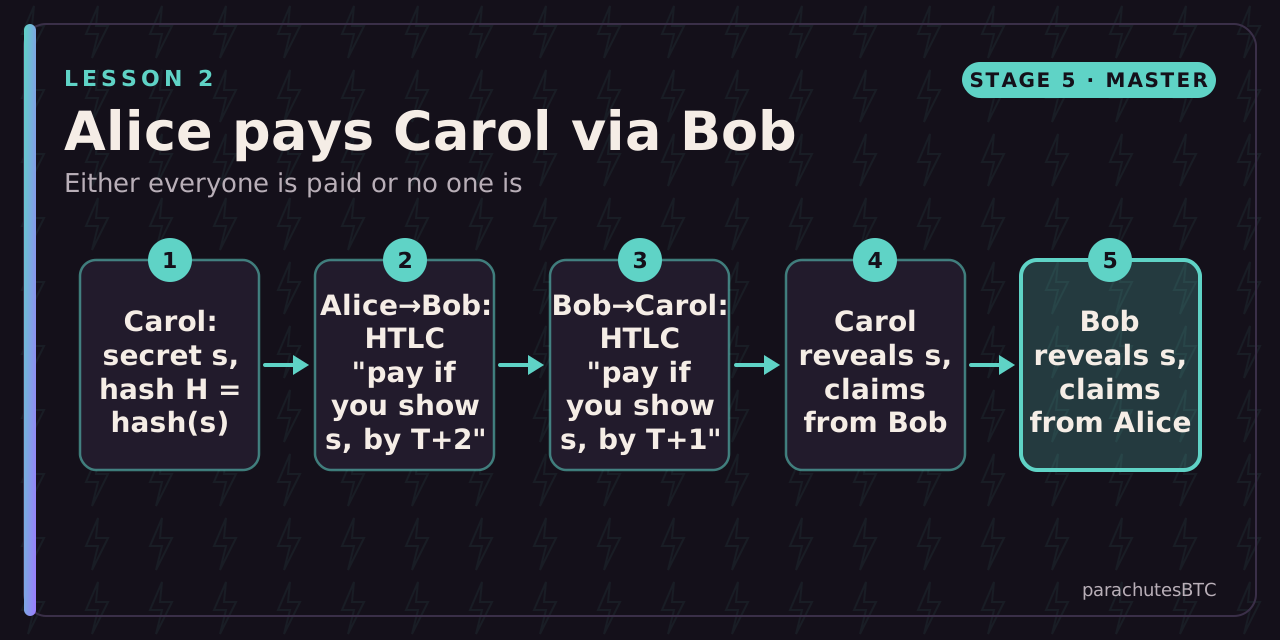
HTLCs, step by step
A hashed timelock contract pays whoever reveals a secret before a deadline, or refunds after. Chaining them with decreasing deadlines lets payments cross strangers safely.
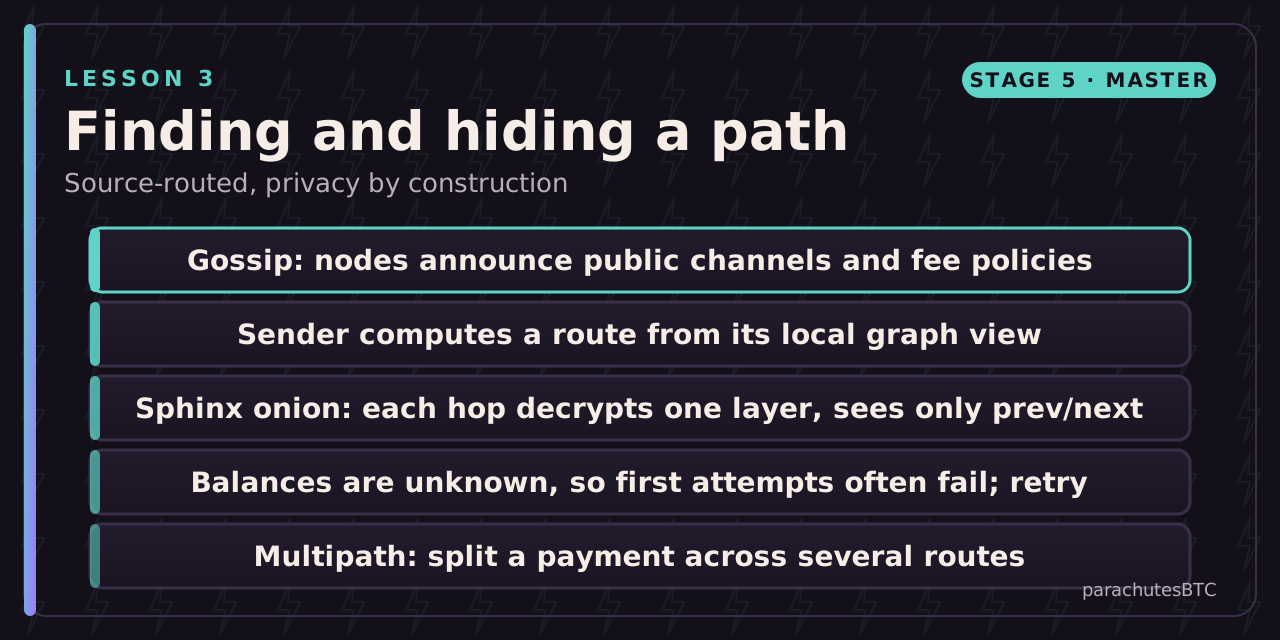
Onion routing and pathfinding
Senders build routes from a gossiped channel graph and wrap each payment in layers of encryption. Balances are private, so payments probe and retry; multipath splits big ones.
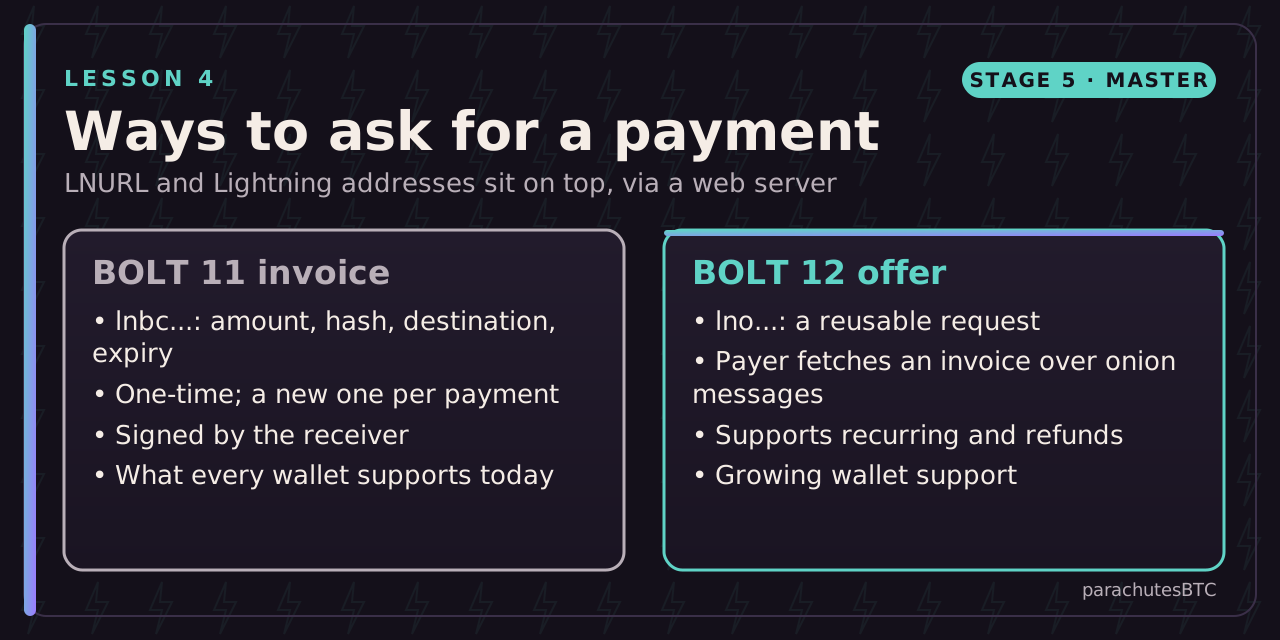
Invoices, offers and addresses
BOLT 11 invoices are one-time, signed requests. BOLT 12 offers are reusable and fetch invoices privately. LNURL and Lightning addresses add convenience through a web server.
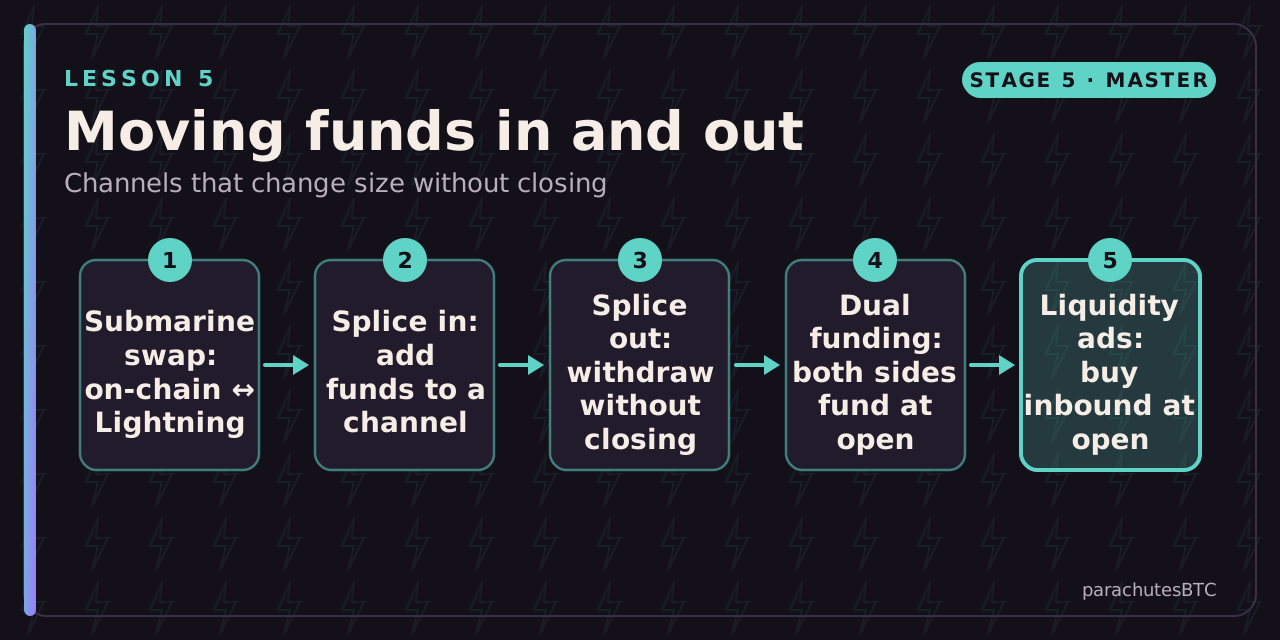
Splicing, swaps and liquidity ads
Submarine swaps move value between chain and Lightning trustlessly. Splicing resizes an open channel in place. Dual funding and liquidity ads solve the inbound problem at open.
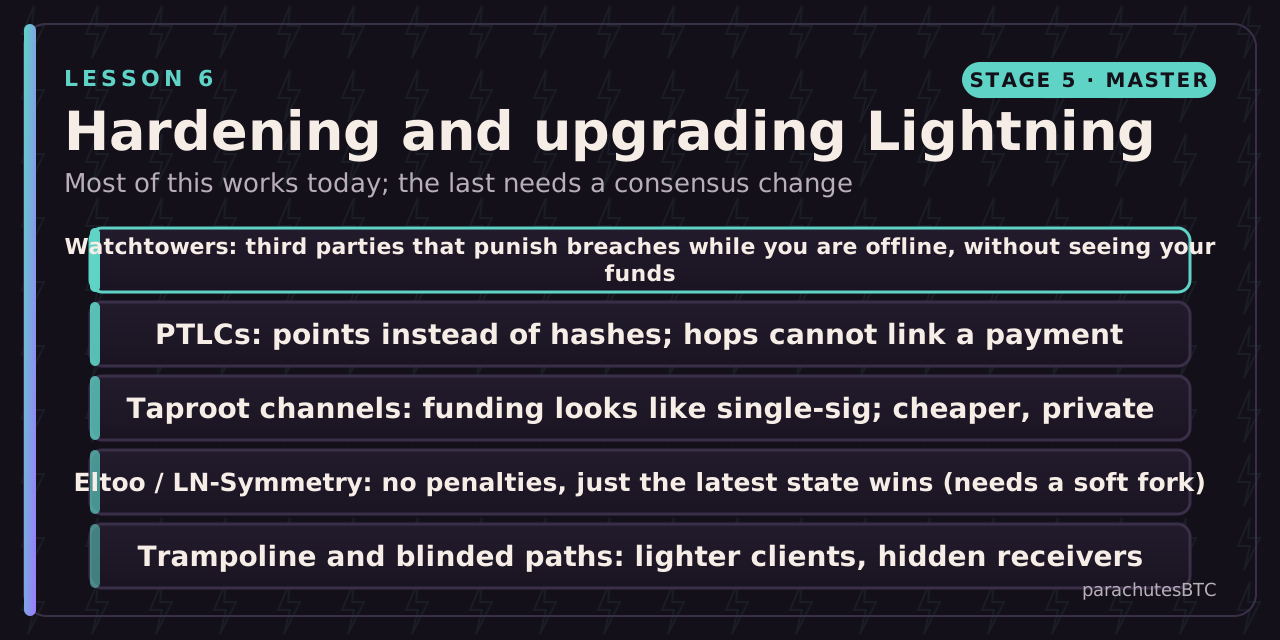
Watchtowers, PTLCs and what comes next
Watchtowers guard channels while you sleep. PTLCs fix routing privacy, Taproot channels cut costs, and Eltoo would replace penalties with a simpler update rule if a soft fork allows it.
STAGE 5 · MASTERTaxes and estate planning (US)
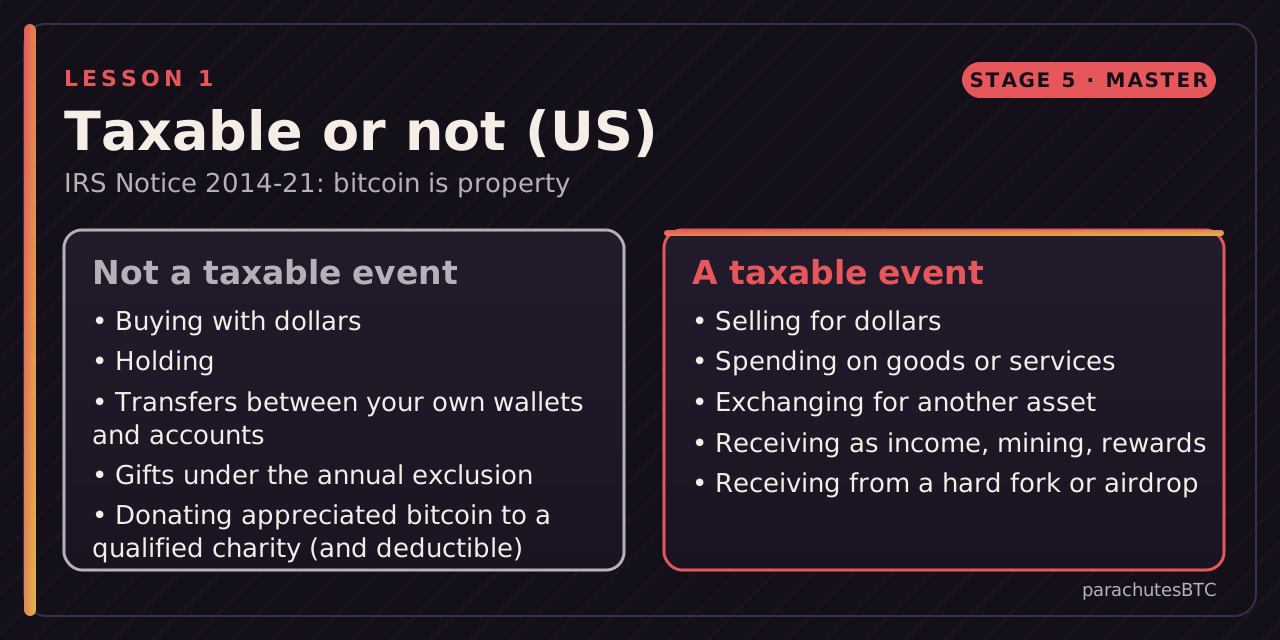
Property, not currency
Since 2014 the IRS treats bitcoin as property. Disposals (selling, spending, exchanging) realise gains; receiving it as income is ordinary income; buying and holding is nothing.
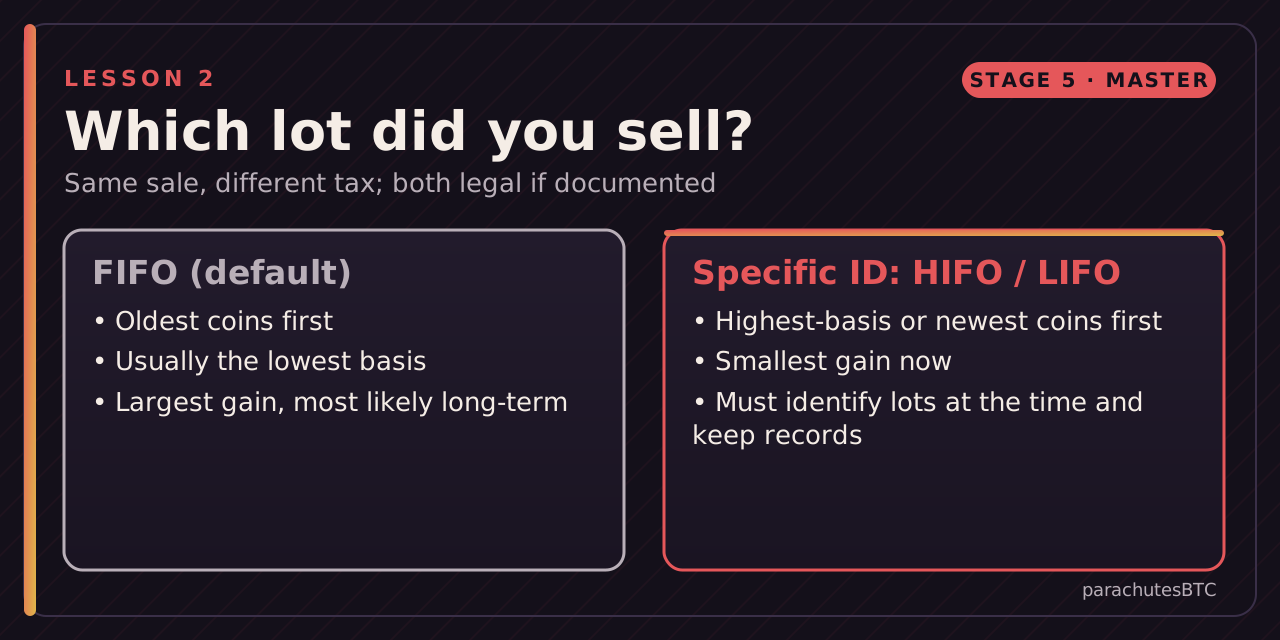
Gains, holding periods and lot methods
Gain is proceeds minus basis; the rate depends on holding period. Which coins you sold is a choice between FIFO and specific identification, and it changes the number.
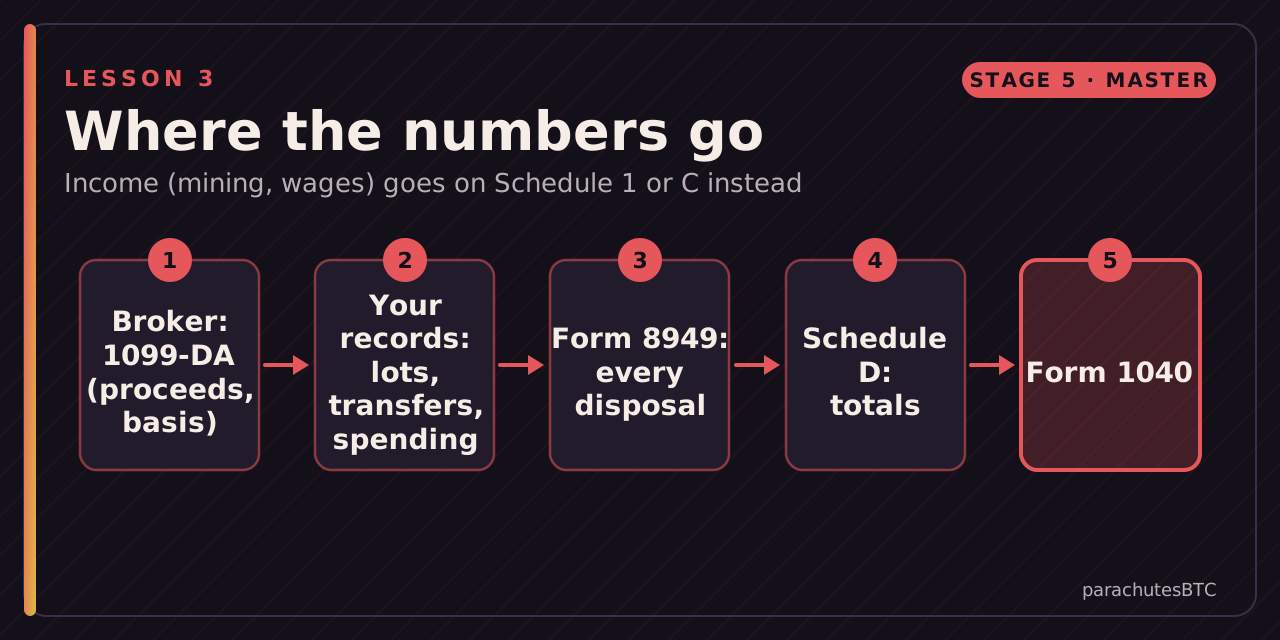
Forms, 1099-DA and reporting
From 2026 brokers report sales and basis on Form 1099-DA. You list every disposal on Form 8949, total on Schedule D, and report income separately. Broker reports are often incomplete.
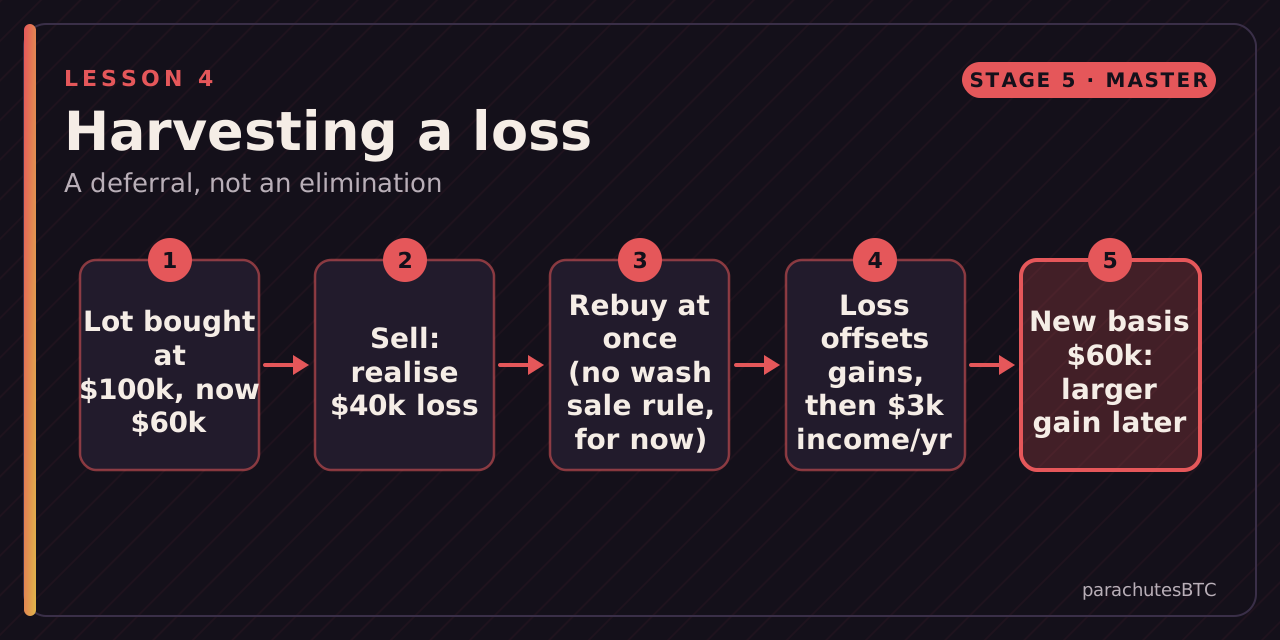
Tax-loss harvesting
Selling at a loss and rebuying realises a loss that offsets gains. Bitcoin is not currently subject to the wash-sale rule, which may change. The basis resets lower.
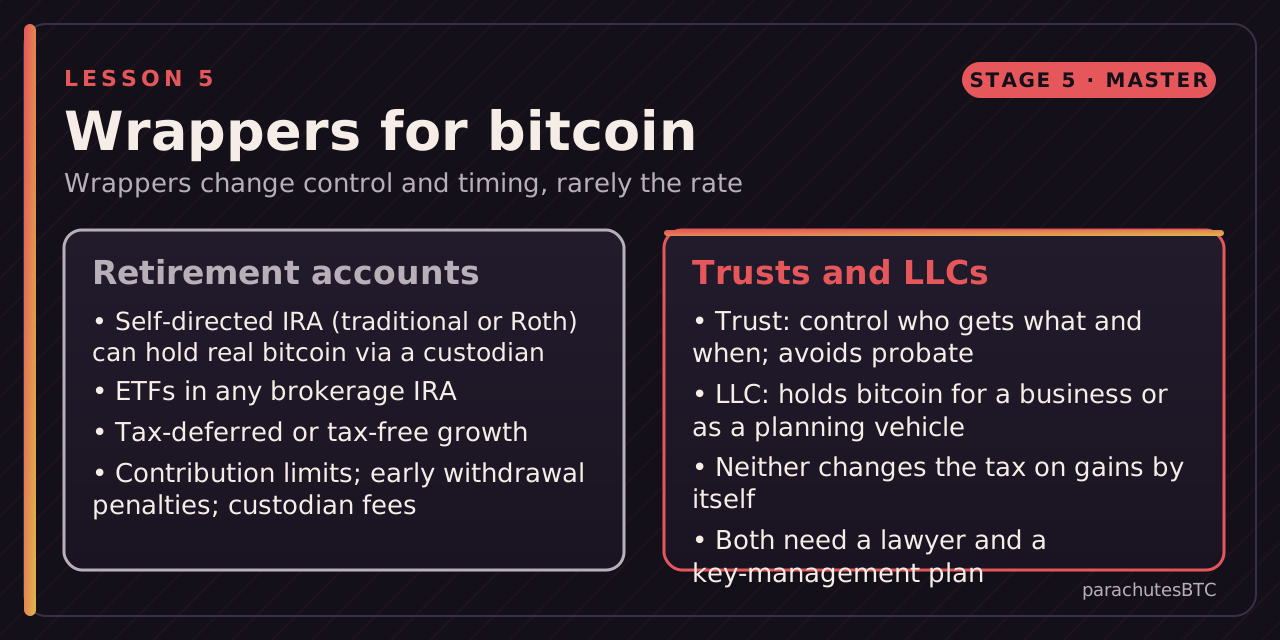
Retirement accounts, trusts and LLCs
Self-directed IRAs can hold real bitcoin with tax-advantaged growth. Trusts control inheritance and avoid probate; LLCs serve businesses. Each needs a custody plan.
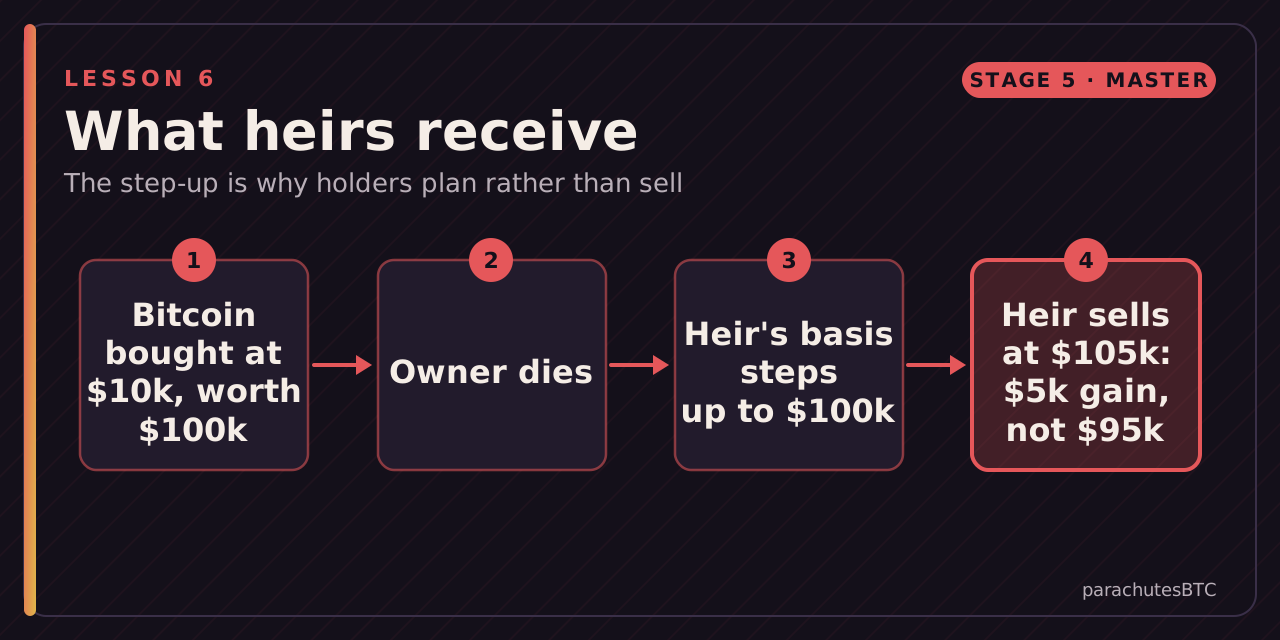
Inheritance and the stepped-up basis
In the US, inherited property gets a basis equal to its value at death, erasing the deceased's unrealised gain. Estate tax applies only above a very high exemption. Keys must still be reachable.
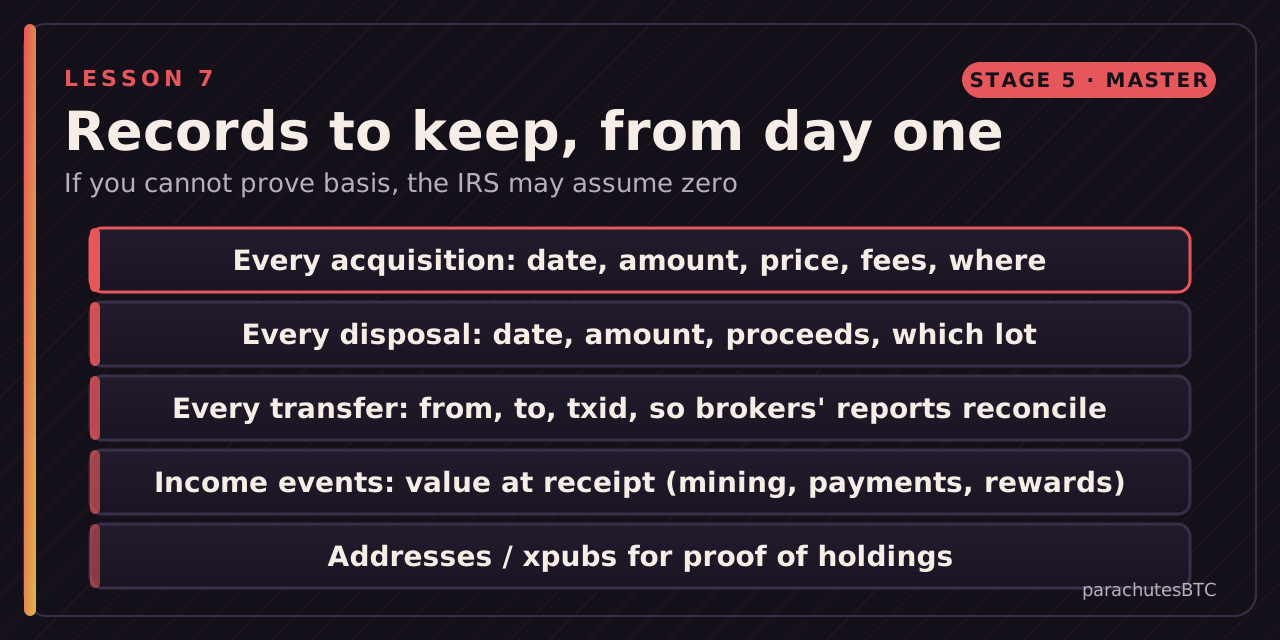
Businesses, mining and records that survive an audit
Businesses holding bitcoin follow fair-value accounting since 2025; mining is income at receipt. For everyone, records that prove basis and reconcile transfers are the whole game.
STAGE 5 · MASTERBitcoin and the state
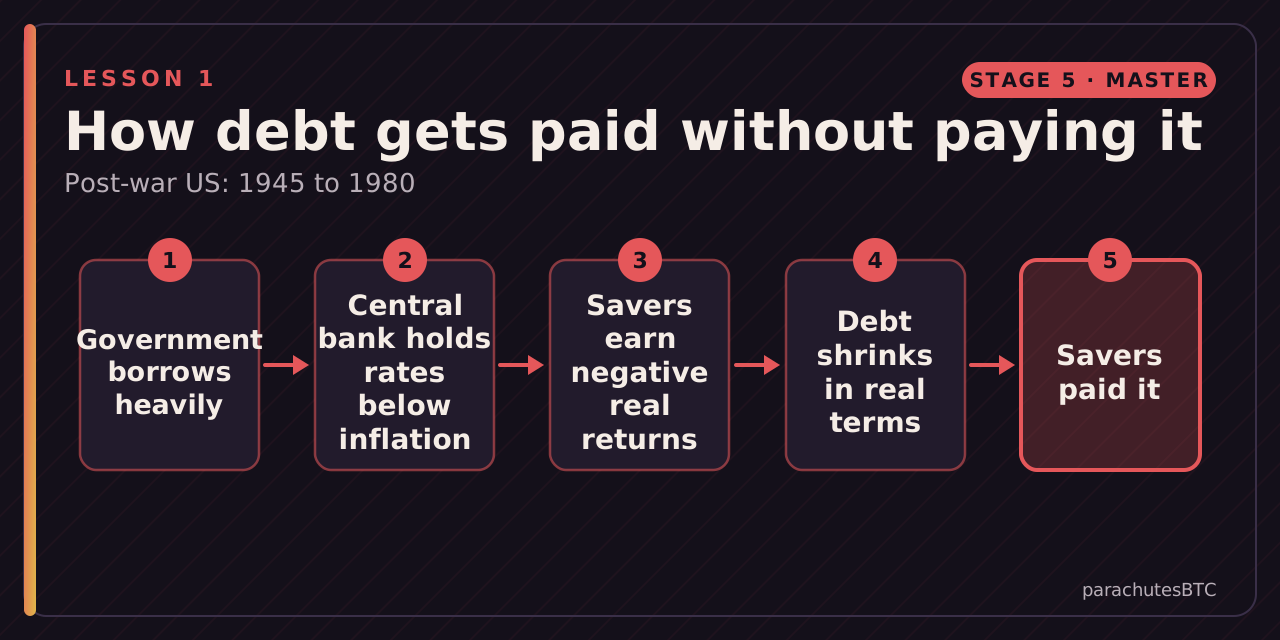
Financial repression
Governments shrink their debts by holding interest rates below inflation, so savers lose and debtors gain. It paid off the Second World War, and it is back.
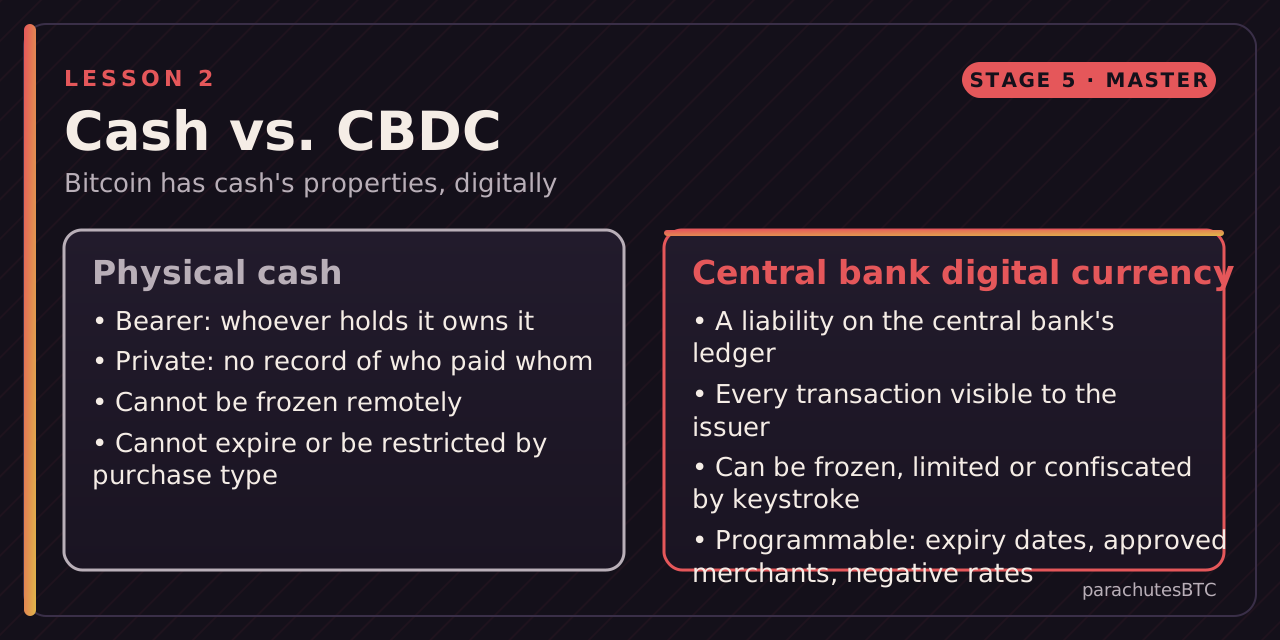
CBDCs and programmable money
A CBDC is central-bank money on a central-bank ledger: fully visible, freezable and programmable. It is the opposite of cash, and of bitcoin.
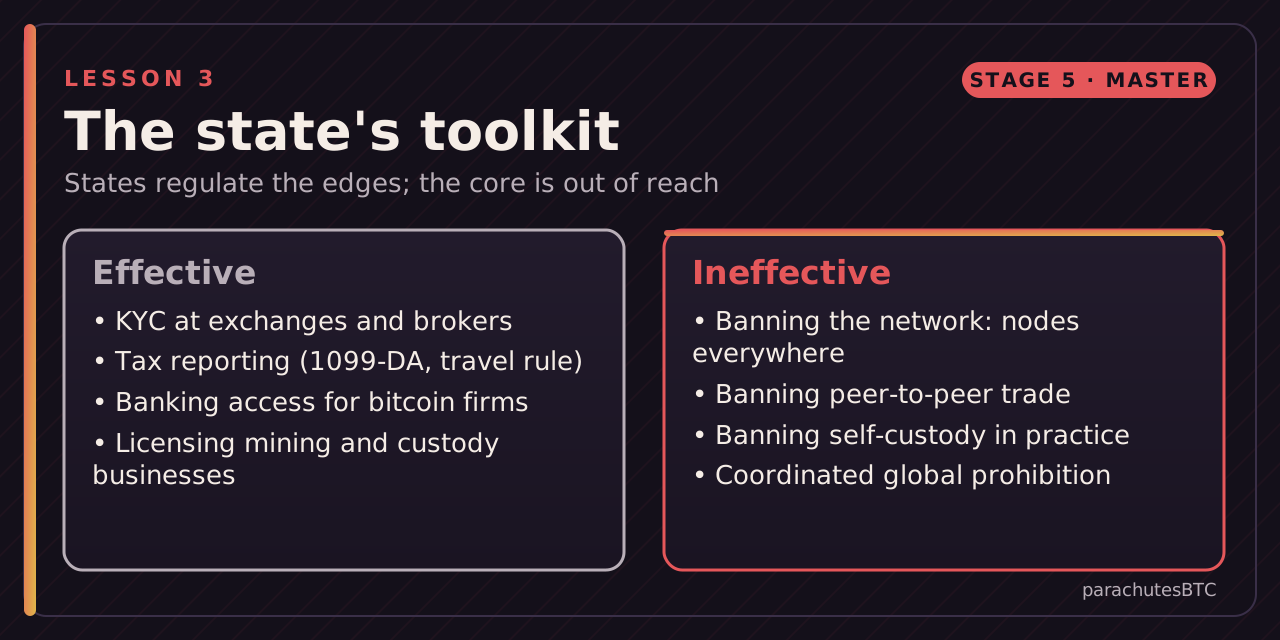
Regulation, bans and what actually works
States control the on-ramps: exchanges, banks, taxes, licences. They cannot control the network, and every national ban has pushed activity underground rather than ending it.
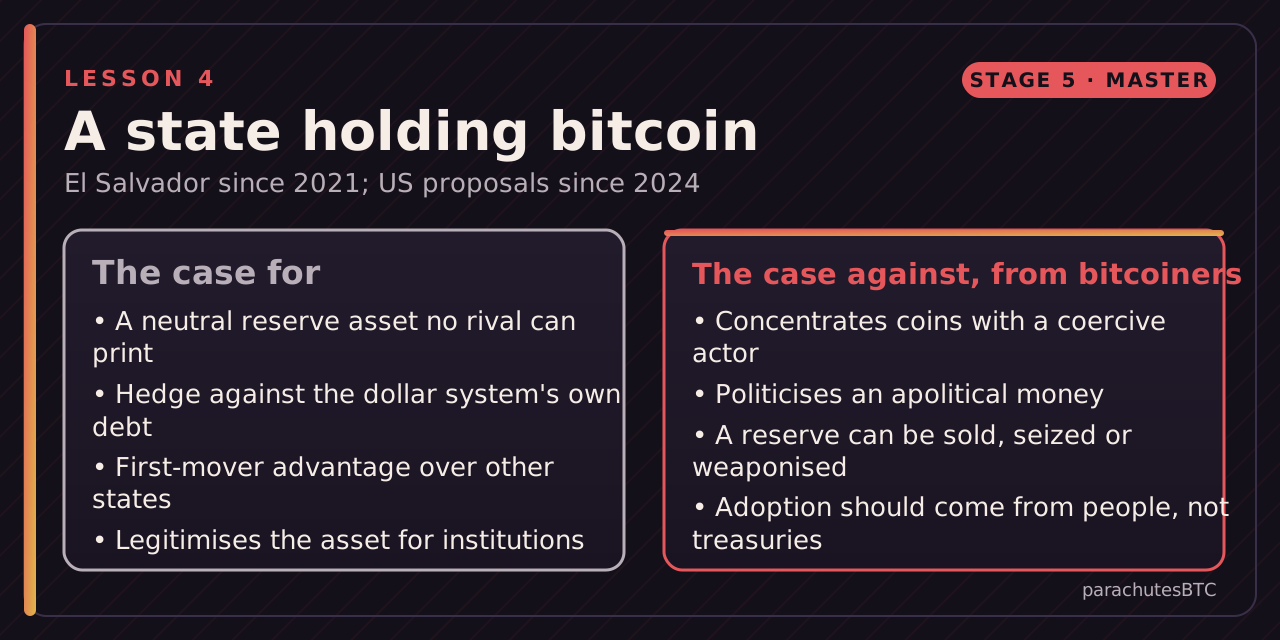
Strategic reserves and state adoption
States holding bitcoin as a reserve is no longer hypothetical. The case for is game theory; the bitcoiner case against is concentration and politicisation.
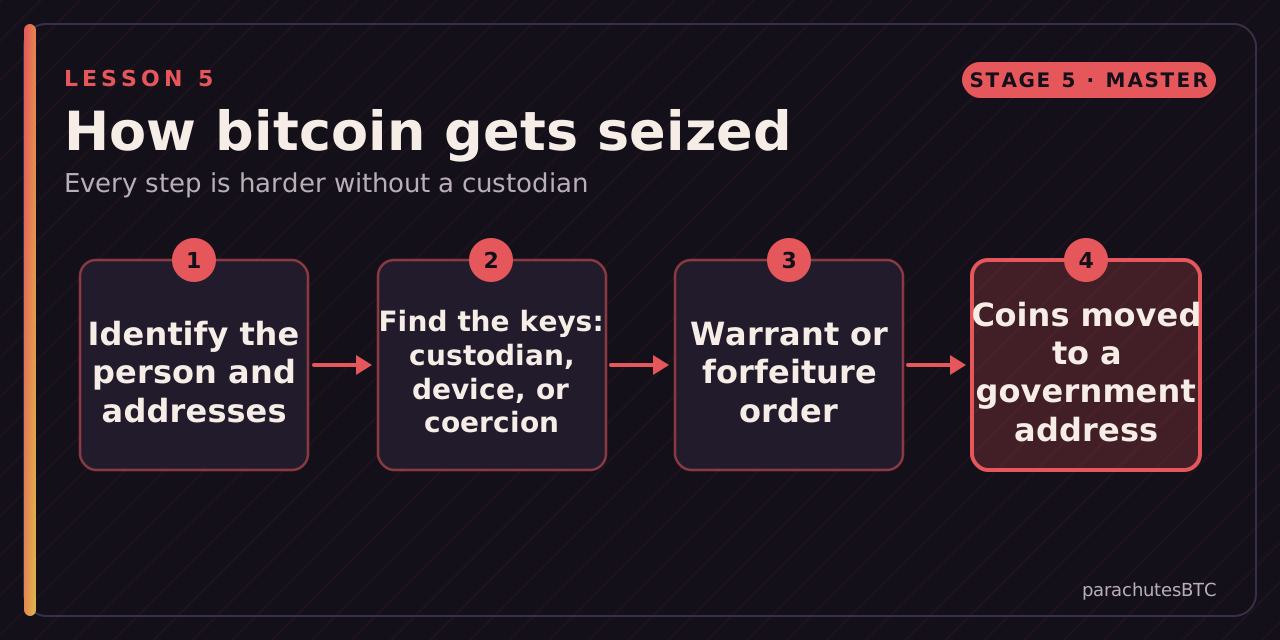
Seizure, confiscation and self-custody
Bitcoin in self-custody cannot be taken without the keys, which must be found or coerced. Custodians make seizure a paperwork exercise. 1933 is the precedent.
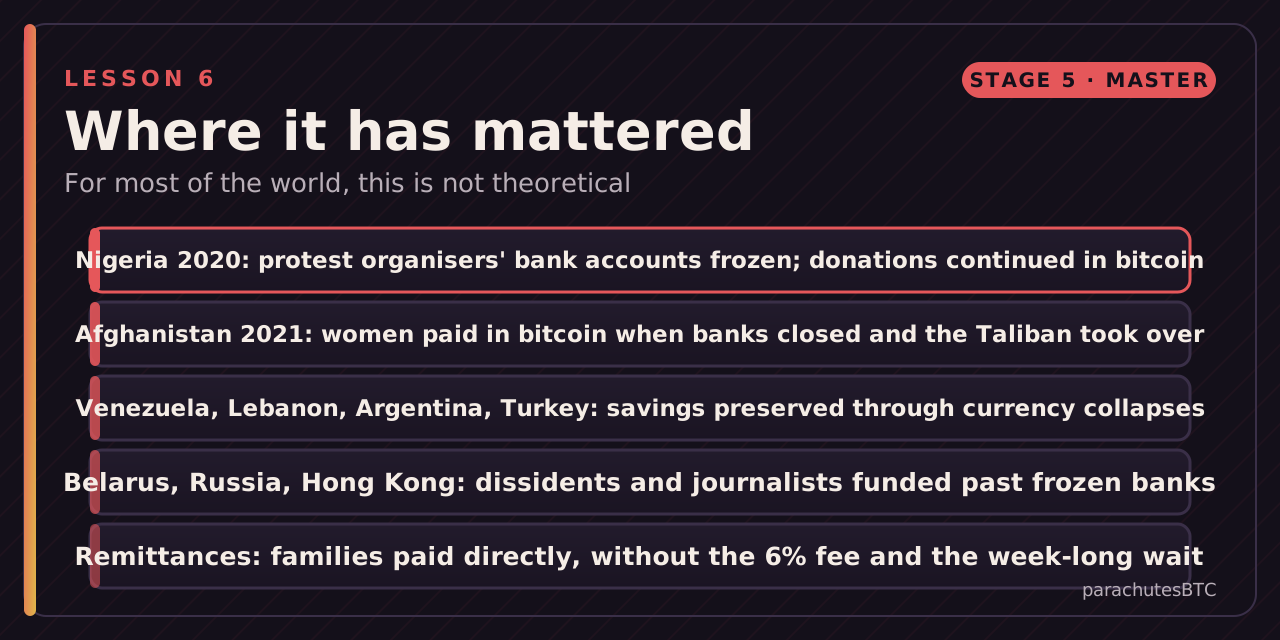
Bitcoin as a human-rights tool
For people under authoritarian governments or collapsing currencies, uncensorable, unconfiscatable money is not a thought experiment. The cases are documented.