Open the wallet from the previous course, tap Receive, and look at the first four characters of the address. How many characters long is the prefix "bc1q"?
Then prove it: a 3-question quiz · a challenge. The lesson marks itself complete at 100%.
After this lesson you can: say which of the four things in a wallet you back up, which you share, and why the arrows only run one way.
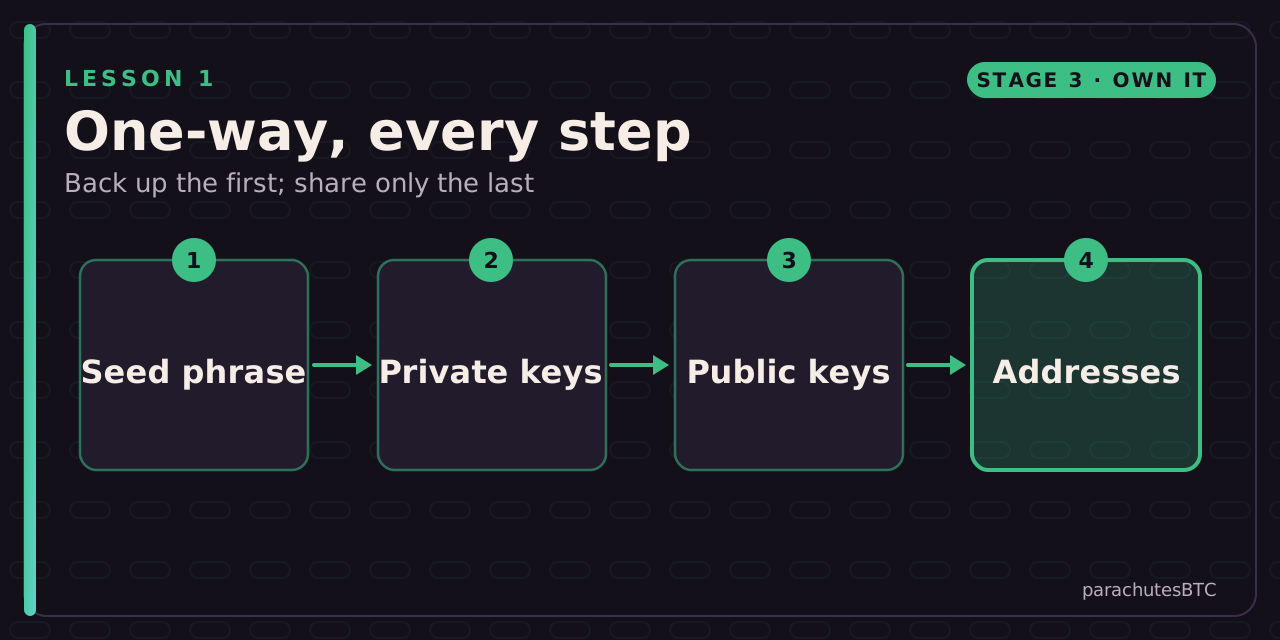
Everything in self-custody follows from one fact: control of bitcoin is control of a private key, and a modern wallet derives all its private keys from one seed.
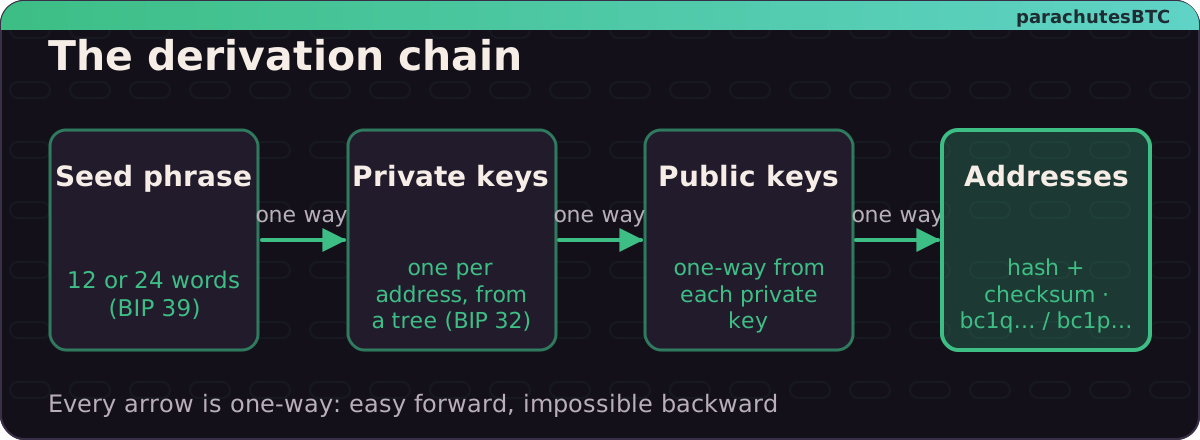
The derivation chain
Seed phrase: 12 or 24 words (BIP 39) encoding random bits. The root.
Private keys: derived from the seed in a tree (BIP 32), one per address, unlimited.
Public keys: derived one-way from each private key.
Addresses: a hash of the public key, encoded with a checksum. bc1q for native SegWit, bc1p for Taproot; older 1 and 3 formats still work.
Each arrow runs one way. From the words you can regenerate everything; from an address you can get nothing.
One seed, unlimited keys, unlimited addresses. Every arrow is one-way.
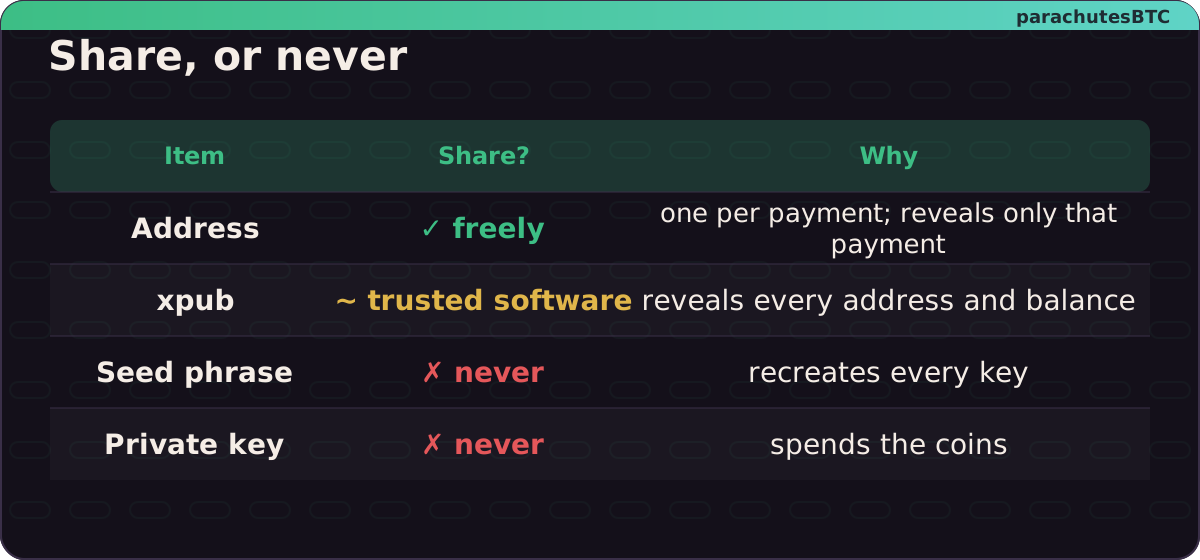
What to share
What can leave your hands.
Address: freely, one per payment.
Extended public key (xpub): reveals every address and balance in the wallet; share only with software you trust to watch it.
Seed and private keys: never, with anyone, for any reason.
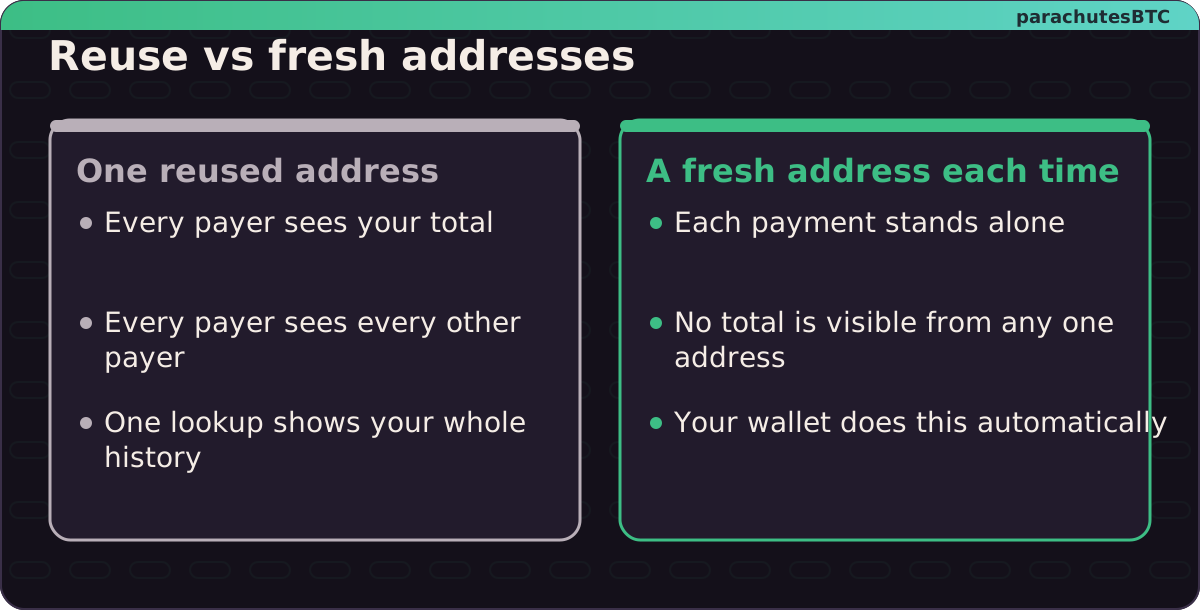
Why address reuse hurts
One address for everything links every payer to every payment. Fresh addresses keep them apart.
Every address is public forever. Reuse one and everyone who paid you can see everyone else who paid you, and your total. Wallets generate fresh addresses automatically; let them.
Tap a card to flip it.
MINI CHALLENGEFind your first address
Open the wallet from the previous course, tap Receive, and look at the first four characters of the address. How many characters long is the prefix "bc1q"?
characters
It is the native SegWit prefix.
bc1q means native SegWit; bc1p would be Taproot. Both are fine. Never share anything above the address in the chain.