
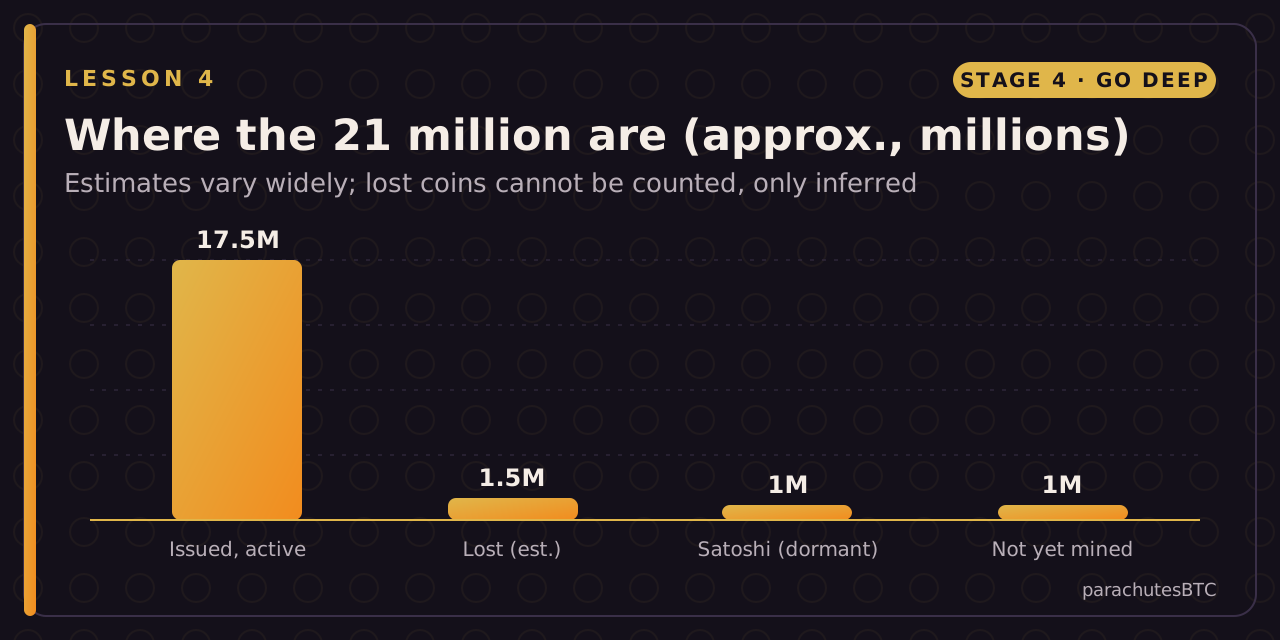
After this lesson you can: estimate the real circulating supply and say why it matters.
The ledger shows every coin that exists. It cannot show which ones can still be spent. Coins whose keys are gone sit at their addresses forever.
How coins get lost
- Keys thrown away or overwritten, especially in the early years when bitcoin was worthless. The famous hard drive in a Welsh landfill holds about 8,000 BTC.
- Transactions sent to mistyped or unspendable addresses.
- Deaths without an inheritance plan.
- Exchange collapses where coins vanished with the operator.
How many

Estimates range from about 1.5 million to nearly 4 million BTC, depending on how long a coin must be dormant before it is called lost. Satoshi's roughly one million coins, untouched since 2010, are usually counted separately: not lost, but not expected to move.
What it means
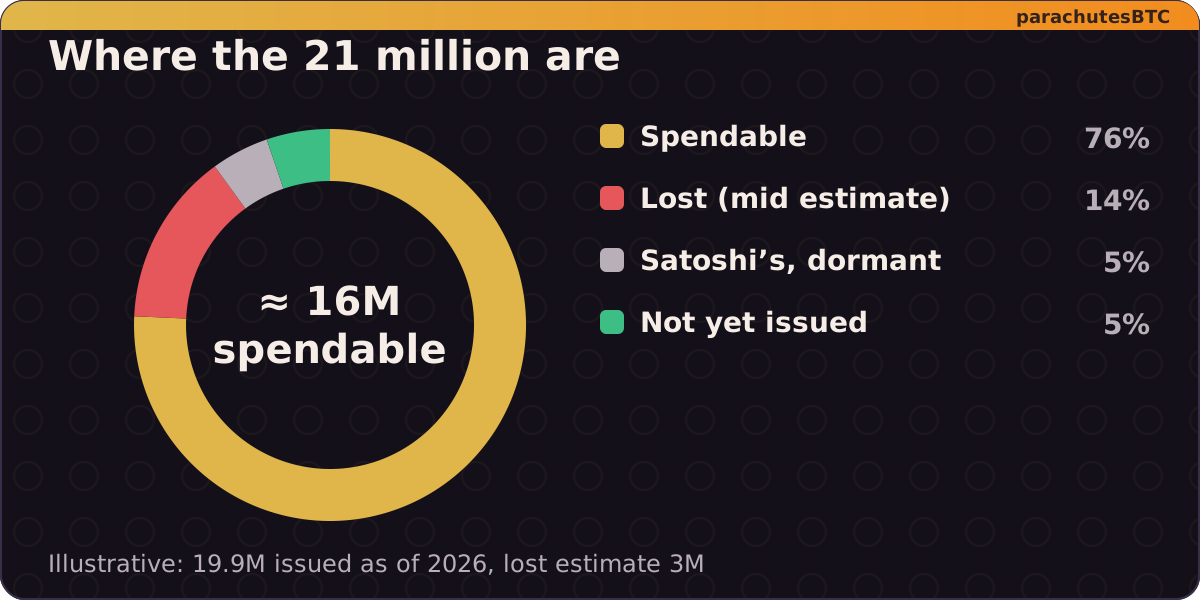
- The effective supply is perhaps 17 to 19 million, not 21 million.
- Lost coins are a gift to every other holder: the same demand across fewer spendable coins.
- Loss is not harmful to the network because bitcoin is divisible; it is harmful only to the person who lost them.
- Every lost coin is an argument for the Self-custody essentials course.
Quantum footnote
Coins at addresses with exposed public keys, including Satoshi's pay-to-public-key coins, are the ones a future quantum computer could threaten first. Whether such coins should be frozen by soft fork before that day is an active debate; see the FUD course's quantum lesson.
If 21 million is the cap and roughly 3 to 4 million are lost, about how many million bitcoin can ever actually circulate?