
STAGE 5 · MASTERLEVEL · Advanced8 LESSONSABOUT 51 MINOWNING & SECURING
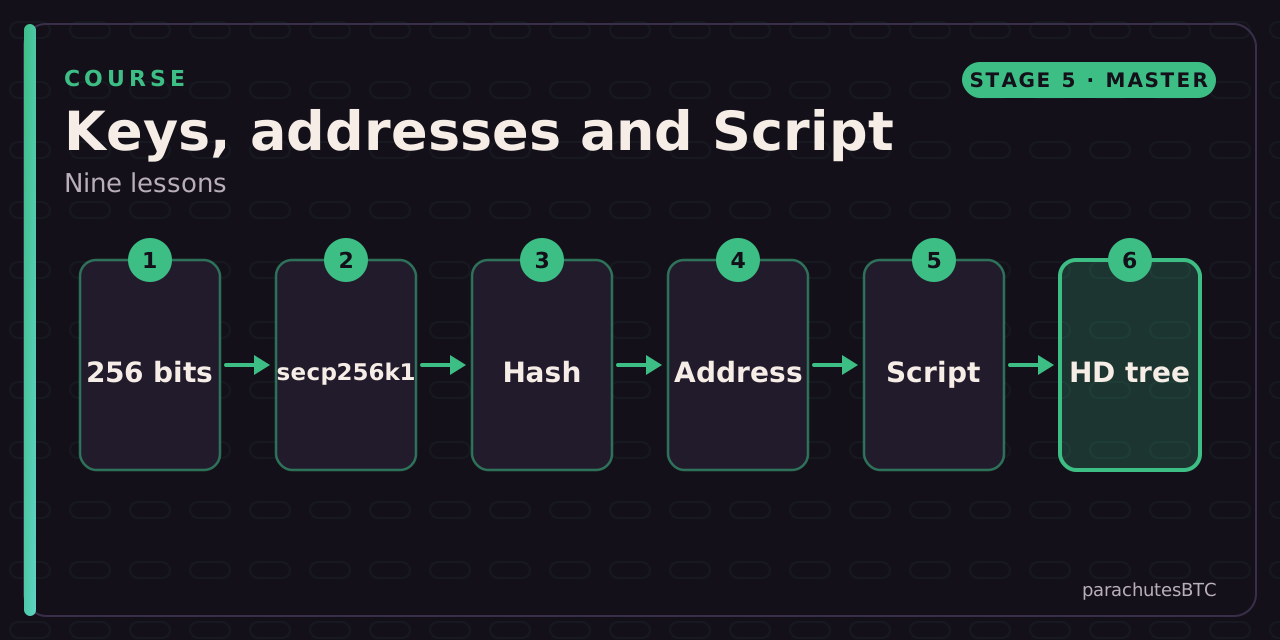
This course opens the box. It follows a key from 256 random bits to an address, through the scripts that lock coins and the signatures that unlock them, and ends with the HD wallet structure and PSBT format that modern wallets use. No programming required, but you will see hex. Eight lessons, about an hour.
BY THE END OF THIS COURSE YOU WILL BE ABLE TO
- Explain how a private key becomes an address, step by step
- Identify any address type and what script it represents
- Read a simple locking and unlocking script
- Recover a wallet from seed plus derivation path
- Describe what Schnorr and Taproot changed
Every lesson ends with a quiz or a challenge; the course is complete when each lesson is.
0 of 8 lessonsStart the course →
LESSONS
01Private keys: 256 bits of randomnessA private key is a random number between 1 and about 1.16 × 10⁷⁷. Its security rests entirely on the randomness that made it.✓ quiz⚡ challenge6 MIN✓02Public keys and the curveA public key is the generator point of the secp256k1 curve multiplied by the private key. Easy to compute, infeasible to reverse, and 33 bytes when compressed.✓ quiz6 MIN✓03Addresses: every format explainedAn address is an encoding of a script template plus a hash or key. The prefix tells you which: 1 for P2PKH, 3 for P2SH, bc1q for SegWit, bc1p for Taproot.✓ quiz▭ cards7 MIN✓04Bitcoin Script: locks and keysEvery output carries a locking script; every input provides an unlocking script. Nodes run them on a stack machine. Script has no loops, which keeps it predictable.✓ quiz7 MIN✓05Signatures: ECDSA and SchnorrA signature proves knowledge of a private key for one exact message. ECDSA was Bitcoin's original scheme; Schnorr, added with Taproot, is smaller and lets keys combine.✓ quiz6 MIN✓06HD wallets, seeds and derivation pathsA seed phrase becomes a master key that derives a tree of keys. The derivation path says where in the tree; without the right path, the right words find an empty wallet.✓ quiz⚡ challenge7 MIN✓07SegWit and Taproot under the hoodSegWit separated signatures from the transaction ID and introduced block weight. Taproot added Schnorr and lets complex spending conditions hide behind a single key.✓ quiz7 MIN✓08PSBTs and air-gapped signingA PSBT is a standard container for a transaction that is not fully signed yet. It lets hardware wallets, air-gapped devices and multisig co-signers each do their part.✓ quiz5 MIN✓