
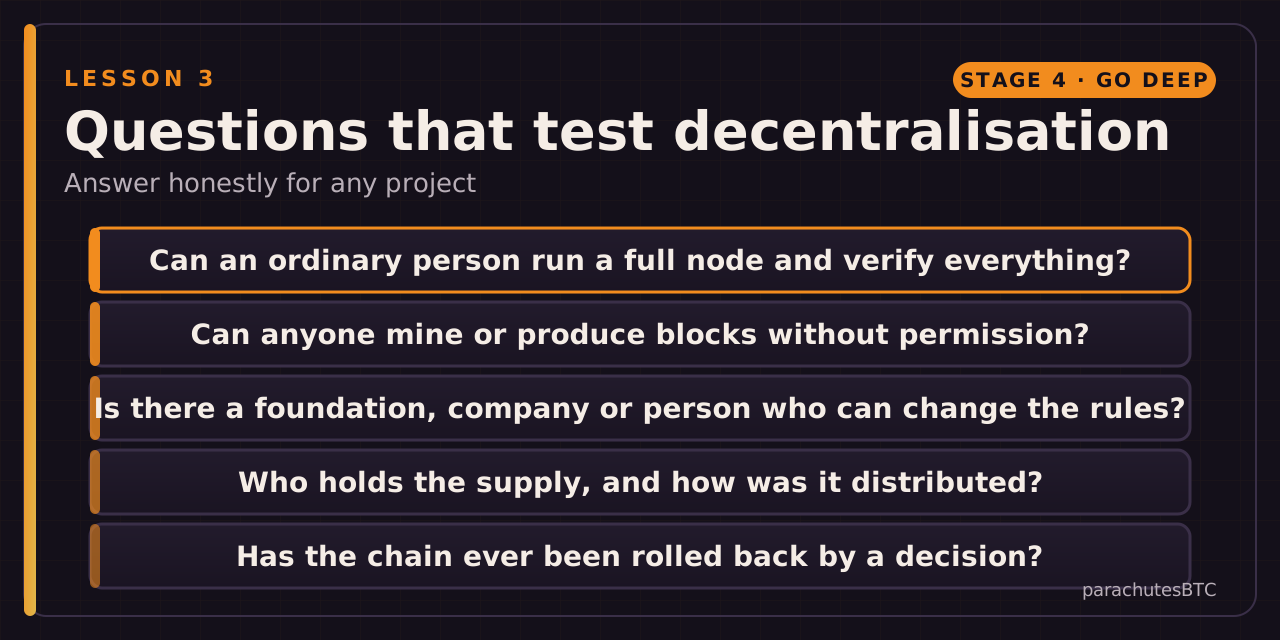
After this lesson you can: ask the five questions that test whether a system is decentralised.
"Decentralised" is the most abused word in the industry. The useful question is binary: can anyone change the rules, roll back the chain, or print more? If yes, there is a centre. It does not matter how many servers they rent.
The five questions
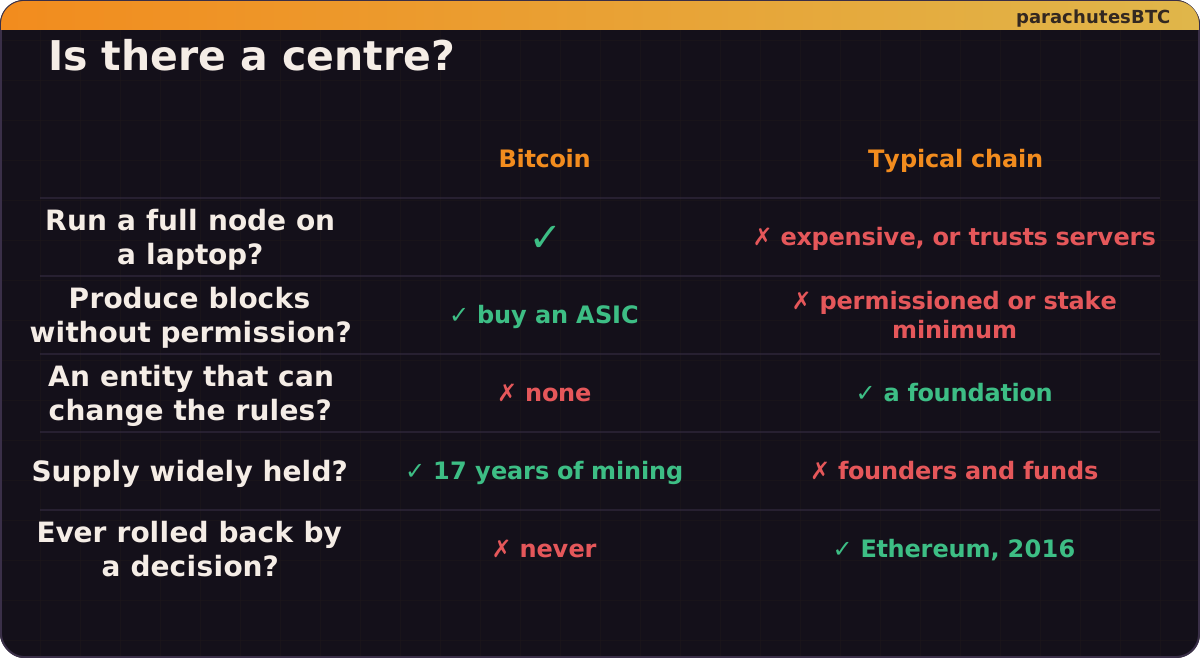
- Can an ordinary person run a full node? Bitcoin: yes, on a laptop with a cheap drive. Many chains: hardware costs thousands, or only a few hundred nodes exist, or "nodes" trust a company's servers.
- Can anyone produce blocks without permission? Bitcoin: buy an ASIC. Many chains: a permissioned validator set, or a stake minimum that excludes almost everyone.
- Is there an entity that can change the rules? Bitcoin: no; changes need broad node adoption and take years. Most chains: a foundation ships upgrades on a schedule.
- Who holds the supply? Bitcoin: distributed over seventeen years of mining and trading. Many chains: majority with founders, funds and the foundation.
- Has the chain ever been rolled back by a decision? Bitcoin: no. Ethereum: yes, in 2016, to reverse a hack, by decision of its leadership.
Why it matters for money
Money needs to be the same for everyone and changeable by no one. A system with a centre will be used by that centre when it matters: to bail out insiders, to comply with a government, to fix its own mistake. That is fiat with a blockchain.
Run the five questions (who can change the rules, who can freeze, who can print, who can be subpoenaed, who can shut it down) on bitcoin. How many have the answer "no one"?