
After this lesson you can: explain where miner income comes from as the subsidy shrinks.
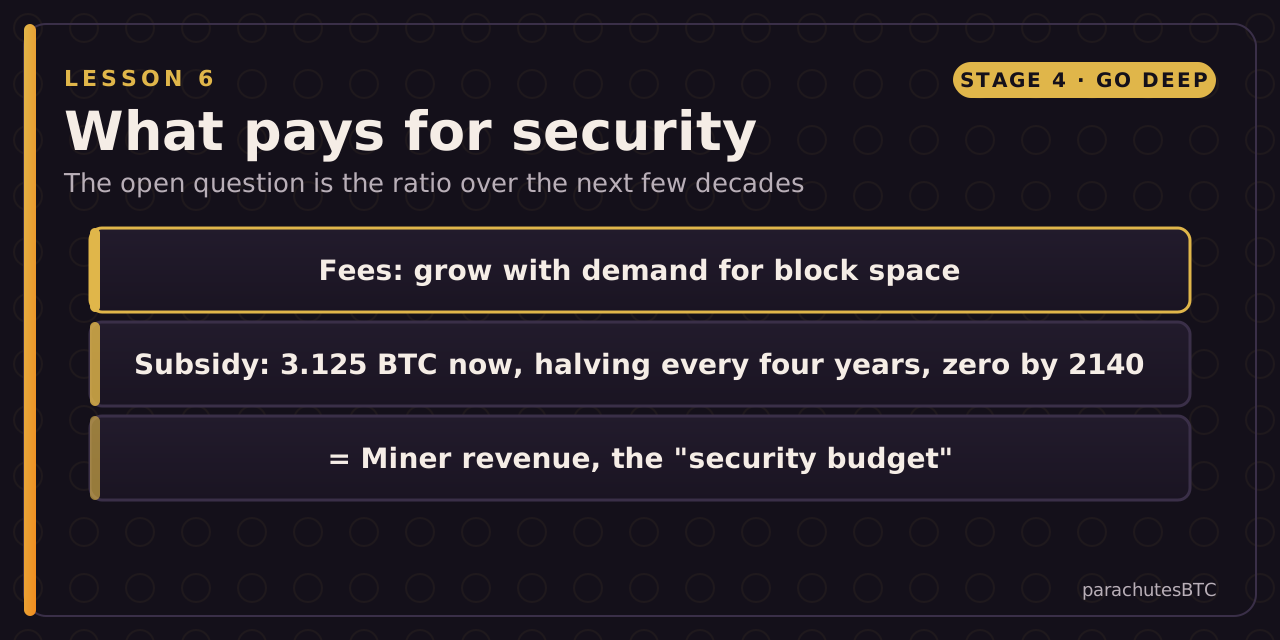
The cost of attacking Bitcoin depends on how much hash power protects it, and hash power follows miner revenue. That revenue, the security budget, is the block subsidy plus transaction fees.
The question
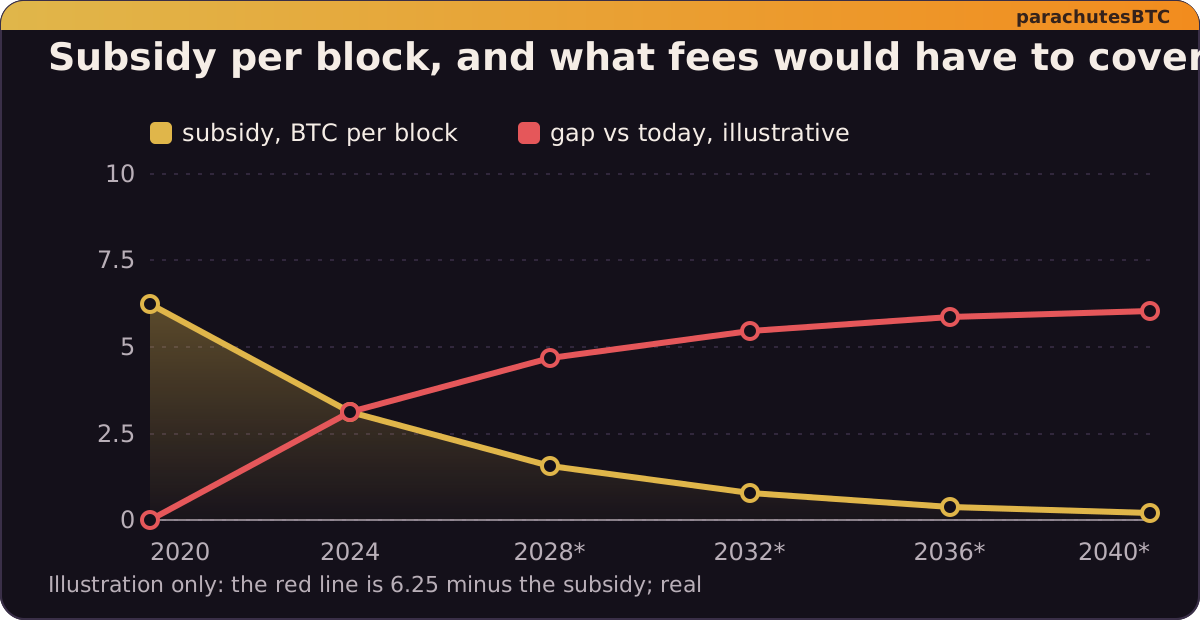
The subsidy halves every four years and reaches zero around 2140. Long before that it becomes small relative to the value of the network. If fees do not grow to replace it, hash power could fall relative to the value protected, making attacks cheaper. This is not FUD; it is a real design question that serious bitcoiners discuss.
The optimistic case
- Fees are a market for block space. As bitcoin's value and use grow, so does what people will pay for final settlement.
- Layers like Lightning bundle many payments into few on-chain transactions, each of which still pays, and high-value settlement is insensitive to fee.
- Fiat-denominated security matters: a smaller BTC subsidy at a much higher price can fund more hardware than today's.
- Historically, every halving has been followed by hash rate highs, not collapse.
The cautious case
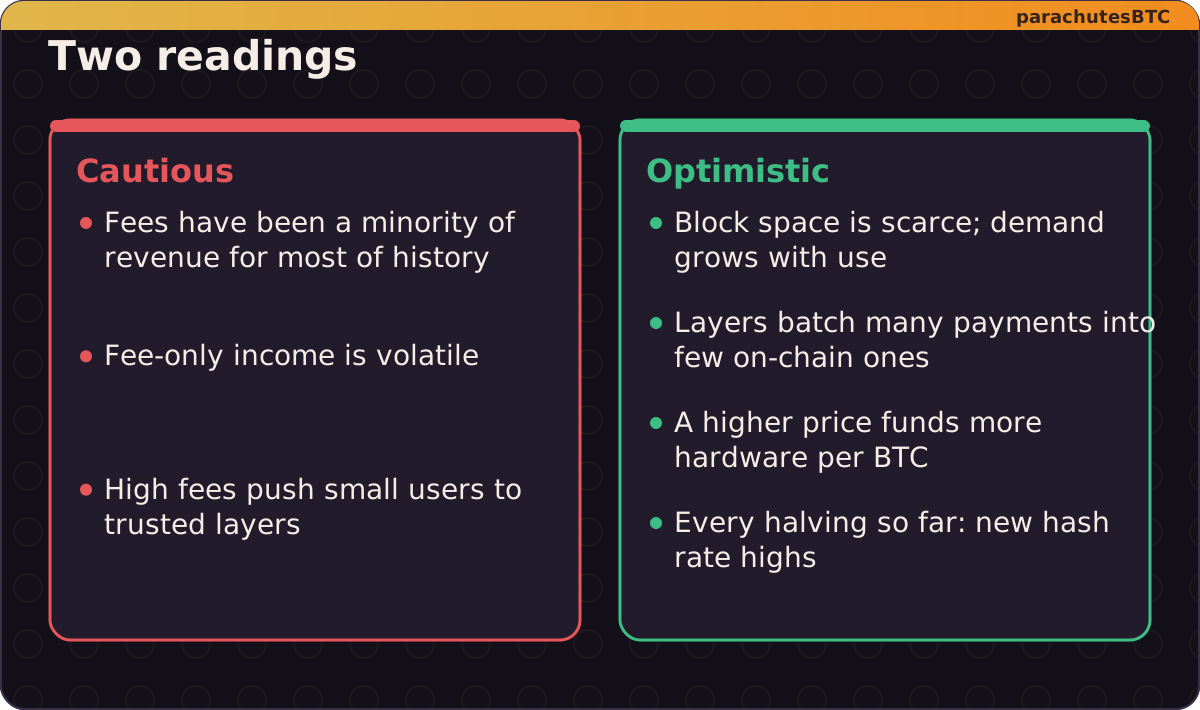
- Fees have been a minority of miner revenue for most of Bitcoin's history, with brief spikes.
- A fee-only regime could make miner income volatile and encourage reorganisations to steal fee-rich blocks.
- If fees must be high, cheap on-chain use for ordinary people ends, pushing them to layers with their own trust assumptions.
What to watch
The fee share of miner revenue, hash price, and the block-space demand created by layers and new uses. All are on the Bitcoin Charts dashboard. Proposals to add a small permanent subsidy ("tail emission") exist and are rejected by most of the community as a breach of the cap. The next few halvings will tell us more than any argument.
Course checklist: what you can now do
Tick each one you have actually done. The course is finished when they are all ticked, not when the quiz is.
After the April 2024 halving the subsidy is 3.125 BTC. What will it be after the next halving, in BTC?