
After this lesson you can: read the whitepaper and recognise every idea in it.
The whitepaper is nine pages and you now know every idea in it. Read it with this map.
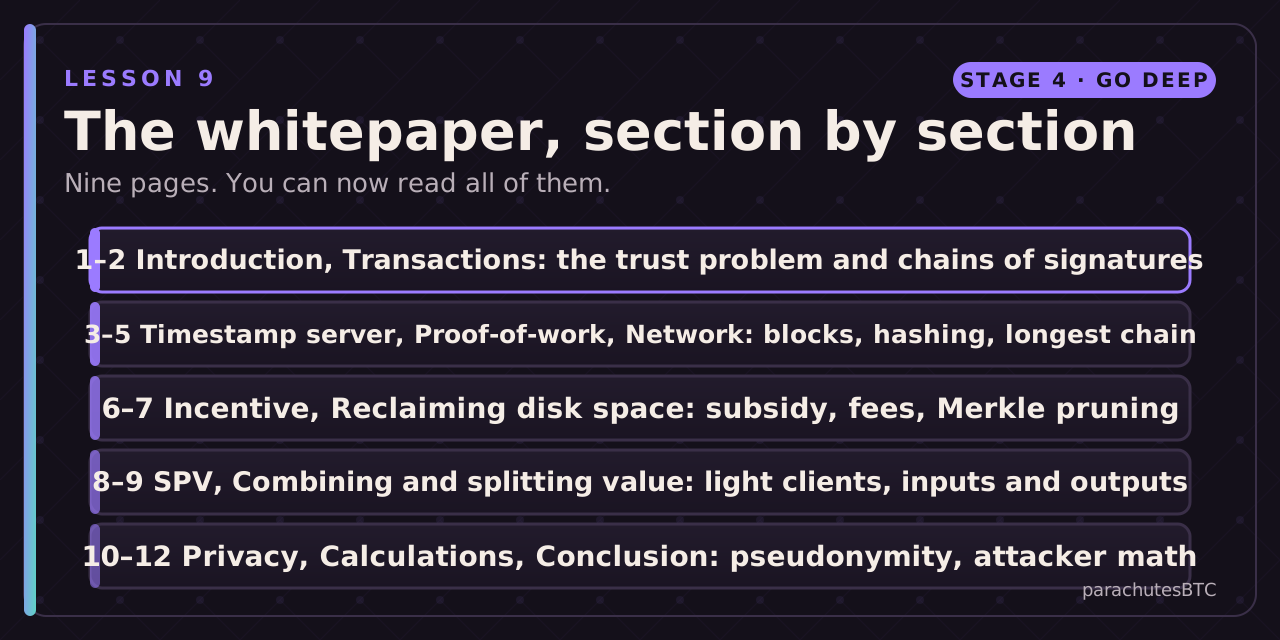
Sections 1 to 2: the problem and the chain of signatures
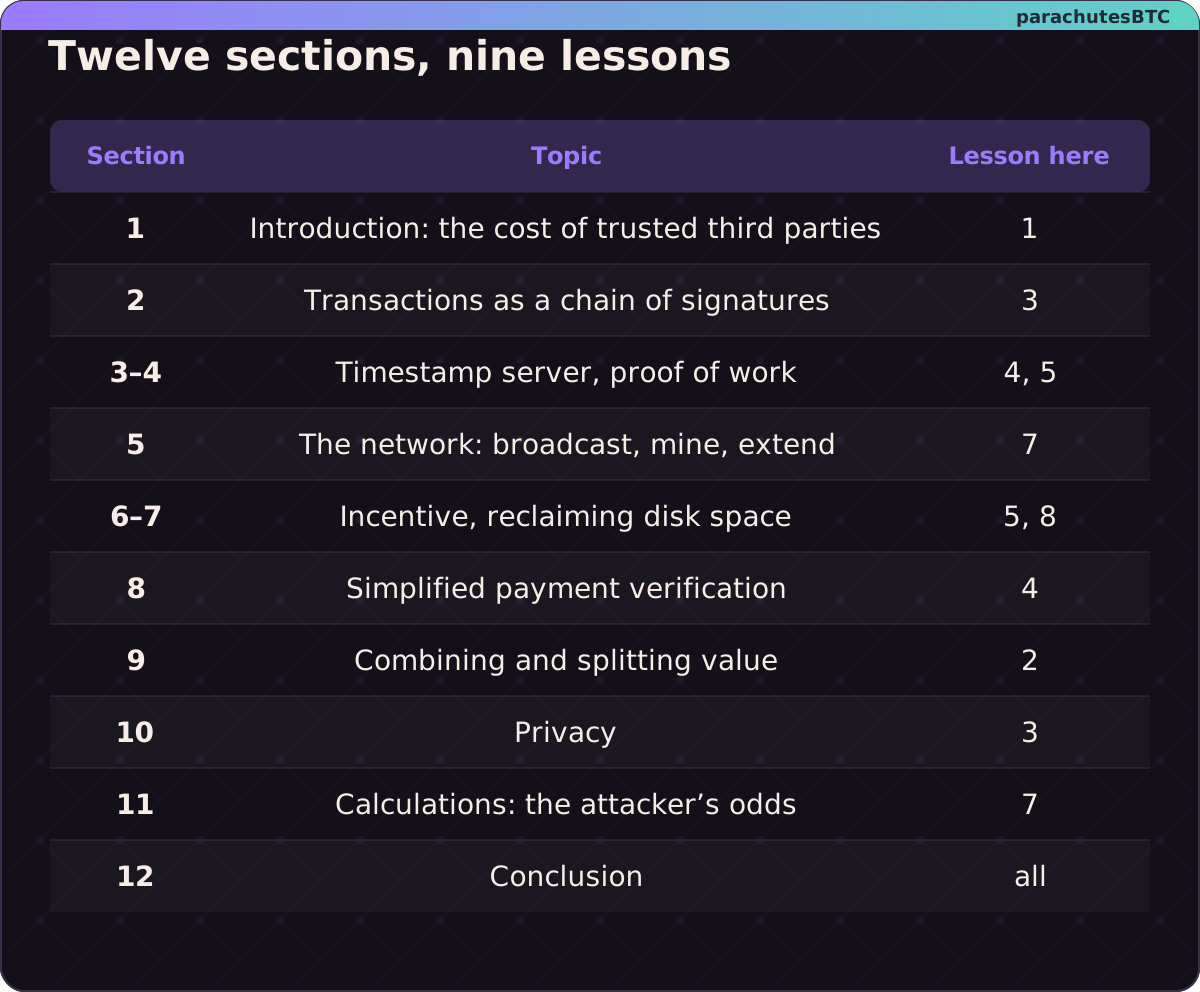
The introduction names the cost of trusted third parties and proposes "an electronic payment system based on cryptographic proof instead of trust". Section 2 defines a coin as a chain of digital signatures: each owner signs the hash of the previous transaction and the next owner's public key. That is lesson 3.
Sections 3 to 5: timestamps, proof of work, the network
A timestamp server hashes items into a chain so each proves the previous existed. Proof-of-work (section 4) is the nonce-and-target mechanism, with the famous line that it is "one-CPU-one-vote" and that the longest chain represents the majority decision. Section 5 is the network: broadcast, collect into a block, find the proof, accept the block only if all transactions are valid, build on it. Lessons 4 to 7.
Sections 6 to 7: incentive and disk space
The first transaction in a block creates new coins ("adds an incentive for nodes to support the network"), and later fees take over, "completely inflation free" once the supply is out. Section 7 is the Merkle tree and pruning old transactions. Lessons 4 and 8.
Sections 8 to 9: light clients, and inputs and outputs
Simplified Payment Verification lets a client check a payment with block headers and a Merkle branch. Section 9 describes transactions with multiple inputs and at most two outputs: the payment and the change. Lesson 2.
Sections 10 to 12: privacy, the attacker's odds, conclusion
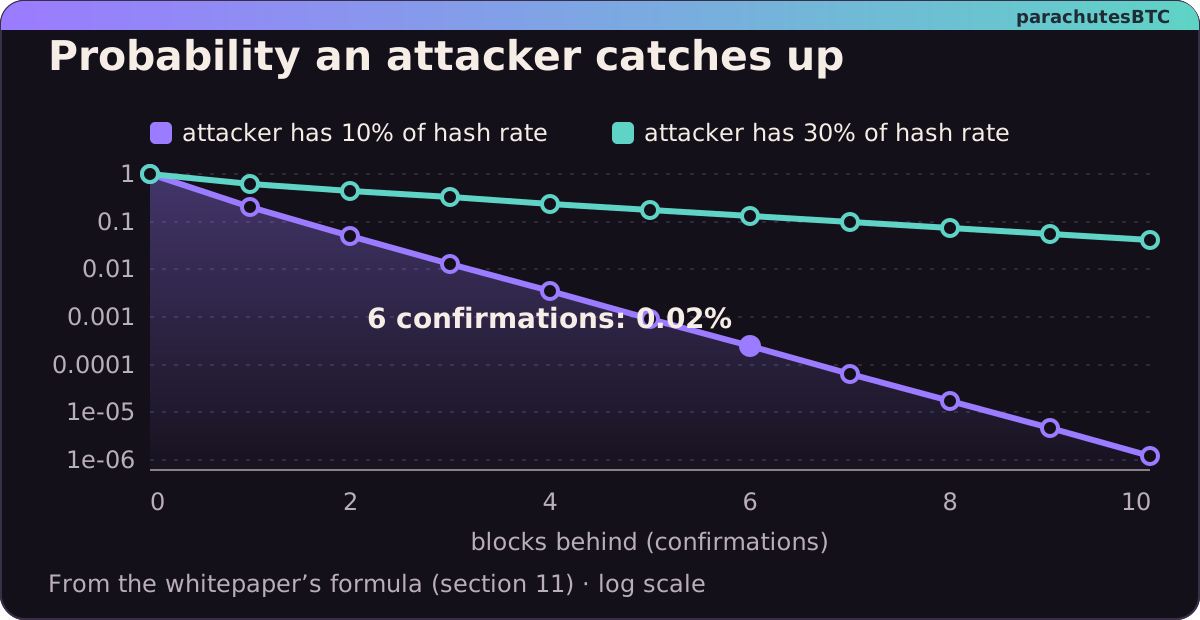
Privacy is by keeping public keys anonymous and not reusing them. Section 11 computes the probability an attacker catches up from z blocks behind: it drops exponentially, which is the math behind "six confirmations". The conclusion: "a system for electronic transactions without relying on trust."
Read it here: bitcoin.org/bitcoin.pdf. Then try the monetary policy course or go deeper with Keys, addresses and Script.
Course checklist: what you can now do
Tick each one you have actually done. The course is finished when they are all ticked, not when the quiz is.
Open the whitepaper and count its pages, excluding references.