
— —
Follow on X
LESSONS

The difficulty adjustment

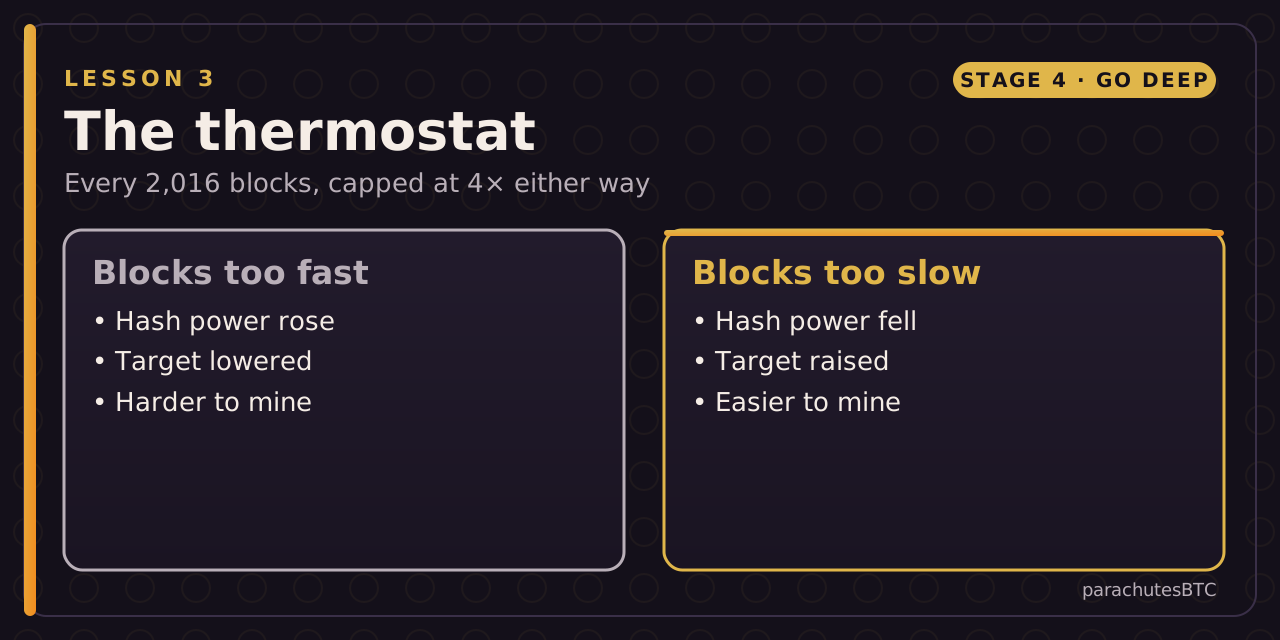
The difficulty adjustment keeps blocks near ten minutes regardless of hash power. It is what makes the supply schedule steady in time, not just in total.

4 MIN READ
The difficulty adjustment raises difficulty when blocks are fast and lowers it when slow.
LEVEL · Intermediate
IN THIS LESSON · 3 OF 6
BY THE END YOU WILL BE ABLE TO ANSWER
  • If hash power doubles, what happens to the number of bitcoin issued per day?
  • What was the largest downward difficulty adjustment?
  • By how much can difficulty change in one adjustment?
  • 2,016 blocks took 12 days instead of 14. By what percentage will difficulty rise at the next adjustment?

Then prove it: a 3-question quiz · a challenge. The lesson marks itself complete at 100%.

After this lesson you can: explain why more miners do not make more bitcoin.

The supply schedule is written in blocks. For it to be steady in time, blocks must arrive at a steady rate however much hardware is mining. That is the difficulty adjustment's job.

The rule

Every 2,016 blocks, nodes compare the actual time taken with the expected 20,160 minutes and scale the target by the ratio, capped at a factor of four per adjustment. Fast blocks mean a lower target (harder); slow blocks mean a higher one (easier).

What it means for monetary policy
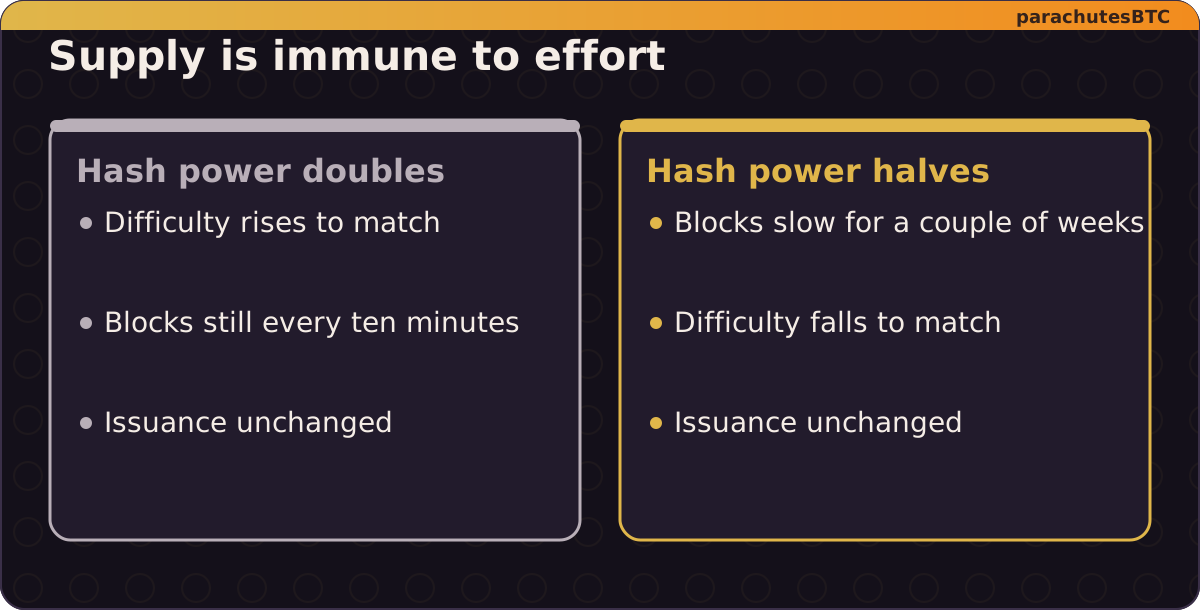
Two columns: hash power rising and hash power falling both leave issuance unchanged.
Effort changes who wins the blocks, never how many coins there are.

  • Adding hash power does not create more bitcoin. It only raises the difficulty for everyone. Supply is immune to effort.
  • Losing hash power does not stop issuance. After China's 2021 mining ban, roughly half the network went offline; blocks slowed for weeks, then difficulty fell about 28% in one adjustment, the largest ever, and the schedule resumed.
  • The cost of producing a bitcoin floats with competition, but the number produced does not.
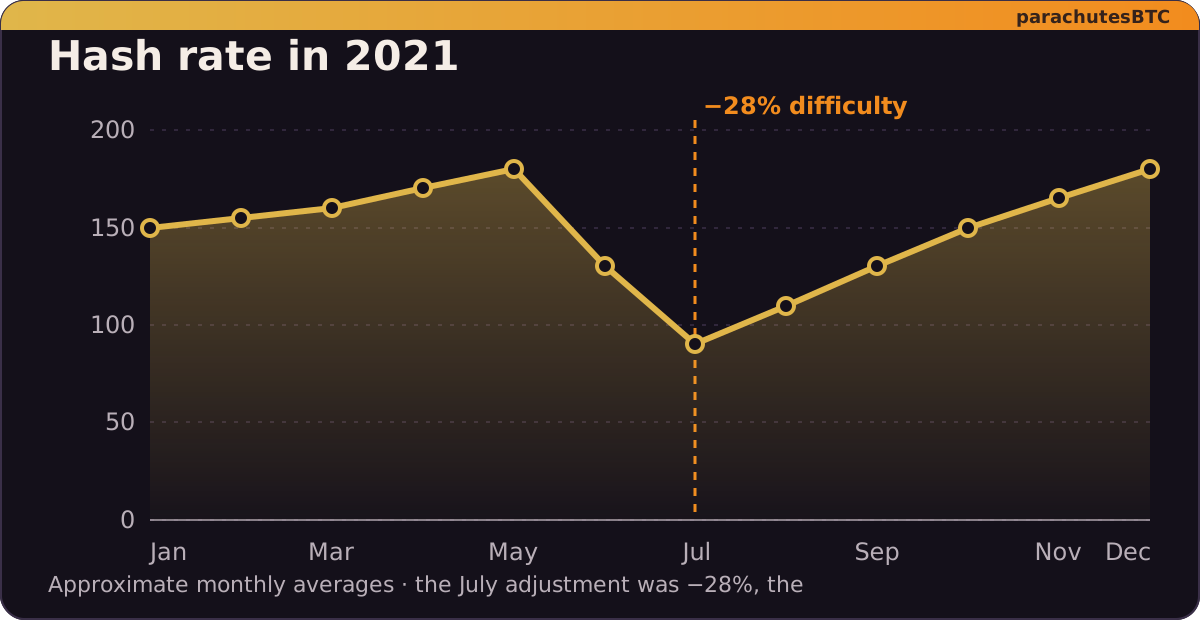
Line chart of network hash rate through 2021: a sharp fall after China’s mining ban and a full recovery by December.
2021: half the network switched off; difficulty fell 28% in one step; the schedule never moved.

What you can watch

Difficulty, hash rate and the estimated next adjustment are on the Bitcoin Charts dashboard under Mining.

MINI CHALLENGERetarget math

2,016 blocks took 12 days instead of 14. By what percentage will difficulty rise at the next adjustment?

percent
CHECK YOURSELF
1/3 If hash power doubles, what happens to the number of bitcoin issued per day?
2/3 What was the largest downward difficulty adjustment?
3/3 By how much can difficulty change in one adjustment?
pick an answer for each question

SOURCES

  1. Difficulty (River Glossary)
Progress is saved in this browser only.