Why did shells, salt, gold and paper all work as money at some point?
Count the things in your wallet or phone that are money only because someone promises to accept them (cards, banknotes, app balances). How many did you count?
Then prove it: a 3-question quiz · a challenge. The lesson marks itself complete at 100%.
After this lesson you can: say in one sentence why anything works as money.
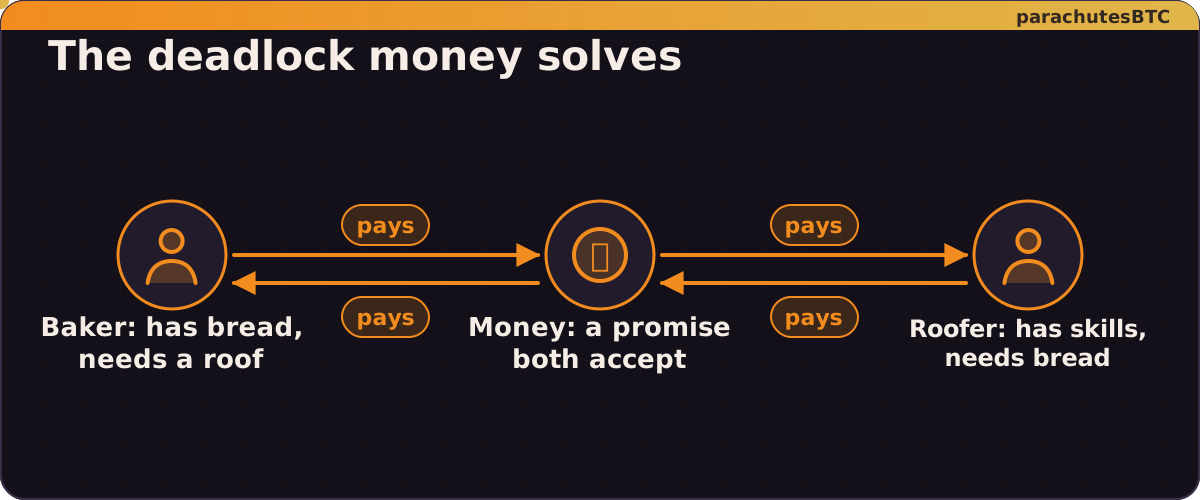
Money solves a simple problem. If you bake bread and I fix roofs, swapping directly only works when each of us wants what the other has. Money breaks that deadlock: you take it for your work, and trust that someone else will take it for theirs.
Without money, the baker and the roofer can only trade when each wants what the other has. Money removes the deadlock.
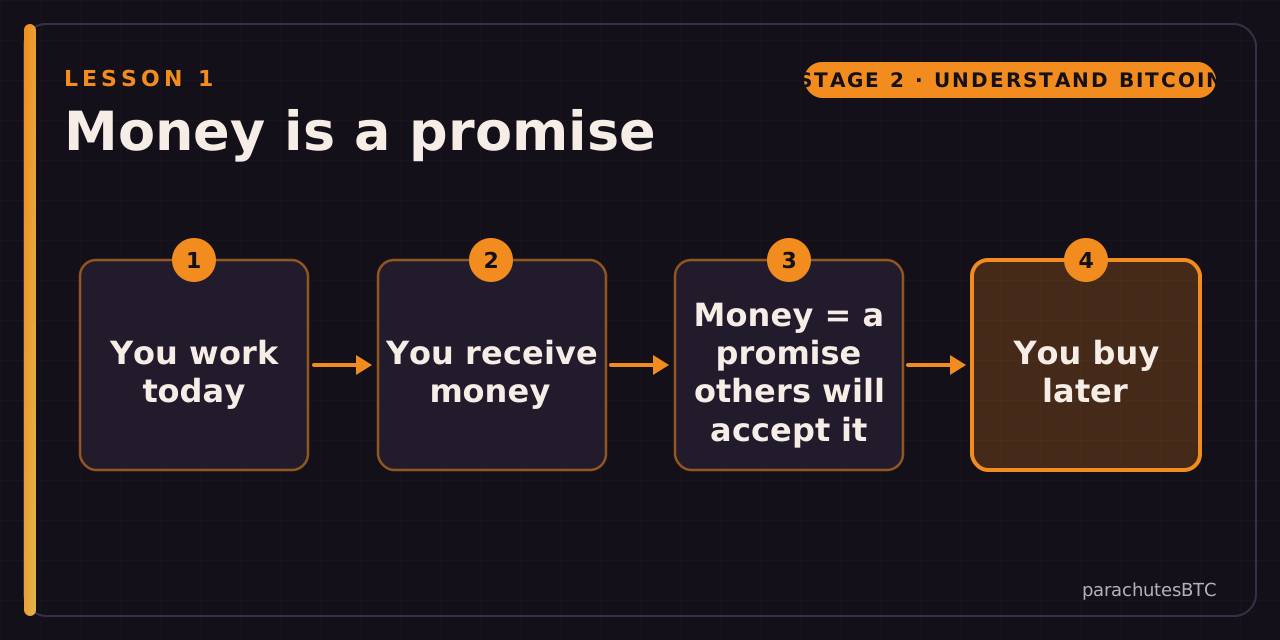
So money is really a promise. It is worth something today because you expect it to be accepted tomorrow.
What makes a promise good
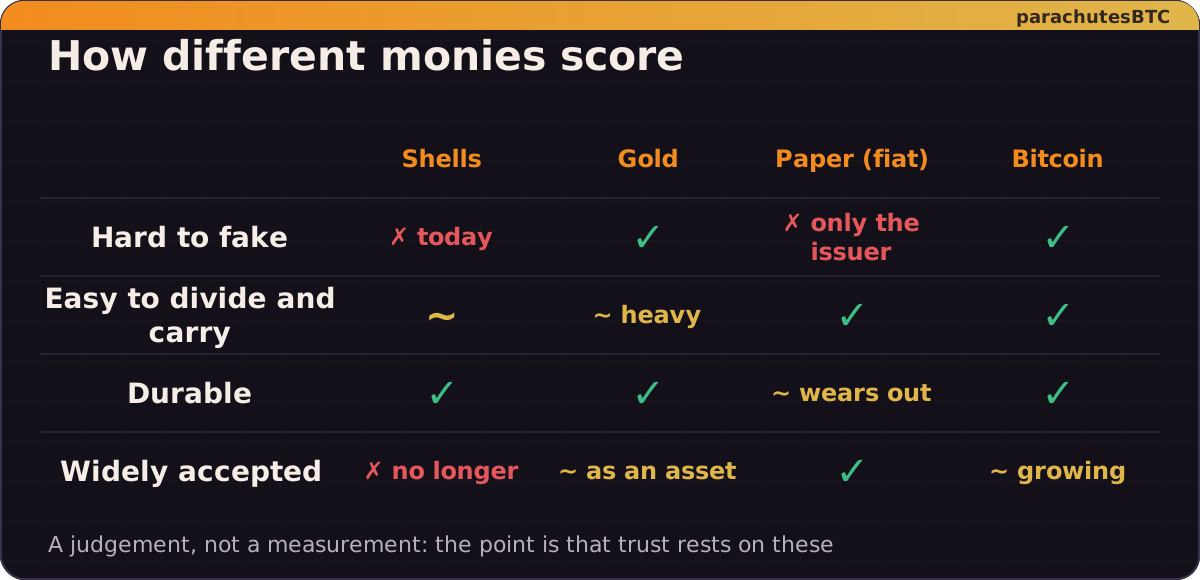
A rough scorecard. No money is perfect; the ones that last score well on most of these.
Over history people have used shells, salt, gold, silver and paper. The ones that lasted tended to share a few traits:
Hard to fake. If anyone can make more, the promise weakens.
Easy to divide and carry. You can pay for something small or large.
Durable. It does not spoil or rust away.
Widely accepted. Others will take it too.
One thing to remember
Money is only as good as the trust behind it. The next lesson looks at what happens when that trust bends.
Money vs Currency · Hidden Secrets of Money, episode 1Watch on YouTube ↗
MINI CHALLENGECount the promises
Count the things in your wallet or phone that are money only because someone promises to accept them (cards, banknotes, app balances). How many did you count?
items
Any count is right; the point is to notice none of them is the thing itself.
Every one of those is a promise. Bitcoin is the first that needs no promiser.
01Shared trust that others will accept it laterMoney is a promise others will honour. The materials changed over history; the trust is the constant.
02It lets people trade without having to find someone who wants exactly what they haveMoney is the thing everyone will accept, so you do not need a direct swap of goods.
03Because enough people trusted that others would accept them laterThe common factor is shared trust in future acceptance, not the material itself.