What is the counter-argument the lesson gives for flexible money?
At 2% inflation a year, roughly what fraction of purchasing power is left after 35 years? Enter a percentage.
Then prove it: a 3-question quiz · a challenge. The lesson marks itself complete at 100%.
After this lesson you can: explain inflation as a broken promise, not a mystery.
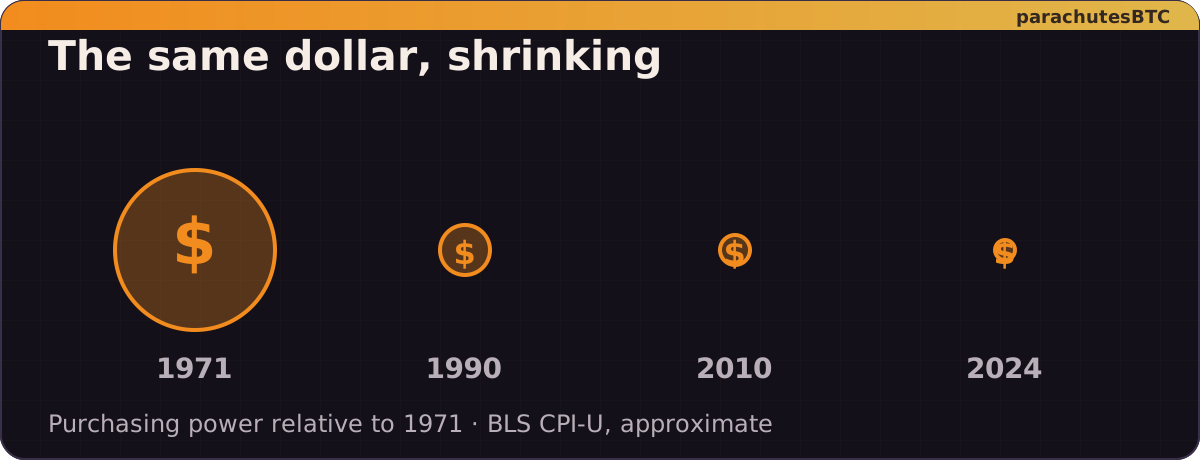
If more money is created, and the amount of goods stays the same, each unit of money tends to buy a little less. That is inflation: a general rise in prices over time.
What a 1971 dollar buys, shrinking over time. Approximate, from US CPI-U.
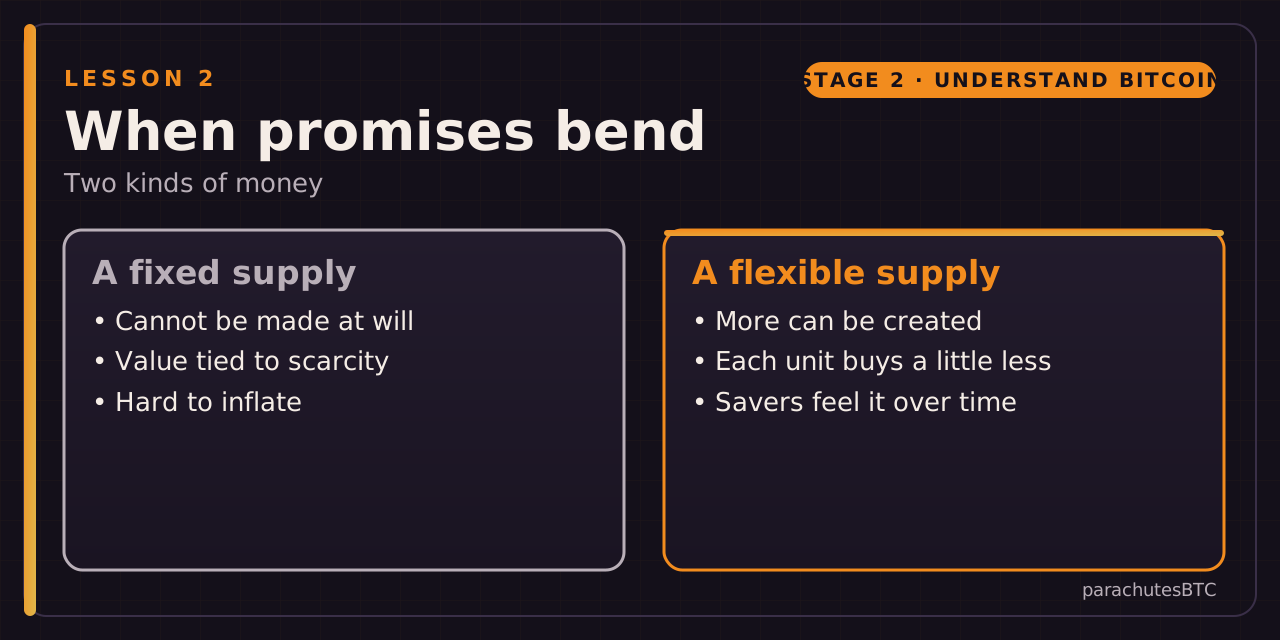
Modern national currencies, often called fiat money, can be created by central banks and by lending. That flexibility lets governments respond to crises. It also means savings held in that currency can lose purchasing power slowly.
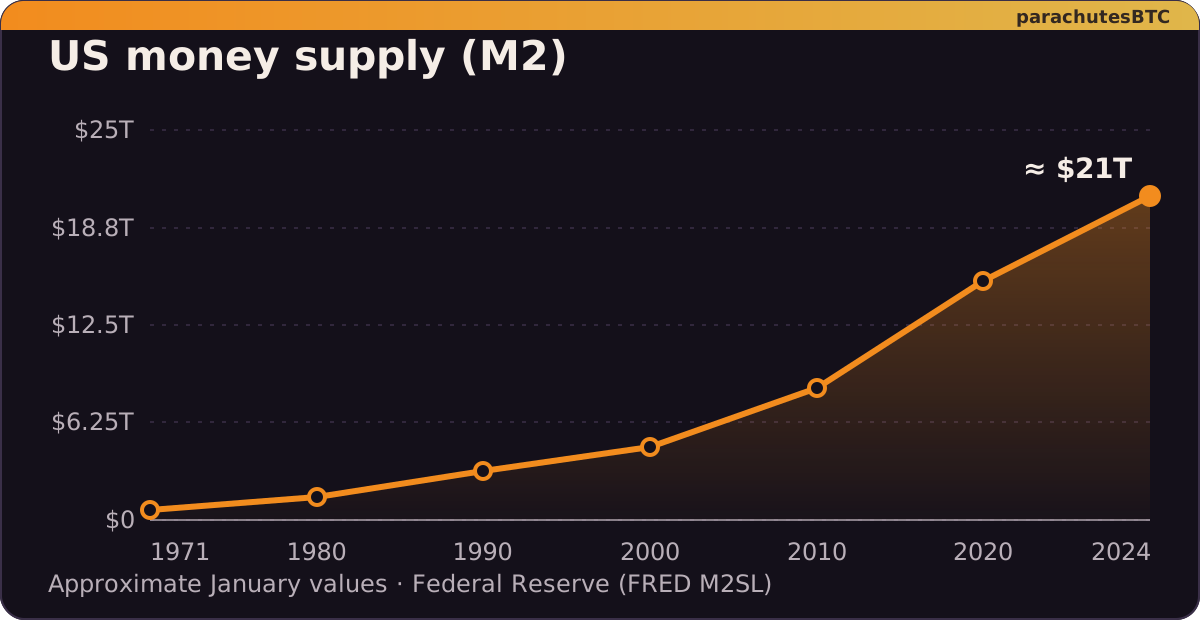
The US money supply (M2), approximate January values. Flexibility means the supply can grow; it has, every decade.
Why this matters for the rest of the course
People who like the idea of Bitcoin often point to this tension. They ask: what if there were a money whose supply was fixed in advance and checkable by anyone?
Others disagree, and point out that flexibility helps economies in emergencies, and that Bitcoin's price is far more volatile than major currencies. Both views are held by thoughtful people.
One thing to remember
Inflation is the slow loss of what a unit of money buys. Bitcoin was designed with a hard supply limit partly as a response. Whether that makes it better money is the question to keep asking as you learn.
01Each unit of money buying less over timeWhen the money supply grows faster than goods, each unit buys less.
02A national currency that can be created by central banks and by lending, with no fixed limitFiat is created by decree and by credit; its supply has no ceiling.
03Flexibility helps economies respond in emergencies, and bitcoin's price is far more volatile than major currenciesThe lesson presents both sides: bitcoiners point to dilution; others value flexibility and note bitcoin's volatility.