Open mempool.space and wait for the next block. How many minutes did you wait?
Then prove it: a 3-question quiz · a challenge. The lesson marks itself complete at 100%.
After this lesson you can: explain what a block is and why miners cannot cheat.
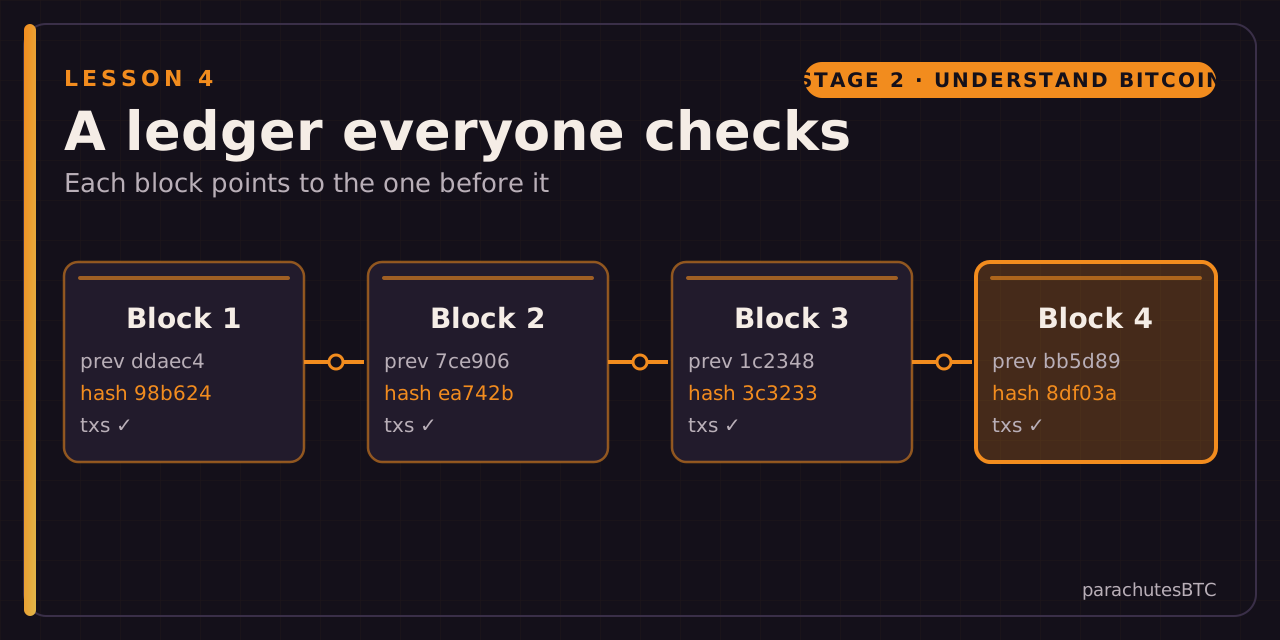
Bitcoin's ledger is a list of transactions grouped into blocks. Each block contains a fingerprint (a hash) of the block before it, so the blocks form a chain. Changing an old block would change its fingerprint and break every block after it.
Each new block carries the fingerprint of the one before it. Change one and every later link breaks.
Who adds the blocks?
Miners compete to add the next block, roughly one every ten minutes. To earn the right they must do a large amount of computing work, called proof of work. The winner is paid newly created bitcoin plus the fees from the transactions in the block.
Who enforces the rules?
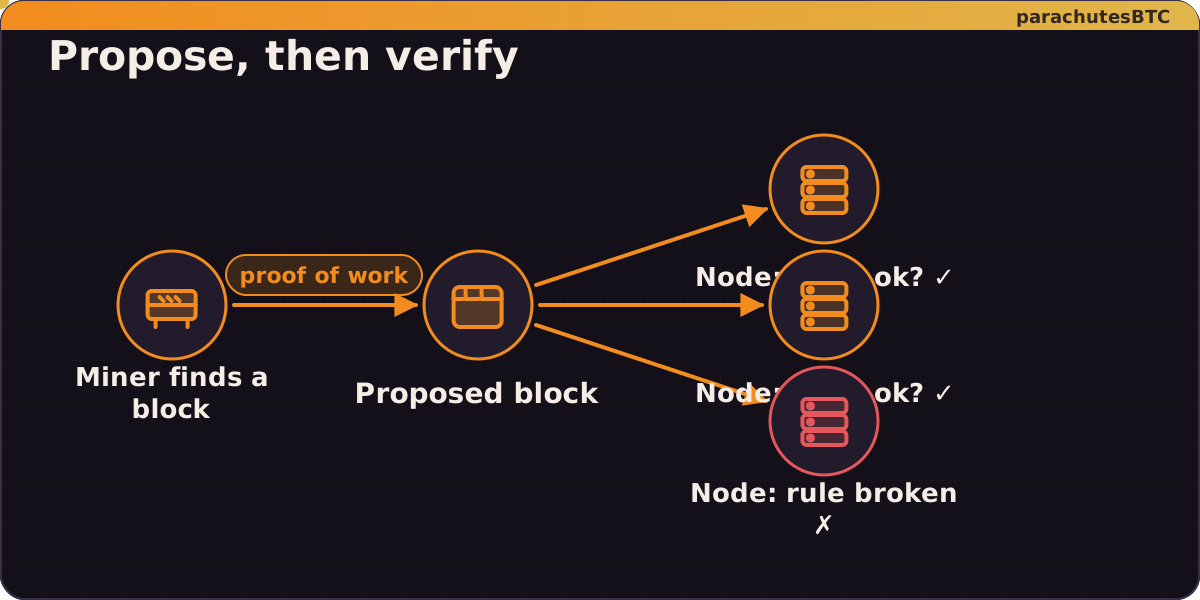
Nodes: computers that keep a full copy of the ledger and check every block against the rules. If a miner breaks a rule, honest nodes reject the block, and the work is wasted.
Why this works
Miners propose, nodes verify. A block that breaks a rule is rejected no matter how much work it carries.
Rewriting history would mean redoing enormous amounts of work faster than everyone else combined. That cost is what makes the record hard to change.
One thing to remember
Miners propose, nodes verify, and cost keeps history in place. See how Bitcoin works for the detail.
01Every node, independentlyMiners propose blocks. Nodes check them and reject any that break the rules, so miners cannot change the rules.
02It would mean redoing the work of every block since, faster than the whole networkEach block builds on the last. Changing one means redoing all that follow.
03A computer that keeps a full copy of the ledger and checks every block against the rulesNodes verify; miners propose. Anyone can run a node and check everything independently.