
After this lesson you can: explain who would have to agree to change 21 million, and why they will not.
The cap is a line of code. Code can be changed. So the real question is: who would have to agree, and would they?
The incentive problem
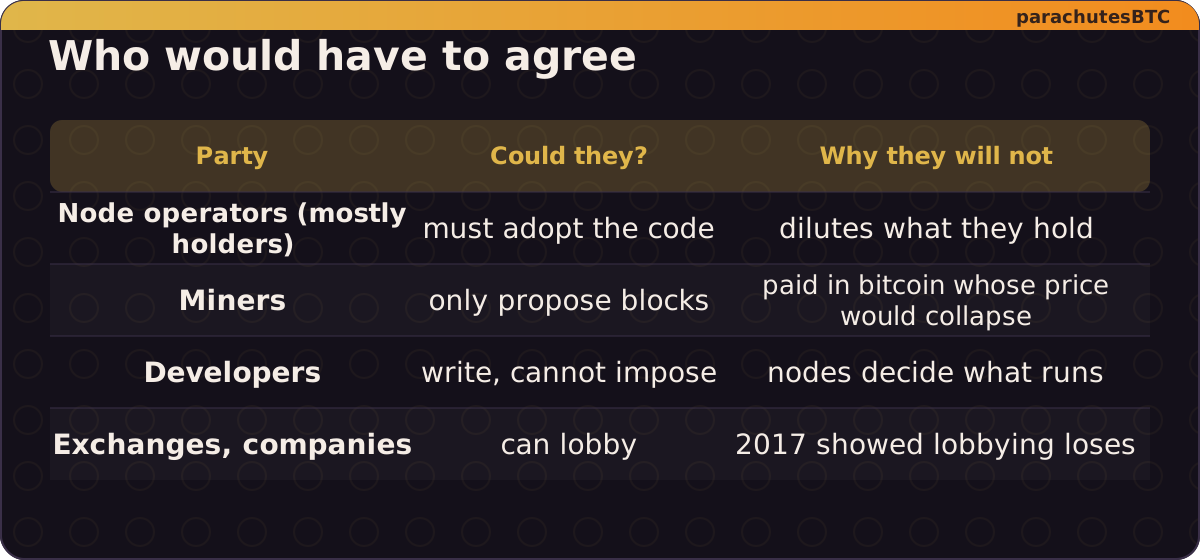
Raising the cap dilutes every existing holder. The people who would have to adopt the change (node operators, who are mostly holders) are the people it would hurt. Miners might briefly gain from a larger subsidy, but their revenue is denominated in bitcoin whose price would collapse if its scarcity were broken. Nobody with skin in the game wants it.
The governance problem
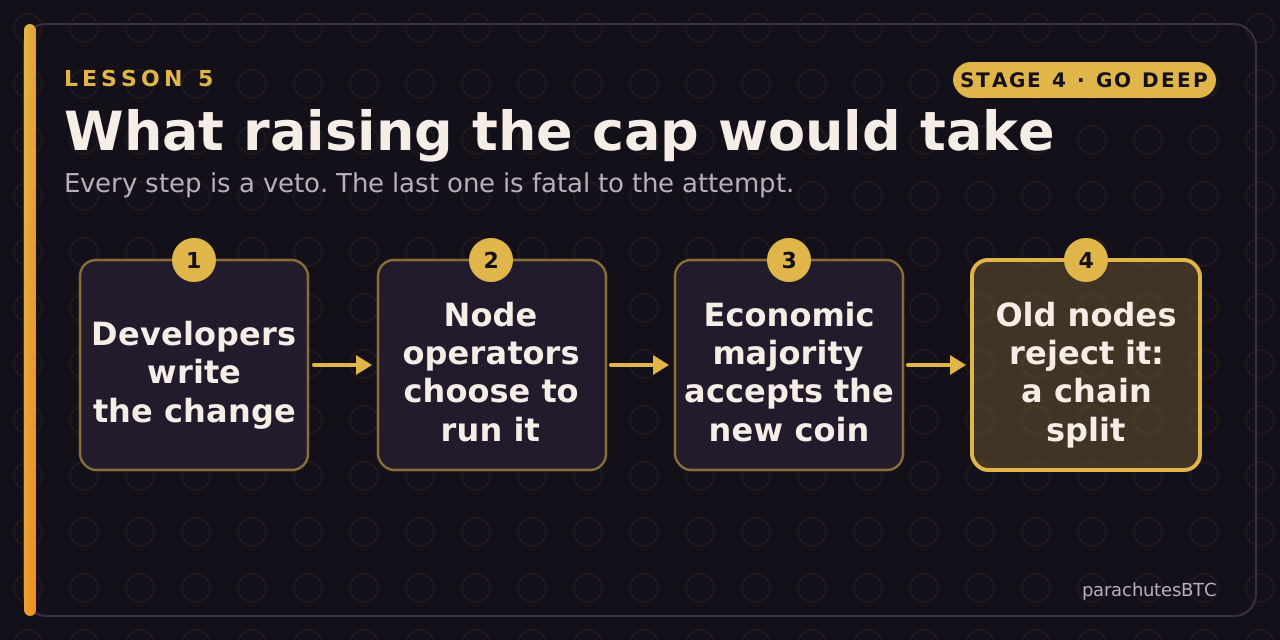
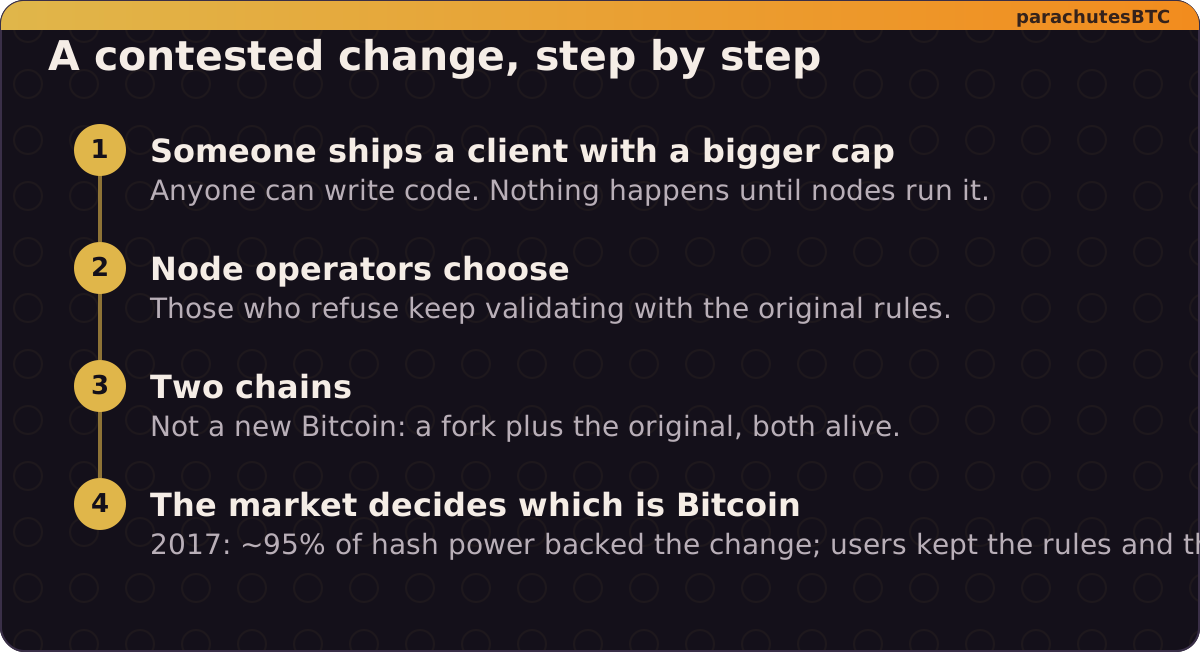
There is no vote. A change becomes the rules only when node operators choose to run it. Those who refuse continue on the original chain with the original cap. The result of a contested change is not a new Bitcoin; it is two chains, and history says the one that kept the rules keeps the name, the value and the users. The 2017 Blocksize War is the proof: about 95% of hash power and most large companies backed bigger blocks, users said no, and Bitcoin Cash exists today as a footnote.
Satoshi's guess
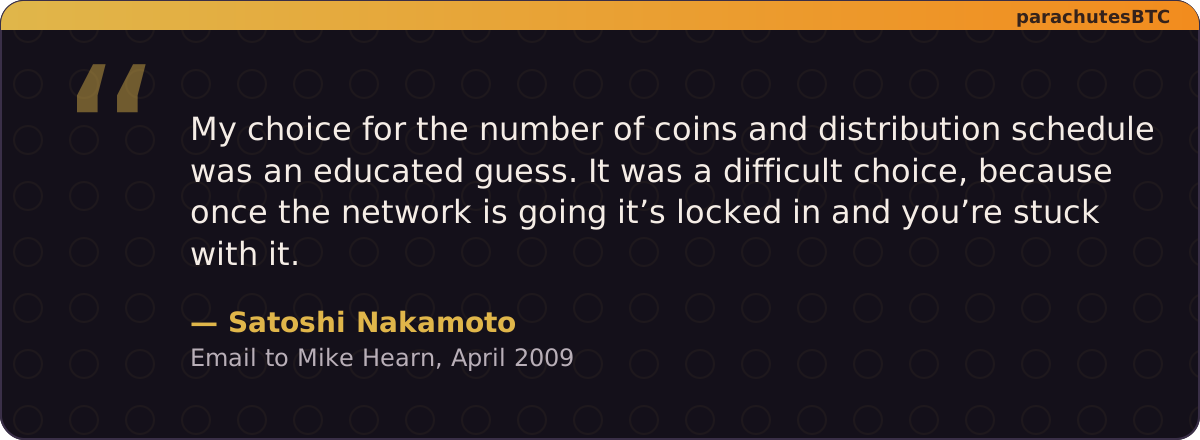
In a 2009 email to Mike Hearn, Satoshi called the number of coins and the schedule an "educated guess" chosen so prices would be in a familiar range if bitcoin succeeded. The specific number is arbitrary. Its fixedness is not: the point was a supply that cannot be revised, and sixteen years of nobody revising it is now part of the asset.
The honest answer
Could a future emergency (say, the security budget question in the next lesson) produce a consensus for tail emission? It is conceivable, and the people proposing it today are few and widely rejected. "Could the cap change" and "will the cap change" are different questions, and the answer to the second is: not without destroying the thing that gives bitcoin its value, which is why the people who could do it will not.
To change the 21 million cap, which group's software must change: (1) miners only, (2) developers only, (3) the economic majority of nodes? Enter the number.