
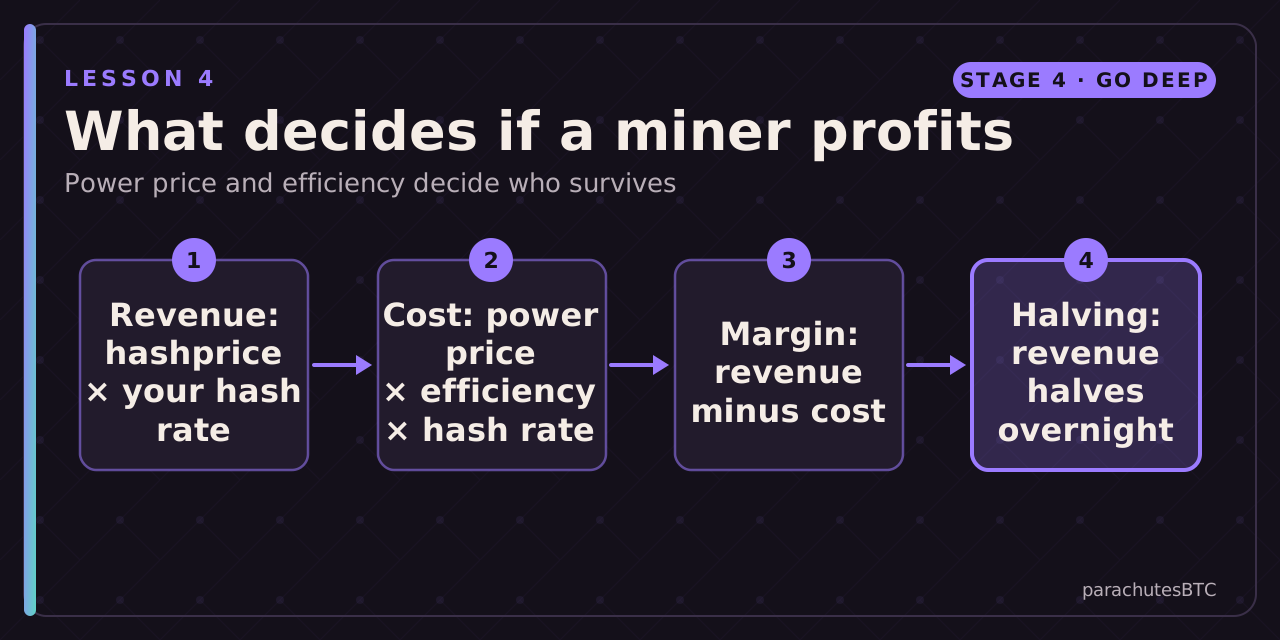
After this lesson you can: compute a miner's margin from hashprice and power price.
Hashprice
The key number in mining is hashprice: how many dollars one terahash per second earns per day. It is (block subsidy + fees) × bitcoin price × blocks per day ÷ network hash rate. It rises with price and fees, falls with difficulty, and halves at each halving. The Bitcoin Charts dashboard tracks it.
A miner's P&L
- Revenue per day = hashprice × machine hash rate.
- Power cost per day = watts ÷ 1000 × 24 × price per kWh.
- Plus hosting, cooling, maintenance, pool fees, and the hardware paid off over its useful life.
Worked example
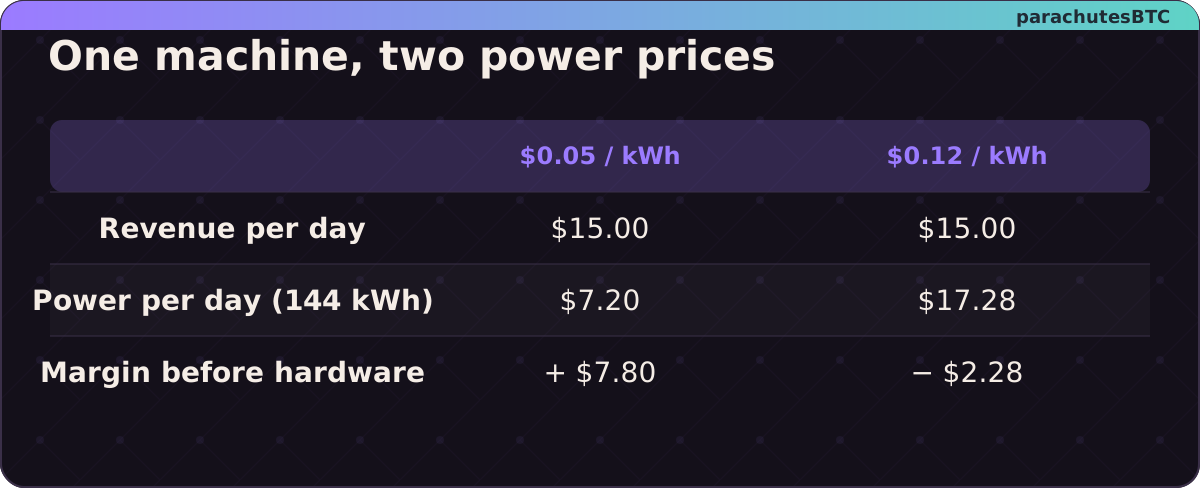
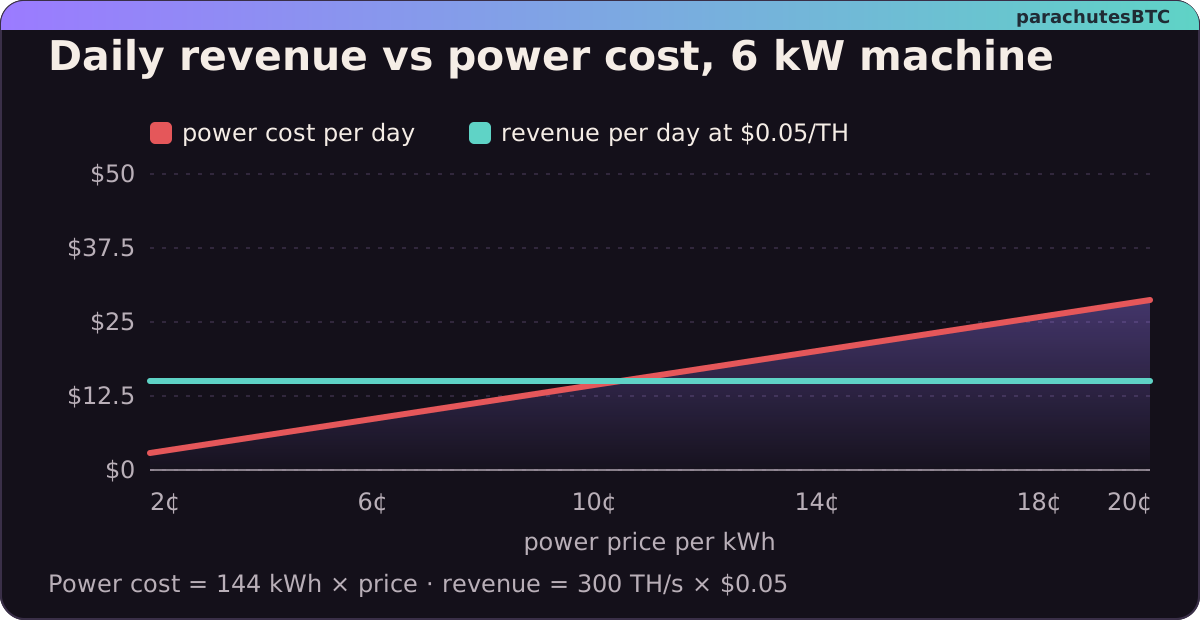
A 300 TH/s machine at 20 J/TH draws 6 kW. At $0.05/kWh that is $7.20 a day in power. If hashprice is $0.05 per TH per day, revenue is $15. Margin: about $7.80 before hardware and hosting. At $0.12/kWh (a typical home rate), power costs $17.28 and the machine loses money every day. This is why mining lives next to cheap power and not in apartments.
Halvings
Overnight, subsidy revenue halves. Miners whose margins were thin shut off, hash rate dips, difficulty falls, and hashprice recovers somewhat for the survivors. Historically, price rises after halvings have more than compensated; nothing guarantees that. Mining is a business of surviving the halving you are in to see the next cycle.
Cycles
Miner revenue tracks price closely. In bull markets, miners expand on borrowed money at peak hardware prices; in bear markets the leveraged ones go bankrupt and sell machines for cents. The industry has consolidated into public companies with access to capital markets, which is itself a centralisation story.
A 6 kW machine earns $15 a day. What is the maximum power price, in cents per kWh, at which it breaks even on power alone? (6 kW × 24 h = 144 kWh per day.)