
— —
Follow on X
LESSONS

"It's too volatile to be money"

Volatility is what adoption from zero looks like when supply cannot respond. It has fallen over time, and it is a feature of the journey, not the destination.

5 MIN READ
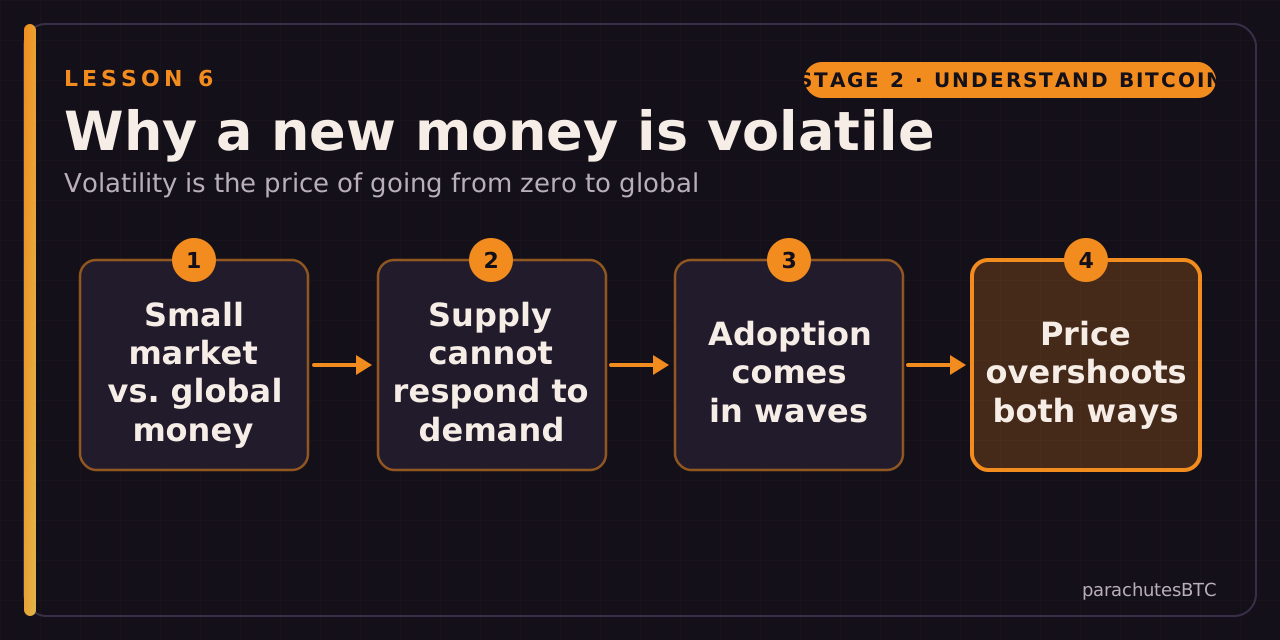
A flow showing why a small, fixed-supply, newly adopted money is volatile.
LEVEL · Beginner
IN THIS LESSON · 6 OF 10
BY THE END YOU WILL BE ABLE TO ANSWER
  • Why can't bitcoin's supply absorb demand shocks?
  • Which is the sound practical conclusion?
  • How has bitcoin's volatility changed over time?
  • Annualised volatility was around 110% in bitcoin's early years and around 50% in recent cycles. By roughly what percentage has it fallen?

Then prove it: a 3-question quiz · a challenge. The lesson marks itself complete at 100%.

After this lesson you can: explain why volatility is expected and what has happened to it.

The strongest version

A money should be stable. Bitcoin moves 5% in a day and 70% in a year. Nobody can price a coffee in it.

Why it is volatile

  • It is small. Against global money and assets worth hundreds of trillions, bitcoin is a rounding error, so modest flows move it.
  • Its supply cannot respond. When demand rises for gold, miners dig more; when it rises for bitcoin, only the price moves.
  • Adoption comes in waves, and markets overshoot in both directions.
  • It has no central bank smoothing it, which is the point.

What the data shows
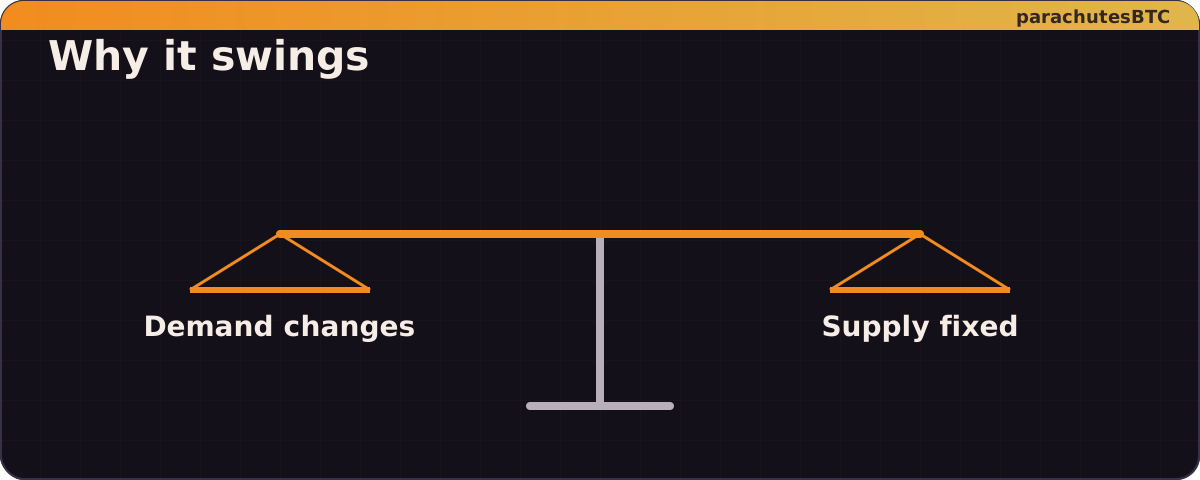
Animated scale: demand rises while supply stays fixed, so only the price can move.
When supply cannot respond, every change in demand lands on the price.

Measured over years, bitcoin's volatility has declined as the market has grown, with each cycle's drawdown shallower than the last so far. Stability is not a property you can design in; it is an outcome of size and maturity.
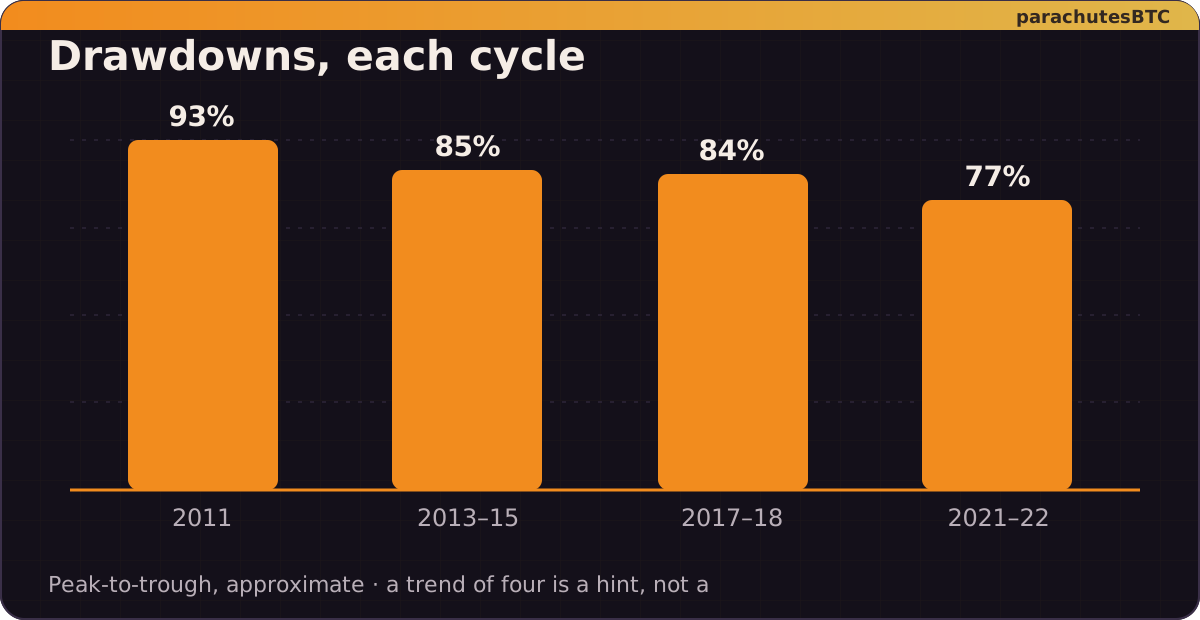
Bar chart of the four major drawdowns, each a little shallower than the last.
Each cycle’s fall has been a little shallower than the last. Four points, not a law.

The honest version

Bitcoin is not yet a stable unit of account, and it may not be for a long time. For now it is a savings technology first and a payment rail second (Lightning handles payments without needing the price to be stable). Anyone who needs their money next month should not hold it in something that can fall by half. That is not an argument against the technology; it is advice about time horizons.

Risk & Volatility are Misunderstood · ExplainerWatch on YouTube ↗
MINI CHALLENGEThen and now

Annualised volatility was around 110% in bitcoin's early years and around 50% in recent cycles. By roughly what percentage has it fallen?

percent
CHECK YOURSELF
1/3 Why can't bitcoin's supply absorb demand shocks?
2/3 Which is the sound practical conclusion?
3/3 How has bitcoin's volatility changed over time?
pick an answer for each question

SOURCES

  1. Parker Lewis, Gradually, Then Suddenly: Bitcoin Is Not Too Volatile (Nakamoto Institute)
  2. Why is bitcoin volatile? (River Learn)
Progress is saved in this browser only.