Open a real proof-of-reserves page, find the assets and the liabilities, compute the ratio, and know the three things a proof of reserves cannot tell you.
Before you start: An account at an exchange or brokerage, or just a browser.
IN THIS LESSON · 4 OF 10
BY THE END YOU WILL BE ABLE TO ANSWER
What are the two halves of a proof of reserves?
Why is a proof of reserves called a snapshot?
What makes the liabilities side of a proof honest?
A published proof shows 12,400 BTC in company-controlled addresses and 12,000 BTC owed to customers. What is the reserve ratio, as a percentage?
Then prove it: a 3-question quiz · a challenge. The lesson marks itself complete at 100%.
After this lesson you can: open an exchange's proof-of-reserves page and say, in one sentence, what it proves and what it does not.
What it is
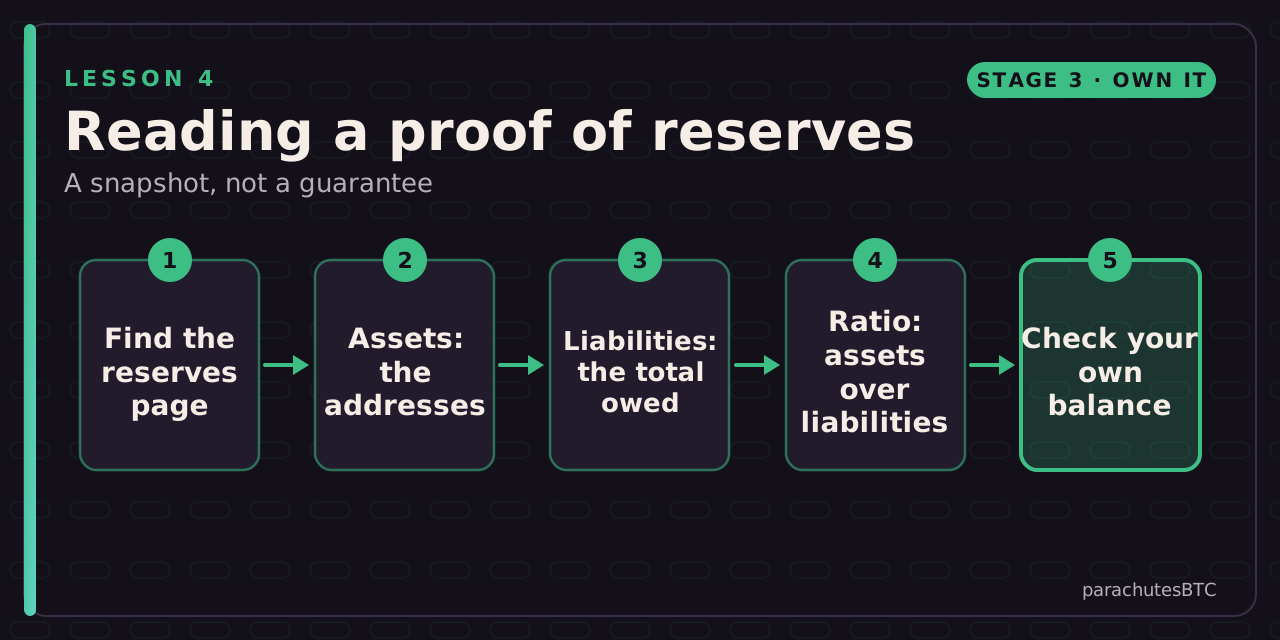
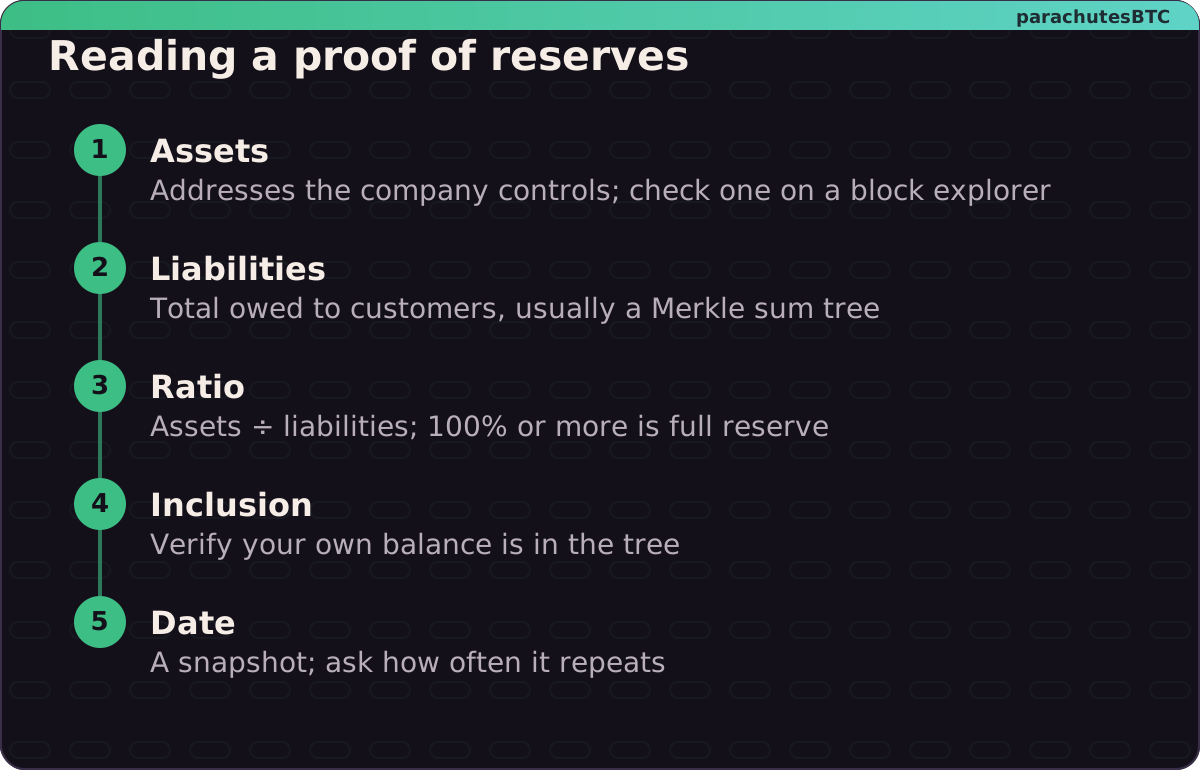
A proof of reserves (PoR) is an exchange showing that it holds the bitcoin it owes its customers. Two halves: proof of assets, a list of the addresses the company controls, which anyone can check on the public ledger; and proof of liabilities, the total owed to customers, usually published as a Merkle sum tree so that each customer can confirm their own balance is included without everyone's balance being public. Assets divided by liabilities is the reserve ratio. At or above 100% the company is full reserve.
Fractional versus full reserve.Image: River Learn, river.com/learn/what-is-proof-of-reserves
Steps
How a proof of reserves fits together.Image: River Learn
What it cannot tell you
The ratio is the headline; the date and your own inclusion are what make it mean something.
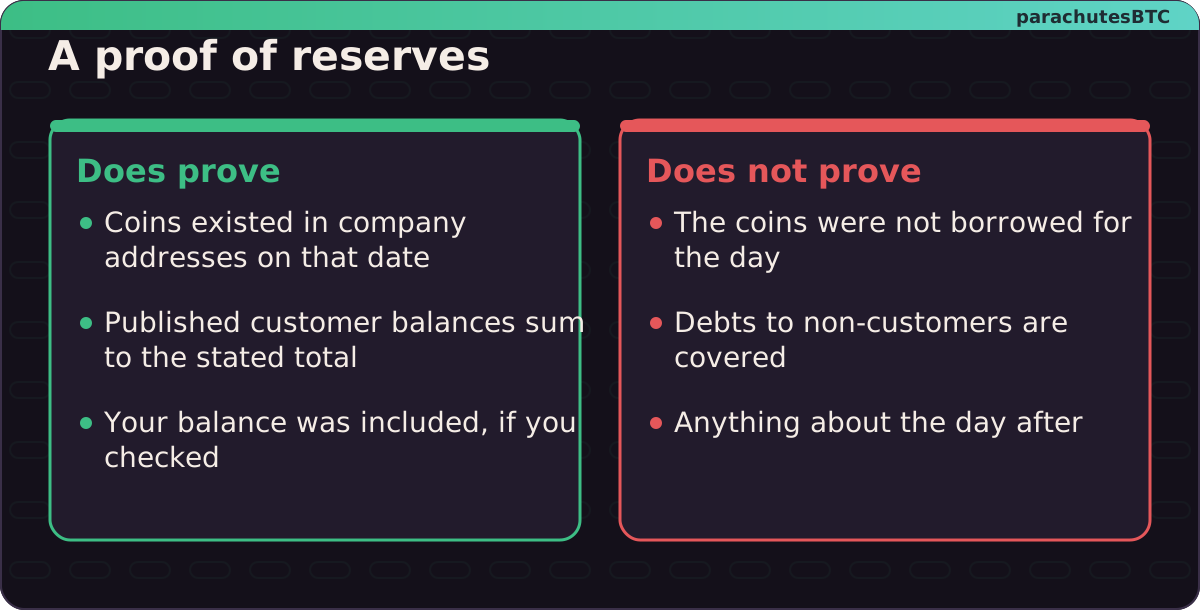
It is a snapshot. Coins can be borrowed for the day of the proof and returned after. Monthly repetition makes that expensive; it does not make it impossible.
Liabilities depend on participation. If customers never check their inclusion, the liabilities side rests on trust.
It only covers customer balances. Debts to other parties are outside it. In bankruptcy, customer claims usually rank ahead, but "usually" is not "always".
A proof of reserves makes a custodian more trustworthy. It does not make a custodian your wallet.
Proves solvency on a date. Does not prove tomorrow, or debts outside customer balances.
MINI CHALLENGEReserve ratio
A published proof shows 12,400 BTC in company-controlled addresses and 12,000 BTC owed to customers. What is the reserve ratio, as a percentage?
percent
Assets divided by liabilities, times 100.
About 103%. Above 100% is full reserve with a margin. Now check the date on the snapshot.
01Proof of assets (addresses the company controls) and proof of liabilities (the total owed to customers)Assets over liabilities gives the reserve ratio.
02Because it shows holdings on one date, and coins could be borrowed for that day and returned afterwardsRepetition, ideally monthly, is what gives a snapshot weight.
03Customers checking that their own balances are included in the published totalA Merkle sum tree lets each customer verify inclusion without exposing everyone's balance.